⚡ Key Facts: Stroke Care in Emergencies
- The Critical Window: Every single minute a stroke goes untreated, the brain loses approximately 1.9 million neurons, making rapid identification paramount (American Heart Association). For the practical checklist side, use the community emergency preparedness guide.
- Prevalence in Crises: According to the Centers for Disease Control and Prevention (CDC), stroke is a leading cause of serious long-term disability, and its incidence can spike during high-stress Survival Scenarioss.
- Ischemic vs. Hemorrhagic: Approximately 87% of all strokes are ischemic (caused by a blockage), while the remainder are hemorrhagic (caused by a ruptured blood vessel). For the practical checklist side, use the family emergency planning guide.
- Delayed EMS Reality: During large-scale disasters, Federal Emergency Management Agency (FEMA) records show that emergency medical services response times can extend from minutes to days, shifting the burden of acute care onto bystanders.
- The Power of BE-FAST: Utilizing the expanded BE-FAST protocol identifies up to 95% of acute strokes, compared to only 85% identified using older, less comprehensive diagnostic models.
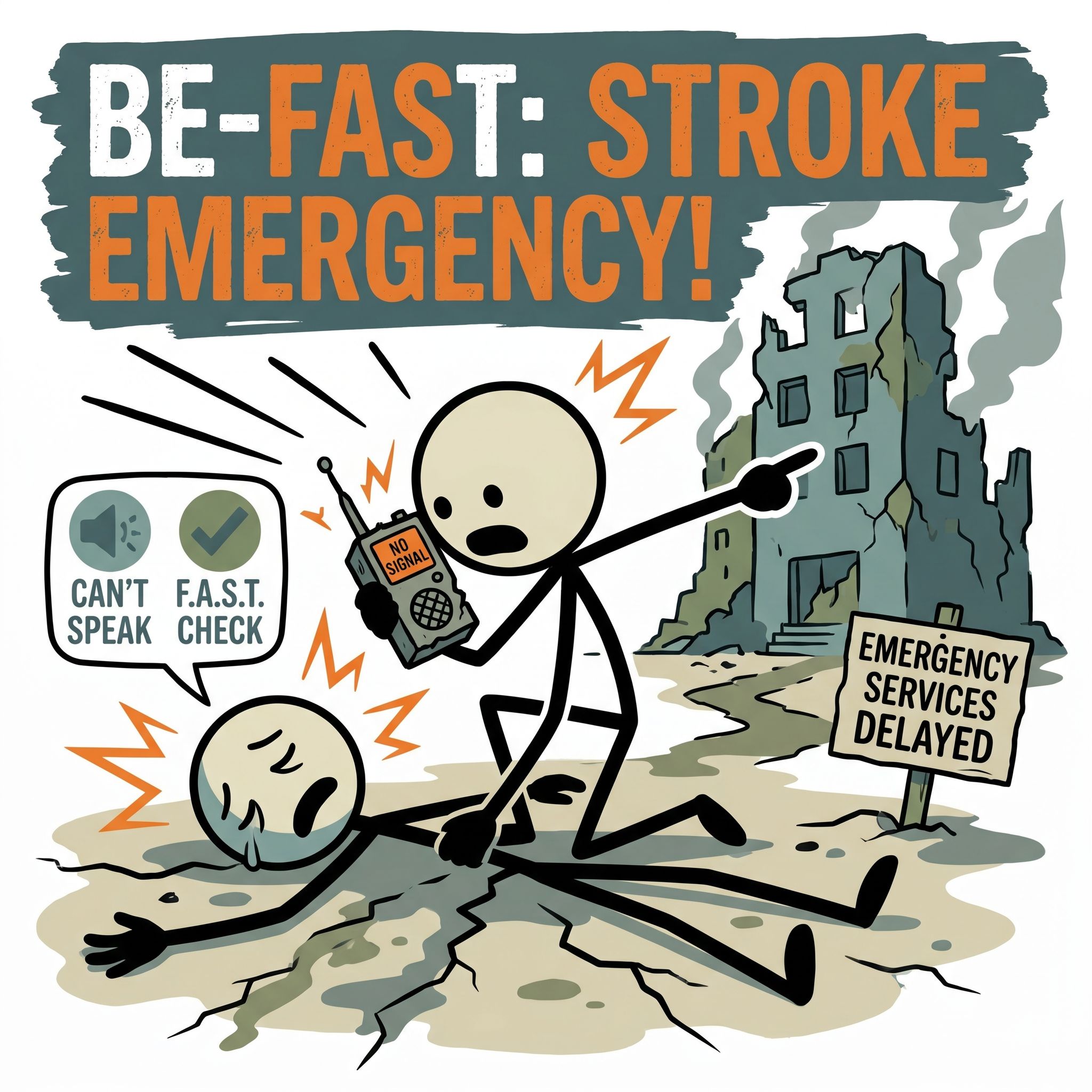
Imagine a severe winter storm has collapsed the local power grid, or a category-four hurricane has left your neighborhood preparedness network completely isolated by floodwaters. Phone lines are dead, roads are impassable, and emergency medical services (EMS) are facing a backlog of life-threatening calls that stretches into days. In the middle of this crisis, a family member suddenly stumbles, drops their coffee mug, and struggles to speak. You are instantly thrust into the role of a first responder. When professional medical care is unavailable, your understanding of disaster medical preparedness transitions from a theoretical interest to an absolute lifeline. Knowing how to identify stroke symptoms and manage patient care in a grid-down environment is one of the most vital medical skills you can possess.
Understanding Stroke Pathophysiology: Why Time is Brain
To effectively manage a stroke when emergency services are delayed, you must first understand what is happening inside the human body. A stroke, or cerebrovascular accident (CVA), is a medical emergency characterized by the sudden disruption of blood flow to a portion of the brain. Without oxygen and essential nutrients carried by the blood, brain cells begin to die within minutes. This rapid cellular death is why neurologists constantly repeat the maxim: "time is brain." Your primary goal in emergency stroke treatment is to preserve as much brain tissue as possible by maintaining physiological stability until professional medical intervention can be reached.
There are two primary classifications of stroke, and understanding the difference—and the limitations of diagnosing them without advanced imaging—is critical for safe first-aid management:
Ischemic Stroke
Accounting for the vast majority of cases, an ischemic stroke occurs when a thrombus (blood clot) or atheromatous plaque occludes an artery supplying blood to the brain. This blockage starves downstream brain tissue of oxygen. Within the affected area, there is a core of dead tissue surrounded by a zone of severely compromised but still salvageable tissue known as the ischemic penumbra. In a disaster scenario, your primary physiological objective is to keep this penumbra alive by maintaining adequate blood pressure and oxygenation.
Hemorrhagic Stroke
A hemorrhagic stroke occurs when a weakened blood vessel ruptures, bleeding directly into the brain parenchyma or the surrounding subarachnoid space. This not only deprives downstream tissue of blood but also creates localized pressure, swelling, and chemical irritation that damages surrounding brain structures. Hemorrhagic strokes are highly lethal and are often characterized by a sudden, excruciating headache (commonly described as the "thunderclap" headache) accompanied by rapid neurological decline.
In a hospital setting, doctors utilize a non-contrast computed tomography (CT) scan to instantly differentiate between these two types of stroke. In a disaster medical preparedness scenario, you will not have access to a CT scanner. Because you cannot definitively distinguish between an ischemic and a hemorrhagic stroke at home, you must treat the patient with extreme care, avoiding any interventions—such as administering aspirin—that could prove fatal if the stroke is hemorrhagic.
The BE-FAST Protocol: Identifying Stroke Symptoms FAST
When professional help is delayed, rapid and accurate identification is your first line of defense. The medical community has long relied on the "FAST" acronym, but modern clinical standards have expanded this to "BE-FAST" to capture strokes that occur in the posterior circulation of the brain (which controls balance and vision). Memorizing and applying these stroke symptoms FAST can save a life and drastically reduce long-term disability.
When assessing someone you suspect is suffering from a stroke, systematically run through the BE-FAST protocol:
B - Balance (Ataxia and Equilibrium)
Observe the individual's gait and coordination. Is there a sudden loss of balance? Are they leaning heavily to one side, stumbling, or unable to stand upright without assistance? A sudden onset of dizziness, vertigo, or a feeling of spinning can indicate a stroke affecting the cerebellum, which coordinates voluntary movements and balance.
E - Eyes (Visual Disturbances)
Ask the patient if they are experiencing sudden vision changes. This includes double vision (diplopia), blurred vision, or a complete loss of sight in one or both eyes. You can perform a quick visual field test by asking them to look directly at your nose while you wiggle your fingers in their peripheral vision. Ask them to point to which hand is moving. A stroke can cause hemianopia, where the patient loses half of their field of vision in each eye.
F - Face (Facial Drooping and Symmetry)
Instruct the individual to smile or show their teeth. Look closely at their face. Is the smile symmetrical, or does one side of the mouth droop or remain flat? If you suspect subtle drooping, ask them to close their eyes tightly. In a stroke, the muscles on one side of the lower face are often paralyzed, while the forehead may still wrinkle normally (a key differentiator from Bell's Palsy, though in an emergency, any sudden facial weakness must be treated as a stroke).
A - Arms (Motor Weakness and Pronator Drift)
Have the patient extend both arms straight out in front of them at shoulder level, with their palms facing upward, and close their eyes for ten seconds. Watch for "pronator drift." If one arm begins to drift downward, rotate inward (pronate), or if they are completely unable to lift one arm, this indicates unilateral motor weakness, a classic sign of a contralateral brain lesion.
S - Speech (Aphasia and Dysarthria)
Engage the patient in conversation and ask them to repeat a simple, familiar phrase, such as "The sky is blue." Listen closely to their delivery. Is their speech slurred, thick, or garbled (dysarthria)? Are they using the wrong words, struggling to find words, or completely unable to speak or understand you (aphasia)? Aphasia indicates that the stroke is affecting the dominant hemisphere of the brain (usually the left hemisphere), which houses the language centers.
T - Time (Onset Documentation)
In a standard municipal environment, "Time" means calling 911 immediately. In a disaster scenario where EMS is delayed or unavailable, "Time" means establishing and documenting the exact "Last Known Well" (LKW) time. Write this down on a piece of paper, on the patient's arm with a marker, or in your medical logbook. Knowing the precise onset time is critical because medical interventions like thrombolytic therapy (tPA) or mechanical thrombectomy have strict, time-delimited eligibility windows (typically 3 to 4.5 hours for tPA) if transport eventually becomes available.
Step-by-Step Stroke First Aid When EMS is Unavailable
If your BE-FAST assessment indicates a stroke and you have confirmed that emergency transport is delayed or impossible, you must immediately transition to supportive care. While you cannot perform advanced medical procedures like clot-busting or surgical decompression at home, your immediate actions can prevent secondary brain injury, protect the airway, and stabilize the patient. Here is the definitive protocol for stroke first aid in a crisis scenario:
1. Secure the Airway, Breathing, and Circulation (ABCs)
Your absolute priority is to ensure the patient's airway remains open and clear. A stroke can impair the muscles of the throat, tongue, and esophagus, leading to a high risk of airway obstruction or aspiration of saliva and vomit.
- Assess Breathing: Observe the rise and fall of the chest. Ensure breathing is regular and deep.
- Clear Obstructions: If the patient is unconscious or has a decreased level of consciousness, do not leave them flat on their back. If they begin to vomit or accumulate secretions, roll them immediately onto their side into the recovery position to allow gravity to drain fluids from the mouth.
2. Optimize Patient Positioning
How you position the patient can directly impact intracranial pressure (ICP) and cerebral perfusion pressure (CPP).
- If the Patient is Conscious and Alert: Keep them resting comfortably with their head and upper body elevated at approximately a 30-degree angle. This elevation helps facilitate venous drainage from the brain, which can decrease intracranial pressure and reduce brain swelling. Avoid bending their neck, as this can compress the jugular veins and restrict blood flow out of the cranium.
- If the Patient is Unconscious or Semiconscious: Place them in the recovery position (lateral recumbent position) on their non-affected side if possible. This keeps the tongue from falling backward into the throat and prevents aspiration of fluids. Keep their head aligned with their spine.
3. Enforce a Strict NPO (Nothing by Mouth) Status
This is one of the most critical rules of how to treat a stroke at home. Do not give the patient anything to eat or drink. A stroke frequently causes dysphagia (difficulty swallowing), which may not be immediately obvious. If you attempt to give them water, food, or oral medications, they are highly likely to aspirate these substances into their lungs. This can cause immediate choking, airway blockage, or a severe, life-threatening condition known as aspiration pneumonia, which carries an incredibly high mortality rate in disaster settings.
4. Do NOT Administer Aspirin or Blood Thinners
A common and dangerous mistake in first aid is administering aspirin to anyone suspected of having a cardiovascular event. While aspirin is highly beneficial during a myocardial infarction (heart attack) and can be helpful in an ischemic stroke, it is actively lethal in a hemorrhagic stroke. Because you cannot diagnose the type of stroke without a CT scan, giving aspirin, ibuprofen, warfain, or any other blood thinners is strictly contraindicated. If the patient is suffering from a hemorrhagic stroke, thinning their blood will accelerate intracranial bleeding, increase pressure on the brainstem, and likely result in rapid death.
5. Prevent Hyperthermia (Fever)
An elevated body temperature significantly accelerates brain damage during an ischemic event. A fever increases the metabolic demands of the brain tissue, causing the salvageable penumbra cells to die much faster. Monitor the patient’s temperature closely. If their temperature begins to rise, use passive cooling techniques: remove excess clothing, apply cool, damp cloths to their forehead, armpits, and groin, and ensure the room is well-ventilated. Do not plunge them into ice water or cause shivering, as shivering increases metabolic demand and body temperature.
Advanced Monitoring and Care in Grid-Down Environments
When emergency stroke treatment must be sustained over hours or days due to a major disaster, you must transition from immediate first aid to long-term patient monitoring. This requires a structured approach to tracking vital signs, managing physiological fluctuations, and preventing secondary complications.
Managing Blood Pressure: The Danger of Overtreatment
In an acute ischemic stroke, the body’s natural response is to raise blood pressure significantly. This is a protective, compensatory mechanism known as "permissive hypertension." The elevated blood pressure is the body’s desperate attempt to force blood through the blocked artery and keep the surrounding penumbra perfused.
One of the greatest dangers in disaster medical preparedness is attempting to aggressively lower a stroke patient's blood pressure at home using their personal medications (such as beta-blockers or ACE inhibitors). If you artificially lower their blood pressure, you will reduce perfusion to the brain, starv the penumbra of oxygen, and permanently expand the stroke's damage.
- The Golden Rule: Do not attempt to lower the patient’s blood pressure unless you are a trained medical professional with specific instructions, or unless the systolic pressure exceeds an extremely dangerous threshold (typically 220 mmHg systolic or 120 mmHg diastolic).
- How to Help: Keep the patient in a calm, quiet, dark environment. Stress, pain, and anxiety will naturally elevate blood pressure to dangerous levels. Minimizing external stimuli is the safest way to manage blood pressure fluctuations without medication.
Tracking Vital Signs and Neurological Status
In an extended care scenario, you must maintain a detailed medical log. Check and record the following vitals every 15 to 30 minutes initially, then every hour once the patient stabilizes:
| Vital Sign | Normal Range | Stroke Considerations in Disasters |
|---|---|---|
| Blood Pressure (BP) | 120/80 mmHg | Expect elevated levels. Do not treat unless >220/120 mmHg. Avoid sudden drops. |
| Heart Rate (HR) | 60–100 bpm | Watch for irregular rhythms (like Atrial Fibrillation, a major cause of ischemic strokes). |
| Respiration Rate | 12–20 breaths/min | Monitor for Cheyne-Stokes breathing (shallow/deep cycles), which indicates brainstem pressure. |
| Oxygen Saturation (SpO2) | 95%–100% | Maintain above 94%. Administer supplemental oxygen only if it drops below this threshold. |
| Pupil Reactivity | Equal, Round, Reactive | Unequal pupils or a sluggish response on one side indicates severe intracranial pressure. |
Managing Hydration and Nutrition Safely
If the disaster persists for more than 24 hours, hydration becomes a major concern. Because the patient cannot swallow safely, you must never give them fluids orally. If you have advanced medical training and access to IV fluids (such as Normal Saline), establishing an IV line to administer maintenance fluids at a slow, controlled rate can prevent dehydration. Avoid fluids containing dextrose (glucose) unless the patient is documented as hypoglycemic, as high blood sugar levels can worsen brain damage during an ischemic event. If you are not trained in IV administration, do not attempt it; instead, focus on keeping the patient cool, dry, and comfortable to minimize fluid loss through sweat.
Psychological Support and Patient Communication
A stroke is an incredibly terrifying experience. Patients are often fully aware of what is happening around them but are completely locked inside their bodies, unable to speak, move, or express their fear. The sudden loss of bodily control, coupled with the chaos of a disaster scenario, can cause extreme panic, which in turn spikes blood pressure and heart rate, worsening their physiological state.
Your role as a caregiver includes providing intensive psychological first aid:
- Speak Calmly and Directly: Walk up to the patient, look them in the eyes, and speak in a calm, reassurring, and slow voice. Even if they cannot respond, assume they can hear and understand everything you say.
- Explain Everything: Tell them exactly what is happening. Use reassuring phrases: "You are safe. I am here with you. We are experiencing a storm, but I know what to do, and I am monitoring you closely."
- Simplify emergency communication plan: Do not ask open-ended questions that require complex answers. Instead, ask simple "Yes" or "No" questions. Instruct them to squeeze your hand once for "Yes" and twice for "No," or to blink their eyes to communicate.
- Control the Environment: Keep bystanders away. Minimize loud noises, bright lights, and frantic conversations near the patient. A quiet, dark, peaceful room is a therapeutic environment for an injured brain.
Building Your Disaster Medical Kit for Neurological Emergencies
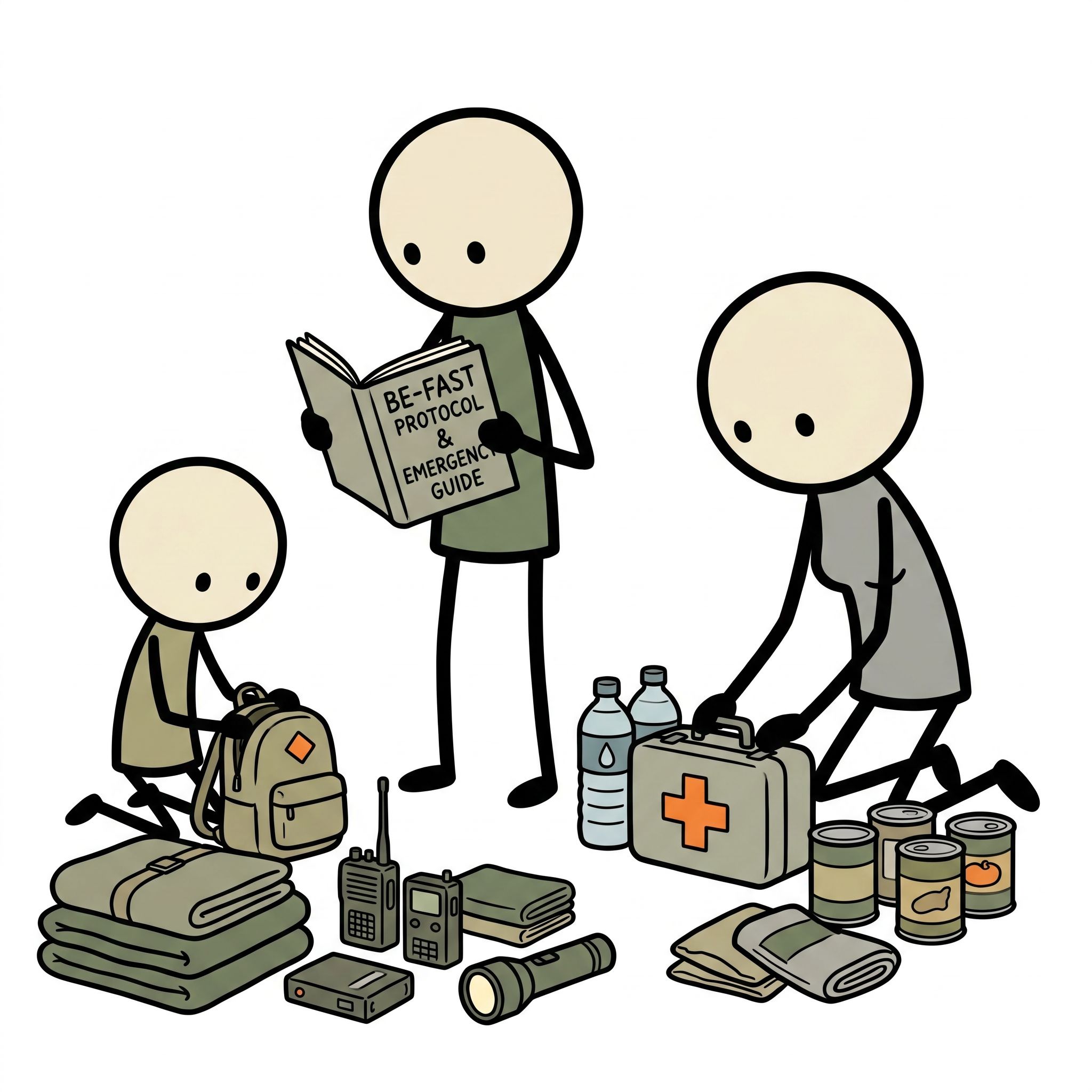
True disaster medical preparedness means having the tools necessary to assess and monitor a patient when professional clinics are offline. While a standard first aid kit contains bandages and antiseptics, a robust emergency kit should include diagnostic tools capable of identifying and tracking neurological events.
Ensure your emergency medical kit contains the following items:
- Manual Sphygmomanometer (Blood Pressure Cuff) & Stethoscope: Automatic blood pressure cuffs can fail if batteries die or if the patient is shivering. A manual cuff is highly reliable and essential for tracking blood pressure trends.
- Pulse Oximeter: To monitor blood oxygen levels (SpO2) and heart rate. This helps you determine if supplemental oxygen is necessary.
- Tactical Penlight: Essential for checking pupillary light reflexes. Shining a light into the eyes helps you assess if the pupils are equal, round, and reactive, which gives clues about brainstem function and intracranial pressure.
- Non-Contact Infrared Thermometer: Allows you to monitor core body temperature without disturbing the patient or risking aspiration with oral thermometers.
- Medical Logbook and Waterproof Pen: To record vitals, symptoms, and the "Last Known Well" timeline. This logbook will be invaluable to paramedics or doctors if the patient is eventually evacuated.
- Emergency Blankets and Cold Packs: To manage body temperature and prevent hyperthermia or hypothermia.
Empowerment Through Preparedness
Facing a medical emergency like a stroke during a disaster is a sobering prospect, but fear is a product of helplessness. By mastering the BE-FAST protocol and understanding the physiological nuances of stroke first aid, you transform yourself from a helpless bystander into an active, capable guardian of your family's health. In a grid-down scenario, you cannot replace a hospital, but your calm, methodical, and informed actions can preserve critical brain function, prevent fatal complications, and buy the precious time needed for professional help to arrive. Keep your medical kits stocked, review these protocols regularly, and remember that when crisis strikes, your preparation is their survival.
Frequently Asked Questions
What is the fastest way to recognize a stroke in an emergency?
Use the B.E. F.A.S.T. acronym: Balance loss, Eyesight changes, Facial drooping, Arm weakness, Speech difficulty, and Time to call emergency services immediately.
What should I do if emergency services are delayed or unavailable?
Note the exact time symptoms started, keep the patient calm and resting with their head slightly elevated, monitor their airway, and prepare safe, immediate private transport to the nearest open emergency medical facility if possible.
Should I give aspirin to someone suspected of having a stroke?
No. Never give aspirin, food, or drink to a suspected stroke victim. If the stroke is hemorrhagic (caused by a ruptured blood vessel), aspirin will worsen the bleeding and can be fatal.
How should I position a stroke victim while waiting for medical help?
If the person is conscious, have them lie down with their head and shoulders slightly elevated. If they are unconscious or vomiting, place them on their side in the recovery position to keep their airway clear.
What critical information must I document for medical responders?
Write down the exact 'last known well' time when symptoms began, a complete list of their medications (especially blood thinners), known allergies, and any relevant medical history.