⚡ Key Facts
- Massive Resource Volume: An average residential in-ground swimming pool holds 15,000 to 25,000 Water Calculator—enough to sustain a family of four for years under the FEMA-recommended guideline of one gallon per person per day.
- Chemical Thresholds: While the EPA limits chlorine in municipal drinking water to 4 parts per million (ppm), pool chlorine levels often range from 1 to 4 ppm, but are accompanied by stabilizers like Cyanuric Acid (CYA) which present severe toxicity risks if ingested directly. For the practical checklist side, use the community emergency preparedness guide.
- Pathogen Resistance: According to the CDC, chlorine-resistant pathogens like Cryptosporidium can survive in properly chlorinated pool water for days, making secondary purification mandatory before consumption. For the practical checklist side, use the neighborhood preparedness network.
- Filtration Limitations: Standard carbon block and ceramic survival filters can remove chlorine and pathogens, but they cannot remove dissolved solids like salt (from saltwater pools) or Cyanuric Acid; only distillation or reverse osmosis can strip these chemical stabilizers. For the practical checklist side, use the emergency communication plan.
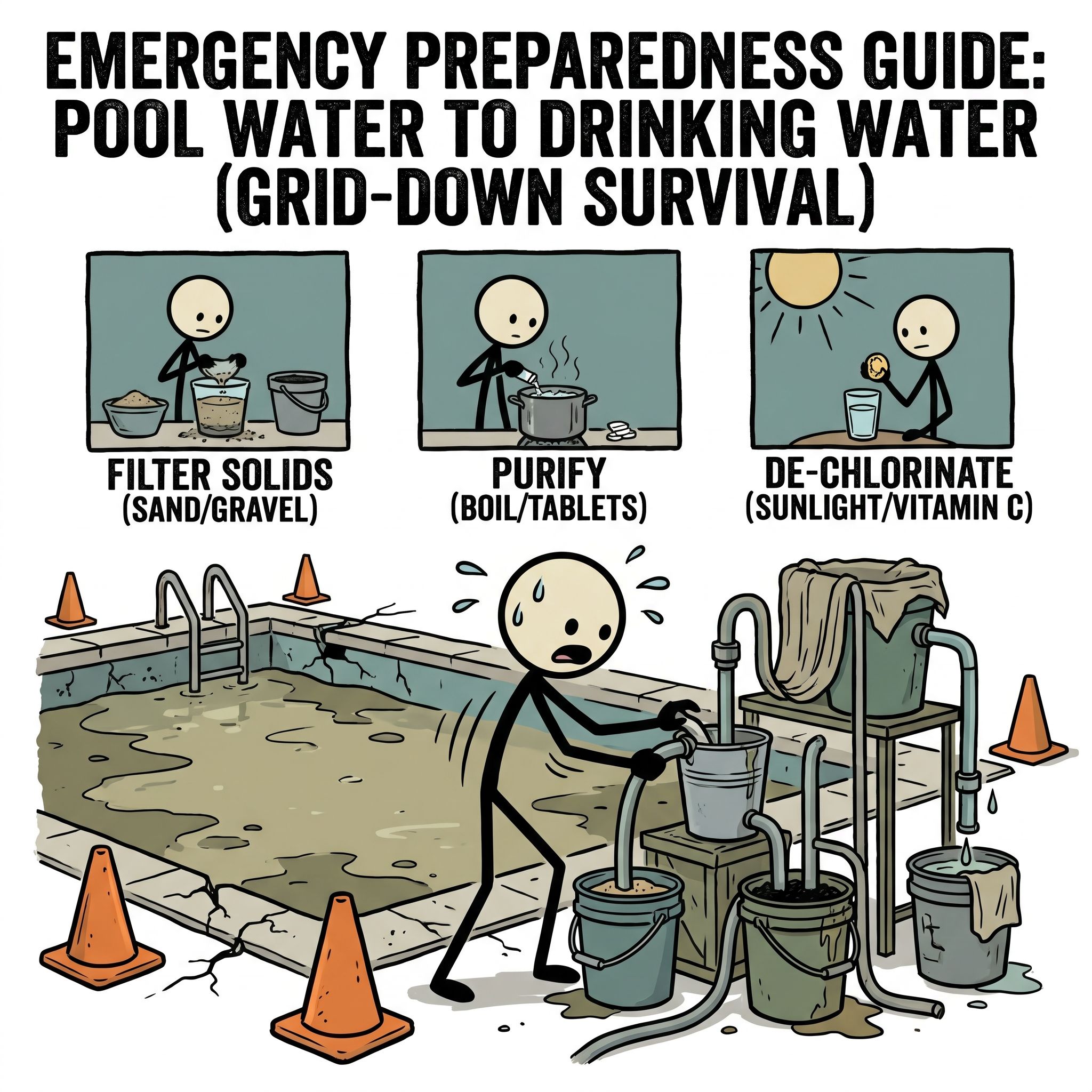
Imagine a prolonged grid-down scenario: a catastrophic cyberattack on municipal infrastructure, a massive solar flare, or an unprecedented winter storm that cripples local power grids for weeks. Within 48 hours, municipal water pressure drops to zero, and the bottled water on supermarket shelves vanishes. In this high-stakes survival situation, your primary concern is hydration. While most households scramble to secure a few gallons of clean water, millions of suburban homeowners have a massive, untapped reservoir sitting directly in their backyards. However, staring at those 20,000 gallons of shimmering blue water brings up a critical, life-saving question: can you drink pool water in an emergency? The short answer is yes, but only if you possess the knowledge, tools, and precise chemical understanding to treat it safely. Raw pool water is not simply "chlorinated tap water"—it is a complex chemical solution that requires systematic filtration, de-chlorination, and purification before it is safe for human consumption.
The Reality of Pool Water: Chemistry and Contaminants
To understand how to make pool water drinkable, you must first understand what is actually floating in your pool. Swimming pool water is treated with a variety of chemicals designed to keep it clear and free of algae, but these same chemicals make it hazardous to your kidneys, liver, and gastrointestinal tract if ingested directly over a prolonged period.
The primary sanitizing agent in most pools is chlorine, typically added in the form of liquid chlorine (sodium hypochlorite) or dry chlorine (calcium hypochlorite). When chlorine dissolves in water, it forms hypochlorous acid, which kills bacteria and pathogens. According to the Environmental Protection Agency (EPA), the maximum safe level of chlorine in drinking water is 4.0 milligrams per liter (mg/L) or 4.0 ppm. While active pool water often hovers within this safe limit (1.0 to 3.0 ppm), the pool also contains "combined chlorine" or chloramines. Chloramines are formed when free chlorine reacts with organic matter like sweat, oils, and urine. Chloramines are responsible for the distinct "pool smell" and are highly irritating to the human digestive tract, causing nausea, vomiting, and mucosal irritation if consumed.
The Danger of Cyanuric Acid (CYA)
Perhaps the most significant obstacle in swimming pool water purification is Cyanuric Acid (CYA), commonly sold as "stabilizer" or "conditioner." In outdoor pools, CYA is added to protect free chlorine from being rapidly degraded by the ultraviolet (UV) rays of the sun. Without CYA, sunlight can destroy up to 90% of a pool's free chlorine in just two hours.
While CYA is invaluable for pool maintenance, it is a metabolic toxin in high doses. The World Health Organization (WHO) and the CDC warn that chronic ingestion of cyanuric acid can lead to the formation of kidney stones, renal tissue damage, and potential kidney failure. Unlike chlorine, which can be boiled off or neutralized, CYA is an incredibly stable compound. It does not evaporate, it is not broken down by boiling, and it cannot be filtered out by standard sediment or carbon filters. Understanding how to bypass or remove this chemical is the difference between life-saving hydration and self-inflicted chemical poisoning.
Biological Pathogens in "Clean" Pools
Even if a pool looks crystal clear and is properly chlorinated, it is not sterile. The Centers for Disease Control and Prevention (CDC) notes that several highly resilient pathogens can survive in chlorinated water. The most notable of these is Cryptosporidium, a microscopic parasite that causes severe diarrheal illness. Cryptosporidium has an outer shell that makes it highly resistant to chlorine disinfection; it can survive in a properly chlorinated pool for up to 10 days. Other pathogens, such as Giardia lamblia, Escherichia coli (E. coli), and various enteroviruses, can also contaminate pool water through bird droppings, windblown dust, and human contact. Therefore, physical filtration alone is never sufficient.
The Three-Step Protocol: Filter, De-chlorinate, Purify
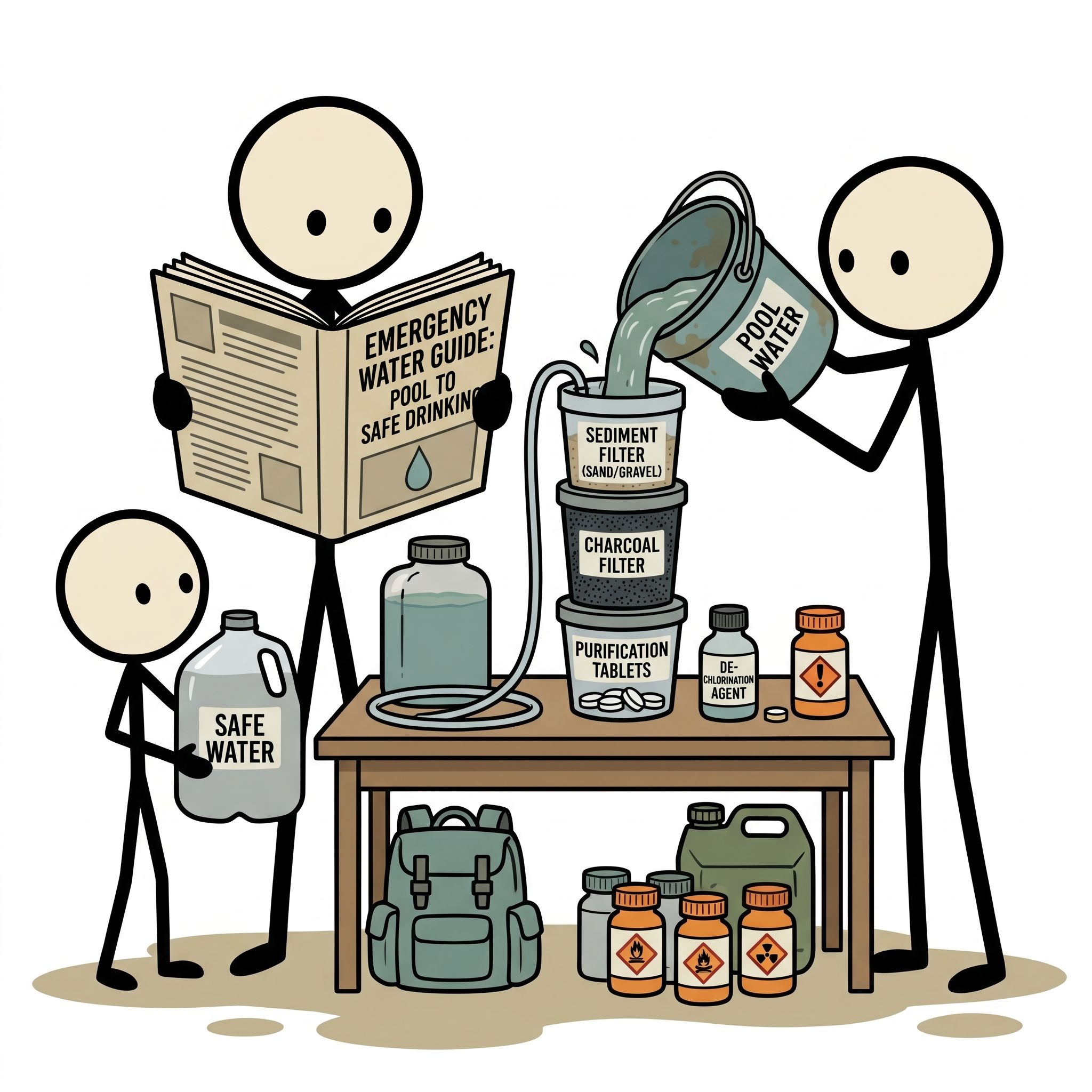
To safely transform pool water into potable drinking water, you must follow a strict, non-negotiable three-step protocol. Attempting to skip any of these steps, or performing them out of order, can result in clogged equipment, chemical illness, or biological infection. This systematic approach ensures that you address physical particulates, chemical additives, and biological pathogens sequentially.
| Phase | Target Contaminants | Primary Methods |
|---|---|---|
| 1. Physical Filtration | Algae, hair, skin flakes, insects, dust, suspended solids (turbidity) | DIY sand/charcoal filters, gravity ceramic filters, micro-filtration pump systems |
| 2. De-chlorination & Chemical Extraction | Free chlorine, chloramines, volatile organic compounds (VOCs), pool shock residues | Activated carbon block filtration, prolonged boiling, solar UV exposure, distillation (for CYA/salt) |
| 3. Biological Purification | Bacteria, viruses, chlorine-resistant cysts (Cryptosporidium, Giardia) | Rolling boil, secondary chemical disinfection (hypochlorite), UV-C sterilization |
Step 1: Emergency Pool Water Filtration (Physical Contaminants)
The first step in emergency pool water filtration is removing all suspended solids, organic debris, and turbidity. If you attempt to run raw, debris-heavy pool water directly through a high-end survival filter (such as a Sawyer Squeeze, Katadyn, or Berkey), the suspended organic matter, algae, and oils will rapidly clog the microscopic pores of the filter membrane, rendering your expensive equipment useless within hours.
Pre-Filtration Techniques
Before passing water through any fine-pore filter, you must perform a rough pre-filtration. Start by scooping water from the center of the pool, avoiding the surface film (where oils and floating debris collect) and the very bottom (where settled sediment rests). Run this water through a clean cotton sheet, a t-shirt, or a series of paper coffee filters nested inside a funnel. This simple step removes larger particles like hair, insects, and windblown dust, significantly extending the lifespan of your primary filtration systems.
Constructing a DIY Gravity Sand and Charcoal Filter
If commercial filtration systems are unavailable, you can construct a highly effective gravity-fed sediment filter using common household items. This classic survival filter utilizes layered media to trap particles of varying sizes.
- Prepare the Vessel: Cut the bottom off a clean 2-liter soda bottle or a 5-gallon plastic bucket. Suspend it upside down.
- The Base Layer: Place a clean, tightly woven cloth (like a bandana or microfiber cloth) or a handful of sterile cotton balls inside the neck of the bottle to act as a barrier that prevents the filtration media from escaping.
- The Fine Carbon Layer: Add 3 to 4 inches of crushed, activated charcoal. If commercial activated charcoal is unavailable, you can use cooled hardwood coals from a campfire, crushed into a fine powder (do not use commercial charcoal briquettes, as they contain toxic binders and combustion accelerators). Charcoal is critical as it begins the chemical adsorption process.
- The Fine Sand Layer: Add 3 to 4 inches of clean, fine play sand or washed beach sand. This layer traps fine particulates and micro-debris.
- The Coarse Sand/Gravel Layer: Add 2 to 3 inches of coarse sand, followed by a final layer of small gravel or pebbles. This top layer acts as a distributor, slowing the water flow and trapping larger organic materials.
Pour your pre-filtered pool water slowly into the top of this DIY column. Discard the first few quarts of water that pass through, as they will contain black charcoal dust. Once the water runs completely clear, you have successfully lowered the turbidity of the water, preparing it for chemical extraction.
Step 2: De-chlorination and Chemical Extraction
Once your pool water is physically clear, you must address the chemical load. This is the most critical phase when learning how to make pool water drinkable. Consuming high levels of chlorine and stabilizer will cause rapid dehydration due to vomiting and diarrhea, completely defeating the purpose of drinking the water.
The Power of Activated Carbon Adsorption
The absolute gold standard for removing chlorine, chloramines, and organic chemicals from water is activated carbon. Unlike mechanical filters that physically block particles, activated carbon works through a chemical process called adsorption. During adsorption, dissolved chemical contaminants adhere to the highly porous surface area of the carbon molecules.
A single gram of high-quality activated carbon has a surface area exceeding 3,000 square meters (approx. 32,000 square feet), packed with microscopic pores. As chlorinated pool water passes through an activated carbon block filter, the chlorine molecules react chemically with the carbon, converting into harmless chloride ions. Simultaneously, organic compounds, algaecides, and chloramines are trapped within the carbon's intricate pore structure.
To achieve this, run your pre-filtered water through a high-quality, gravity-fed carbon filter. Systems like the Berkey (equipped with Black Berkey elements) or the Alexapure Pro are highly effective at stripping chlorine and volatile organic compounds. If you are using a DIY charcoal filter, ensure the water has a slow "dwell time" (the amount of time the water remains in contact with the charcoal). The slower the water trickles through the charcoal, the more chemical contaminants are adsorbed.
Alternative De-chlorination Methods
If you do not have access to activated carbon, you can utilize physics and chemistry to reduce chlorine levels, though these methods will not address the dangerous stabilizer (Cyanuric Acid):
- Off-Gassing (Aeration): Chlorine is a gas dissolved in water. If you leave a bucket of chlorinated pool water sitting open in a well-ventilated area, the chlorine will naturally off-gas into the atmosphere over 24 to 48 hours. You can accelerate this process by vigorously stirring the water or pouring it back and forth between two clean buckets (splashing introduces air and coaxes the gas out of solution). Note: This method only works for free chlorine; it is highly ineffective against chloramines and completely useless against Cyanuric Acid.
- Boiling: Boiling water vigorously for 15 to 20 minutes will drive off dissolved chlorine gas. However, this method has a major drawback in a Survival Scenarios: boiling causes water to evaporate, which actually concentrates any non-volatile contaminants left behind, such as Cyanuric Acid, heavy metals, and salts. Use boiling for de-chlorination only as a last resort, and only if you know the pool's CYA levels are extremely low.
- Solar UV Degradation: Leaving pool water in clear, food-grade plastic or glass containers under direct, intense sunlight for 8 to 12 hours will break down free chlorine. The UV-B rays from the sun disrupt the chemical bonds of hypochlorous acid. Like off-gassing, this does not remove stabilizers or heavy metals.
Step 3: Purifying Pool Water for Drinking (Pathogen Destruction)
Once you have physically filtered the water and chemically stripped the chlorine and organic compounds, you are left with water that is chemically clean but biologically vulnerable. Because you have removed the chlorine, any remaining microscopic pathogens can now multiply rapidly. The final step is purifying pool water for drinking by rendering all biological organisms completely inert.
The Boiling Standard
According to the Federal Emergency Management Agency (FEMA) and the American Red Cross, boiling is the oldest and most reliable method of water purification. Boiling kills all forms of pathogenic bacteria, viruses, and protozoan cysts (including the highly chlorine-resistant Cryptosporidium and Giardia).
Bring your filtered, de-chlorinated pool water to a vigorous, rolling boil for at least one full minute. If you are at an altitude above 5,000 feet (1,500 meters), boil the water for three full minutes, as water boils at a lower temperature at high altitudes. Allow the water to cool naturally in a sanitized, covered container to prevent re-contamination.
Secondary Chemical Disinfection
If fuel is scarce and you cannot boil the water, you must re-introduce a controlled, safe dose of disinfectant. Since you have already filtered out the organic load and the excessive pool chemicals, you can now treat the water as if it were raw freshwater. Use regular, unscented liquid household bleach (sodium hypochlorite, typically 5.25% to 8.25% strength). Refer to the EPA and CDC guidelines for exact emergency disinfection ratios:
- Add 8 drops (approx. 1/8 teaspoon) of regular, unscented liquid bleach per gallon of clear water.
- If the water is slightly cloudy or cold, double the dosage to 16 drops (approx. 1/4 teaspoon) per gallon.
- Stir the mixture thoroughly and let it stand undisturbed for at least 30 minutes.
- After 30 minutes, smell the water. It should have a very slight chlorine odor. If it does not, add another dose of bleach, stir, and let it stand for another 15 minutes before consuming.
Warning: Never use scented bleaches, color-safe bleaches, or bleaches with added cleaners, as these contain toxic surfactants and artificial fragrances.
The Cyanuric Acid (CYA) and Saltwater Dilemma
Up to this point, we have addressed physical debris, chlorine, chloramines, and biological pathogens. However, we must address the elephant in the pool: Cyanuric Acid (CYA) and, in the case of modern saltwater pools, sodium chloride (salt).
If you have an outdoor pool that has been treated with stabilized chlorine tablets (trichlor or dichlor) for years, your CYA levels could easily exceed 50 to 100 ppm. The safe limit for CYA in drinking water is not formally established by the EPA, but health advisories suggest keeping ingestion below 5 ppm to avoid renal complications. Furthermore, if you have a saltwater pool, your water contains roughly 3,000 to 3,500 ppm of salt (about one-tenth the salinity of the ocean). Drinking saltwater will cause rapid dehydration and kidney distress.
Standard carbon filters, ceramic filters, boiling, and chemical disinfection cannot remove CYA or salt. If you are dealing with a saltwater pool or a pool with high CYA levels, you have only two viable options to make this water safe for long-term consumption: distillation or reverse osmosis.
The Distillation Solution (How to Build a Survival Still)
Distillation is the absolute ultimate method of water purification. It relies on thermal dynamics: heating water to its boiling point, capturing the pure steam, and condensing that steam back into liquid water in a separate container. Because chemicals like Cyanuric Acid, salts, heavy metals, and algaecides have much higher boiling points than water, they do not evaporate. They remain behind in the boiling vessel, while only pure, 100% sterile H2O translates into the collection vessel.
You can construct a highly efficient emergency stovetop distiller using common kitchen items:
- The Boiling Chamber: Use a large, deep pot (such as a stockpot) with a lid. Fill the pot halfway with filtered pool water.
- The Collection Vessel: Place a clean, heat-resistant glass or stainless-steel bowl inside the pot. The bowl must float on the water or sit on a clean brick placed at the bottom of the pot, ensuring the rim of the bowl sits well above the water level.
- The Condensation Lid: Place the pot lid on upside down (inverted, so the handle points down toward the collection bowl).
- The Thermal Gradient: Bring the water to a gentle boil. Place ice cubes, cold pool water, or wet cloths on top of the inverted lid. As the water boils, steam rises, hits the cold underside of the inverted lid, condenses into pure water droplets, and runs down the slope of the lid to drip directly into the collection bowl.
This process is slow and fuel-intensive, but it yields pure, completely safe drinking water, free of all pool chemicals, CYA, salt, and pathogens. It is the gold-standard method for converting saltwater pool water into life-saving hydration.
Step-by-Step Survival Action Plan
To ensure you can execute this process flawlessly under pressure, print or memorize this quick-reference survival action plan. This checklist assumes a worst-case scenario where municipal utilities are completely offline.
Phase A: Assessment and Safety Testing
- Visual Inspection: Assess the pool. Is it clear, or has it begun to turn green with algae? Green water requires heavier pre-filtration and longer purification times.
- Chemical Check: If you have a pool test kit, measure the pH, free chlorine, and Cyanuric Acid levels. If CYA is below 30 ppm and chlorine is below 3 ppm, standard filtration and carbon adsorption will easily make the water potable. If CYA is high (above 50 ppm) or it is a saltwater pool, you must prioritize distillation.
Phase B: Execution Steps
- Scoop: Collect water from 12 inches below the surface of the pool using a clean bucket.
- Pre-Filter: Pour the water through a clean cloth or coffee filter to remove hair, leaves, and large sediment.
- Primary Filter: Pass the pre-filtered water through your DIY sand/charcoal filter or a commercial gravity ceramic filter to lower turbidity.
- De-chlorinate: Run the water through an activated carbon block filter (like a Berkey) to strip chlorine, chloramines, and organic compounds. If carbon is unavailable, aerate the water by pouring it between buckets for 15 minutes, then let it sit in the sun for 24 hours (only if CYA is low).
- Sterilize: Bring the de-chlorinated water to a rolling boil for 1 full minute (3 minutes at high altitude) to destroy all bacteria, viruses, and protozoan cysts.
- Distill (If Required): If the pool is saltwater or has high CYA levels, skip steps 4 and 5, and run the pre-filtered water directly through a DIY or commercial thermal distiller.
- Storage: Store the purified water in sanitized, food-grade, airtight containers. Keep them in a cool, dark place to prevent any secondary bacterial growth.
Frequently Asked Questions
Is untreated swimming pool water safe to drink in an emergency?
No. Untreated pool water contains toxic chemicals like chlorine, algaecides, and stabilizers (such as cyanuric acid), as well as potential pathogens, making it unsafe for direct consumption.
How can I remove chlorine and other pool chemicals to make the water drinkable?
Standard filtration does not remove dissolved chemicals. You must use distillation (boiling water and collecting the condensed steam) or a high-quality reverse osmosis system paired with activated carbon filters.
Can I use a standard backpacking filter on pool water?
No. Portable backpacking filters (like Sawyer or LifeStraw) remove biological pathogens like bacteria and parasites, but they cannot filter out dissolved pool chemicals, salts, or chemical stabilizers.
Is boiling pool water enough to make it safe to drink?
No. Boiling kills biological pathogens but actually concentrates dissolved chemicals, heavy metals, and salts. Only distillation—collecting the steam—separates pure water from these chemical contaminants.
What is the safest way to utilize pool water during a long-term survival situation?
Prioritize using pool water for non-drinking purposes like flushing toilets, hygiene, and washing clothes. If you must drink it, use a DIY or commercial distillation setup as your primary purification method.