⚡ Key Facts
- The 4-Hour Clock: According to the USDA Food Safety and Inspection Service (FSIS), an unopened refrigerator will keep food safely cold for only 4 hours during a power disruption.
- Freezer Endurance: A fully packed, unopened freezer maintains safe holding temperatures for approximately 48 hours (24 hours if half-full), provided the door seal remains unbroken.
- The Danger Zone: Bacteria multiply most rapidly between 40°F and 140°F (4.4°C and 60°C). Per CDC data, perishable foods left within this thermal window for more than two hours (or one hour at temperatures above 90°F) become vector hazards for foodborne pathogens.
- Lethal Indoor Hazards: The Consumer Product Safety Commission (CPSC) reports that improper indoor use of portable generators and outdoor fuel-burning appliances causes an average of 85 carbon monoxide fatalities annually, spiking sharply during cold-weather holiday power outages.
- Target Internal Temperatures: Regardless of heat source or disruption, whole poultry must register an uninterrupted minimum internal temperature of 165°F (73.9°C) measured in the thickest part of the breast, thigh, and wing joint.
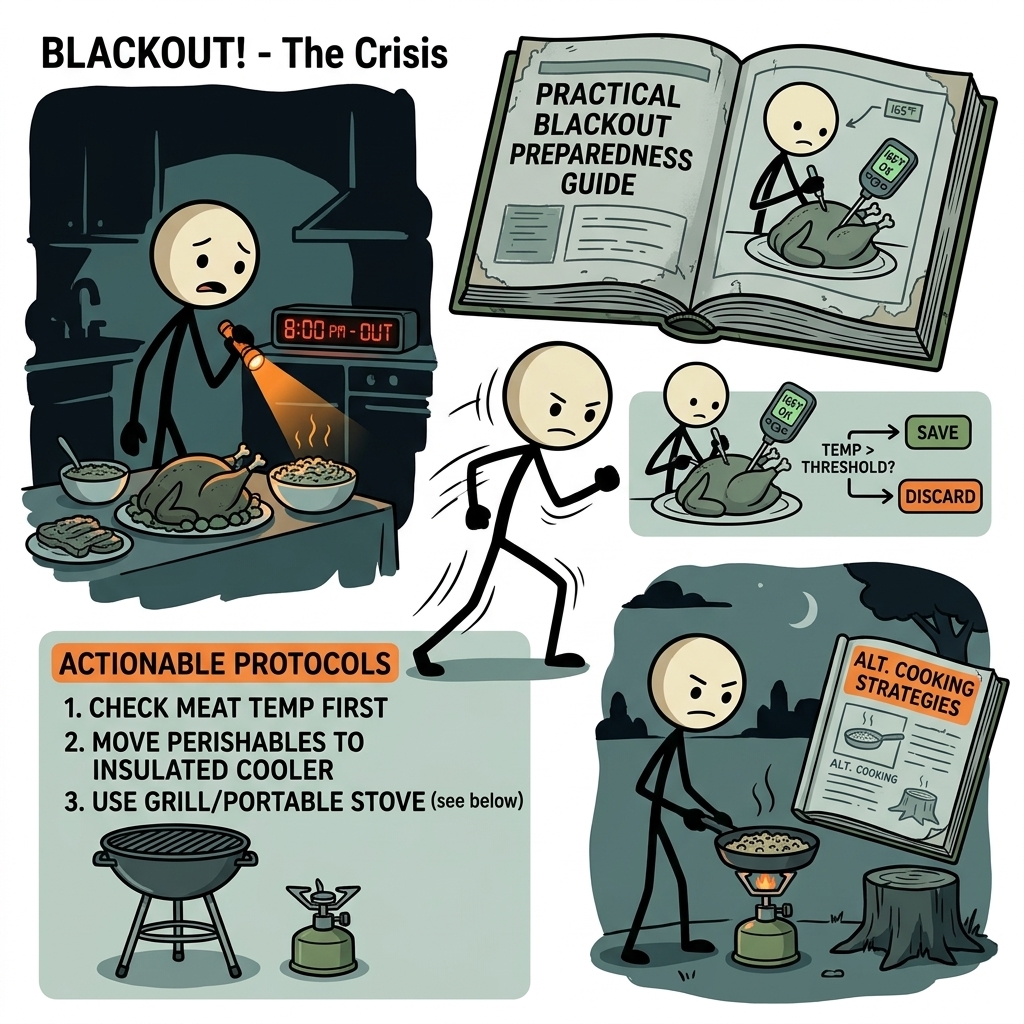
Few domestic scenarios induce panic quite like the sudden snap of a transformer on a freezing holiday afternoon. One moment, the kitchen is filled with the aroma of roasting herbs, simmering broths, and bustling multi-generational conversation; the next, the house drops into dead silence, the oven displays go black, and you are left staring at an 18-pound half-roasted bird trapped inside an appliance that is actively shedding heat. Severe winter weather tracked by the National Oceanic and Atmospheric Administration (NOAA) consistently peaks alongside holiday travel and family gatherings, making a Thanksgiving power outage or winter holiday blackout a statistical reality rather than a remote hypothetical. Navigating this scenario requires a shift from holiday host to tactical kitchen commander. With a clear understanding of microbial timelines, thermodynamic management of cold storage, and calculated outdoor cooking pivots, you can safely salvage the holiday feast without sending your guests to the emergency room. For the practical checklist side, use the community emergency preparedness guide.
The Biological Clock: Understanding the Danger Zone
Food safety during a power outage is governed by microbiology, not culinary preference. The primary threat during any thermal failure is the rapid proliferation of pathogenic bacteria, including Salmonella enterica, Staphylococcus aureus, Campylobacter jejuni, and Clostridium perfringens. The Centers for Disease Control and Prevention (CDC) estimates that 48 million Americans contract foodborne illnesses each year, with substantial spikes occurring around large holiday gatherings where food handling involves large volumes, complex timelines, and crowded staging areas. For the practical checklist side, use the neighborhood preparedness network.
The core battleground is the "Danger Zone"—the temperature band between 40°F and 140°F. Within this range, bacterial populations can double in as little as 20 minutes. Pathogens like S. aureus produce enterotoxins that are notoriously heat-stable; once these toxins are synthesized in improperly held food, subsequent cooking—even to blistering temperatures—will not neutralize their ability to cause severe gastrointestinal distress. For the practical checklist side, use the emergency communication plan.
The standard baseline applied by the USDA is clear: Perishable foods held above 40°F for more than two hours must be discarded. If the ambient room temperature exceeds 90°F (unlikely during a winter outage, but common near active wood stoves or crowded hearths), that threshold shrinks to a strict one-hour operational limit. Every decision made from the second the grid drops must work to keep cold foods strictly below 40°F and hot foods securely above 140°F. For the practical checklist side, use the family emergency planning guide.
Active vs. Passive Pathogen Proliferation
It is crucial to distinguish between raw inventory awaiting preparation and cooked dishes mid-service. Raw proteins harbor baseline surface and structural bacteria that multiply as heat dissipates or ambient temperatures rise. Cooked items like stuffing, creamy gratins, and giblet gravies represent ideal growth media: rich in moisture, neutral in acidity, and densely packed with accessible nutrients.
When an outage strikes, grab a calibrated digital probe thermometer immediately. Do not rely on ambient kitchen temperatures or touch tests. Your instant-read probe is your most critical piece of tactical gear; document the exact time the power failed and record baseline temperatures of all primary assets across your kitchen.
Cold Storage Defense: Managing Refrigerators and Freezers
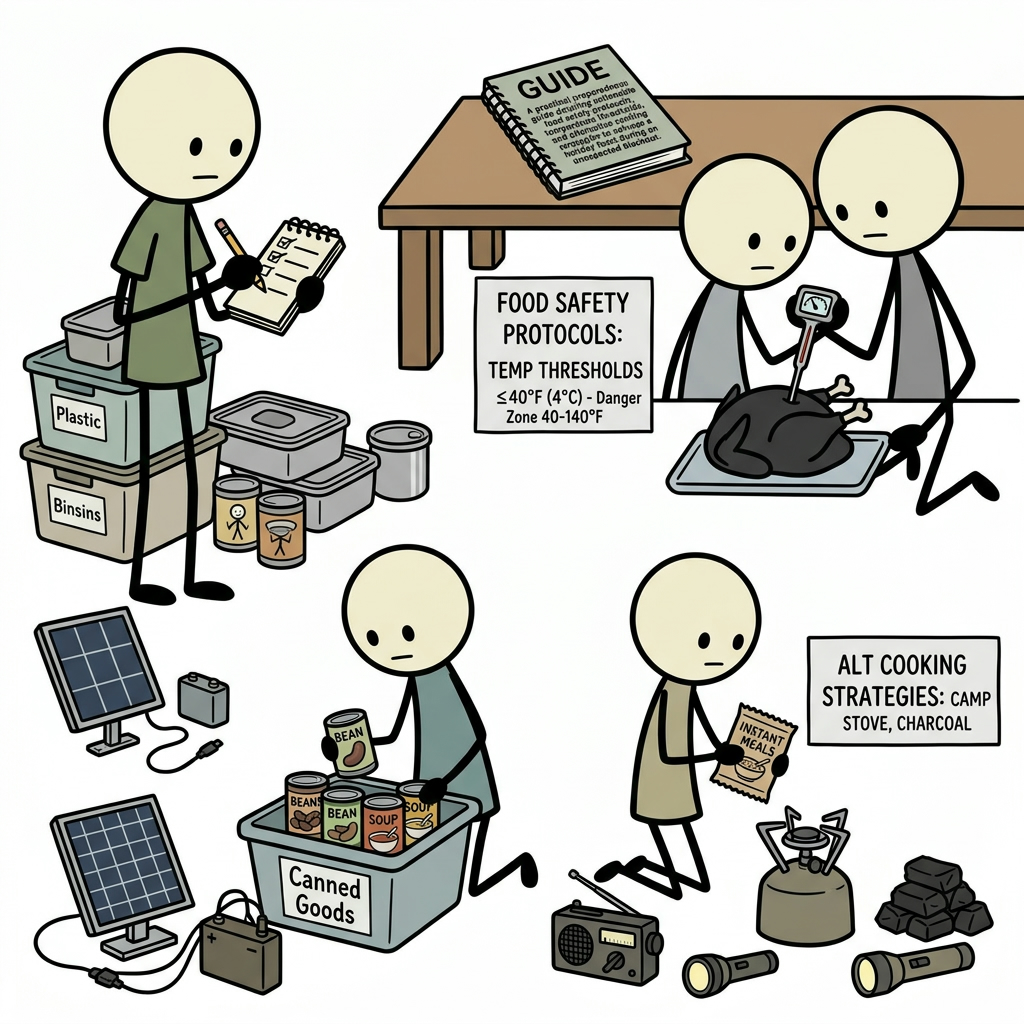
Your refrigerator and freezer are insulated thermal vaults. The moment the compressor shuts off, your primary objective is preserving the established thermal mass. Refrigerator food safety blackout protocol begins with an immediate, absolute physical moratorium on opening appliance doors.
An unopened refrigerator will maintain a food-safe internal temperature below 40°F for approximately four hours. Every time the door swings open to assess the status of the milk or retrieve a beverage, warm kitchen air rushes in, displacing the sinking cold air and shaving 15 to 30 minutes of protective buffer off that four-hour window. Instruct all household members and guests that the refrigerator is sealed until an organized triage operation is initiated.
Freezer Thermodynamics and Mass Stabilization
Freezers operate under different thermodynamic parameters due to the sheer latent heat capacity of frozen water. A fully packed chest or upright freezer will maintain safe temperatures for up to 48 hours without grid power. If the freezer is only half-full, that buffer drops by half to approximately 24 hours.
To maximize this defensive asset during an unexpected interruption:
- Group the Cold Mass: Rapidly open the freezer once, push all frozen items tightly together toward the center or bottom shelves, and immediately reseal the door. Grouping items minimizes surface-area-to-volume exposure and slows warming.
- Deploy Thermal Ballast: If you keep frozen gallon jugs or gel packs in your freezer as part of your standard emergency holiday preparedness, shift them over and around high-risk items like raw meats or chilled casseroles.
- Dry Ice Deployment: If severe storm warnings precede your gathering, securing 25 to 50 pounds of commercial dry ice can extend safe freezer holds for three to four days. Always handle dry ice with insulated gloves and never store it in an airtight, non-vented vessel due to sublimation pressure risks.
The "Snowbank Myth" vs. Practical Outdoor Chilling
When an outage coincides with a winter freeze, the immediate impulse for many homeowners is to carry the turkey, dairy, and side dishes out to the back patio or bury them in a snowbank. The USDA explicitly advises against using outdoor snowbanks as makeshift walk-in coolers for several critical reasons.
First, sunlight creates a pronounced greenhouse effect inside coolers or direct packaging, driving internal temps well above 40°F even when ambient outdoor air is freezing. Second, outdoor conditions fluctuate wildly throughout a 24-hour cycle. Third, outdoor emergency food storage guide invites domestic pets, rodents, and wild scavengers, compromising sanitation through physical contact, urine, or biological cross-contamination.
If you must leverage the cold environment, do so using hard-sided, sanitized marine coolers. Pack clean snow or ice around securely wrapped food containers inside the cooler, monitor internal temperatures using a remote-probe thermometer run through the drain plug or lid seal, and secure the cooler in a locked, unheated garage or shed away from direct solar radiation and pests.
The Turkey Pivot: Salvaging the Centerpiece Without Power
Cooking turkey without electricity is the ultimate stress test of your culinary readiness. The exact operational strategy you deploy depends entirely on where the bird was in the cooking lifecycle when the power cut out.
Scenario 1: The Bird is Raw or Currently Brining
If the bird is resting in a wet brine, dry-brining on a sheet tray, or sitting prepped in a cold roasting pan, leave it in the sealed refrigerator if the power is projected to return within four hours. If the outage is widespread and indefinite, do not wait. Transition the raw turkey into a dedicated cooler packed with crushed ice to maintain an internal temperature below 38°F, or move directly to an outdoor cooking setup.
Scenario 2: The Bird is Partially Cooked in an Electric Oven
This is the highest-risk operational scenario. An oven that suddenly loses power will rapidly transition from an active heat chamber to a low-temperature incubation box. If the bird’s internal core temperature is below 135°F when the oven dies, the residual heat will quickly bleed out, trapping the meat squarely within the Danger Zone.
Execute this sequence:
- Probe Instantly: Insert an accurate digital probe into the deepest portion of the breast and the thickest area of the inner thigh, avoiding bone. Document the current core and ambient oven temperatures.
- The Two-Hour Evaluation: If the bird had just entered the oven and registered below 90°F, you have zero thermal protection. Do not leave the bird inside the dying oven. If it cannot be transferred to an active, reliable secondary cooking apparatus immediately, you must evaluate disposal. The USDA warns that partially cooked meat that sits in a cooling appliance creates a prime environment for spore-forming anaerobic bacteria.
- The Transfer Protocol: If an alternative heat source (grill, smoker) can be stabilized at 325°F–350°F within 30 minutes, immediately extract the bird from the oven and resume the thermal process. The internal temperature must push through the 140°F threshold without prolonged plateaus.
Scenario 3: The Bird is Near Completion
If the internal temperature of the breast already reads 150°F to 155°F when the outage strikes, the bird has accumulated significant thermal momentum. Keep the oven door firmly shut. A heavy-duty, modern oven retains useful heat for 20 to 30 minutes. Monitor the internal probe remotely. If the core continues climbing toward 165°F via carryover cooking, allow it to finish. If the temperature stalls below 165°F and starts falling, pull the bird, wrap it tightly in heavy-duty aluminum foil, and finish the final thermal push on an outdoor grill.
Alternative Cooking Tactics and Field Operations
When cooking indoors is no longer viable, you must shift your cooking station outside. Crucial safety rule: Never, under any circumstances, operate a charcoal grill, gas barbecue, wood smoker, or liquid-fuel camp stove indoors, inside a breezeway, or inside an attached garage. Carbon monoxide is colorless, odorless, and completely undetectable without electronic monitors. Position all alternative cookers at least 10 feet away from combustible structures, overhangs, and exterior home air intakes.
Tactic A: The Two-Zone Indirect Barbecue Method
Both charcoal and propane grills can be easily configured to replicate the convective dry heat of a standard kitchen oven. The key is setting up a two-zone indirect cooking profile.
For a gas grill, ignite the outer burners on high and leave the central burners completely off. For a charcoal kettle grill, push white-hot coals into two distinct piles on opposite sides of the lower grate, placing an aluminum drip pan filled with one inch of warm water or stock directly in the center. Position the roasting pan containing the turkey over the unlit central zone. Close the lid and calibrate the vents or burner dials to maintain a steady ambient dome temperature of 325°F to 350°F (163°C to 177°C).
Spatchcocking—removing the backbone and flattening the bird—is the most effective technique for alternative heat cooking. A flattened turkey cooks in roughly half the time of a whole spherical bird, drastically reduces fuel consumption, and eliminates the deep thermal core pocket that frequently harbors undercooked tissues during fluctuating grill temperatures.
Tactic B: The Dutch Oven and Charcoal Briquette Formula
Heavy cast-iron Dutch ovens provide remarkable thermal stability during wind and freezing conditions. For sides, braised meats, or separated turkey legs and thighs, charcoal briquettes allow precise temperature management via basic arithmetic.
To calculate the briquettes required for a standard Dutch oven, use the Rule of Four: take the diameter of the oven in inches and multiply it by two. For a 12-inch Dutch oven targeting 350°F, you need approximately 24 briquettes. Distribute them strategically: place one-third of the coals underneath the oven (8 briquettes) and two-thirds across the flanged lid (16 briquettes). Top-heavy heat distribution produces an ideal roasting environment while preventing delicate food bases from scorching on the bottom.
Tactic C: Portable Multi-Fuel Camp Stoves
Compact dual-burner propane or isobutane stoves are indispensable for stove-top operations. While they lack the capacity to roast a whole bird, they excel at high-output liquid boiling and reheating. Use them to maintain gravies at safe holding temperatures (above 140°F), simmer parboiled potatoes, or boil water for sanitization cycles. Ensure these units are heavily shielded from freezing crosswinds, which dramatically degrade burner BTU output.
The Perishables Matrix: Keep, Cook, or Toss?
In a prolonged blackout, you cannot salvage everything. Trying to protect low-value, high-risk items divides your focus and compromises critical safety buffers. Execute a rapid triage of your holiday inventory using the parameters established by the USDA FSIS and FDA food safety codes.
| Culinary Category | Specific Asset Examples | Threshold After 4 Hours (>40°F) | Actionable Protocol |
|---|---|---|---|
| Immediate High Risk | Raw/Cooked Poultry, Dressing/Stuffing, Gravy, Egg Custards, Pumpkin Pie, Heavy Cream | DISCARD | High moisture and neutral pH make these primary vectors for rapid enterotoxin production. Discard without tasting. |
| Moderate Risk / Conditional | Mashed Potatoes, Soft Cheeses (Brie, Ricotta), Green Bean Casserole, Cooked Greens | CONSUME OR TOSS | If held below 40°F for the duration, cook or heat rapidly to 165°F. If held above 40°F for >2 hours, dispose immediately. |
| Inherently Safe / Low Risk | Hard Cheeses (Cheddar, Parmesan), Butter, Open Cranberry Sauce, Fruit Pies, Fresh Bread | SAFE TO KEEP | High sugar, high acid, or low water activity protects these items. Keep covered and shielded from dust and pests. |
| Raw Produce | Whole uncut carrots, uncut squash, fresh intact herbs, whole apples, potatoes | SAFE TO KEEP | Uncut, unwashed produce with intact skins handles ambient outages safely. Keep cool and dry. |
The Special Hazard of Holiday Stuffing
Stuffing requires unique operational respect. If you elected to cook stuffing inside the cavity of the bird, an outage elevates that dressing to a biological hazard zone. Cavity dressing absorbs juices carrying raw poultry bacteria while sitting shielded in the most thermally insulated part of the animal.
If grid failure occurs before the center of the cavity stuffing reaches a verified 165°F, extract the stuffing immediately using sanitized tongs. Transition it to an oven-safe cast iron pan or foil tin and finish it separately over direct heat until a thermometer registers 165°F through its densest center. If the meat and cavity spent extended time idling below 140°F, discard the internal stuffing entirely; the risk of heat-resistant C. perfringens or staphylococcal enterotoxins is extraordinarily high.
Tactical Sanitation and Infrastructure
A power outage does not just disable heating elements; it frequently disables municipal water delivery, domestic pressure pumps, and baseline sanitation infrastructure. Homes reliant on private well pumps will lose running water the instant electrical circuits drop. In high-density municipalities, treatment plant failures can trigger sudden boil-water notices during regional grid collapse events.
Cross-contamination in a dimly lit, water-deprived kitchen turns an uncomfortable situation into a catastrophic outbreak. Establish these operational safeguards immediately:
Deploy Dedicated Emergency Illumination
Never attempt critical kitchen tasks by candlelight. Open flames near kitchen textiles, cooking oils, and alcohol are a major residential fire risk. Mount battery-powered LED lanterns or equip your kitchen crew with hands-free headlamps featuring clean white beams. Verifying clear flesh tones, surface moisture changes, and small digital probe displays requires bright, direct task lighting.
The Two-Bucket Sanitation Station
If tap water is compromised, erect a standard field sanitation station away from your food staging zones:
- Wash Station: A gravity-fed water cooler or camping jug filled with clean potable water, accompanied by antimicrobial soap and single-use paper towels. Do not use shared cloth hand towels, which rapidly collect and transfer cross-contaminants between cooks.
- Sanitizing Rinse: A dedicated vessel containing cool, clean water dosed with unscented household bleach (one tablespoon of standard 6% household bleach per gallon of water, following CDC emergency sanitation guidelines). Use this solution to sanitize cutting boards, knives, and contact surfaces that encounter raw ingredients.
- Alcohol-Based Rubs: Hand sanitizers with at least 60% alcohol are effective for clean hands, but they do not penetrate grease, fat films, or organic matter. Wash visibly soiled hands with soap and water before applying sanitizing rubs.
The 72-Hour Pre-Holiday Mitigation Protocol
True emergency holiday preparedness begins days before guests arrive. By building baseline resiliency into your holiday prep, you remove systemic single points of failure from your kitchen operations.
- Thermal Mass Preparation (72 Hours Out): Freeze four to six clean, food-grade gallon jugs of water and nestle them into open voids within your primary freezer. If an outage occurs, these act as structural thermal anchors, absorbing heat and maintaining sub-freezing states without making a mess as they thaw.
- Hardware Verification (48 Hours Out): Test your digital meat thermometers and calibrate them in an ice-water bath (which should read exactly 32°F / 0°C). Replace questionable batteries. Verify that you possess at least two functional, calibrated backup probes.
- Auxiliary Fuel Assessment (24 Hours Out): Verify that your outdoor propane tanks are full and inspect regulators for perished seals. If using charcoal, stock a minimum of two unopened, dry 20-pound bags of standard hardwood briquettes alongside reliable chimney starters and matches.
- Recipe and Process Decoupling: Store a printed physical copy of your target core cooking temperatures and primary operational recipes in a clear plastic sleeve. If your smartphone battery dies and your digital home hub goes dark, essential timelines and thermal baselines remain readily accessible.
Resilience Over Ruin
A sudden blackout during a major holiday dinner can instantly derail an unprepared kitchen, but it does not have to ruin your holiday gathering. By shifting from standard kitchen operations to deliberate emergency protocols, you transform a potential logistical nightmare into an impressive demonstration of practical family preparedness. Keep the appliance doors sealed, track your core holding temperatures using precise data rather than optimistic guesswork, deploy your outdoor cooking equipment with uncompromising carbon monoxide safety, and ruthlessly discard any side dish that fails the critical time-temperature test. The success of a holiday is never defined by a running electric utility—it is defined by the safety, resourcefulness, and collective resilience of the people gathered around your table.
Frequently Asked Questions
What should I do if the power fails while the turkey is roasting?
Immediately check the internal temperature. If an outdoor grill or alternative cooking source is available, transfer the turkey to finish cooking until it reaches 165°F. If power is out and no alternative heat source is available, discard the turkey if it sits in the 'danger zone' between 40°F and 140°F for more than two hours.
How long will an unopened refrigerator stay cold during a power outage?
An unopened refrigerator will keep food safely cold below 40°F for approximately 4 hours. Keep the door closed as much as possible to retain cool air.
How long will food remain safe in the freezer without power?
A fully packed freezer will hold its temperature for about 48 hours if unopened, while a half-full freezer holds safe temperatures for roughly 24 hours.
Can I use an outdoor propane grill or camp stove indoors to finish cooking Thanksgiving dinner?
No. Never operate outdoor grills, propane fryers, or camp stoves indoors, in an enclosed porch, or inside a garage, as they produce deadly carbon monoxide gas.
Which Thanksgiving leftovers must be thrown away after a prolonged outage?
Discard cooked turkey, stuffing, gravy, dairy-based pies (such as pumpkin), mashed potatoes, and casseroles if they have spent more than two hours at temperatures above 40°F.