⚡ Key Facts
- Historic Grid Vulnerability: According to the National Oceanic and Atmospheric Administration (NOAA), the United States experienced a record-breaking 28 separate billion-dollar weather and climate disasters in 2023, exposing severe vulnerabilities in municipal power grids. For the practical checklist side, use the community emergency preparedness guide.
- Water Scarcity Realities: The Federal Emergency Management Agency (FEMA) notes that municipal water systems can fail within hours of a major power outage, making independent, multi-stage onboard filtration a critical survival asset. For the practical checklist side, use the neighborhood preparedness network.
- Superior Power Density: Lithium Iron Phosphate (LiFePO4) batteries provide up to 10 times the lifespan and double the usable energy capacity of traditional Absorbent Glass Mat (AGM) lead-acid batteries of equivalent weight.
- Stealth Security: The Federal Bureau of Investigation (FBI) property crime statistics highlight that visible survival equipment makes vehicles prime targets during civil unrest, underscoring the vital importance of "gray man" stealth design.
Imagine a regional power grid failure during the dead of winter or the height of a summer heatwave. Within hours, municipal water pumps fail, gas station pumps freeze, home heating and cooling systems shut down, and grocery store shelves empty. This is not a hypothetical scenario; it is a reality experienced by millions of citizens during major environmental events, such as the 2021 Texas winter storm or the severe hurricane seasons documented by the Federal Emergency Management Agency (FEMA). In these prolonged crises, standard residential homes can rapidly transform from safe havens into freezing or sweltering hazards. By contrast, a properly configured, self-sustaining mobile vehicle serves as a dynamic survival shelter. By integrating advanced electrical systems, multi-stage water filtration, thermal insulation, and robust emergency communication plans, you can transform a standard utility vehicle or van into an autonomous life-support pod capable of keeping your family safe, hydrated, and connected through the Survival Scenarios scenarios.
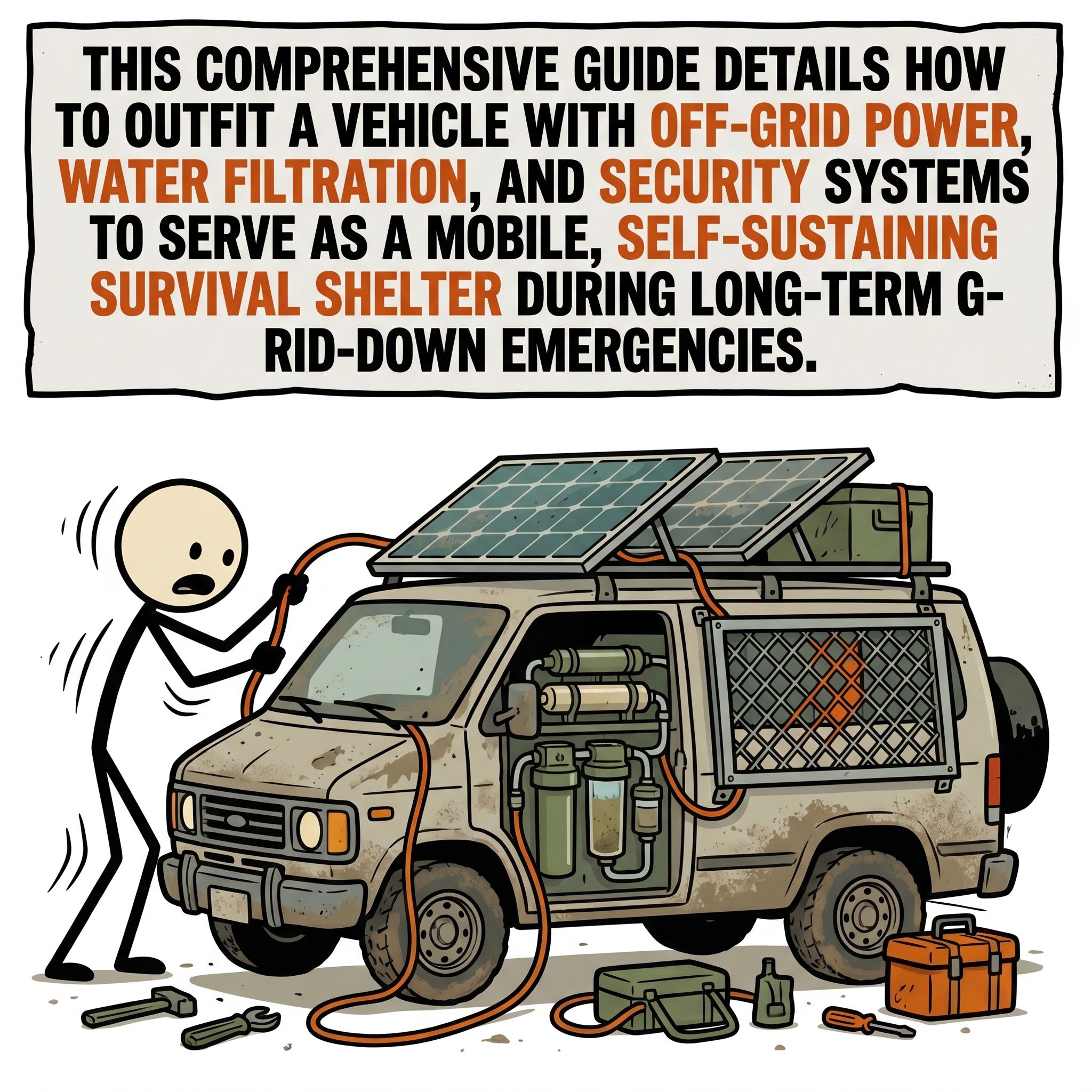
The Core Architecture of a Mobile Survival Shelter
When designing a vehicle to serve as a long-term survival shelter, the foundation of your planning must shift from casual recreation to tactical utility. While the popular "van life" movement offers excellent inspiration for space-saving layouts, true emergency vehicle preparedness requires a much higher standard of durability, redundancy, and self-reliance.
Your first consideration must be the vehicle's Gross Vehicle Weight Rating (GVWR). Every chassis has a maximum operating weight limit set by the manufacturer, which includes the vehicle itself, fuel, passengers, and all cargo. When you outfit a vehicle with heavy water tanks, battery banks, recovery gear, and defensive armor, you can easily approach or exceed this limit. Overloading your vehicle compromises the suspension, strains the transmission, increases stopping distances, and drastically reduces fuel economy—all of which are unacceptable risks in an evacuation scenario.
Selecting the Right Platform
- Full-Size Cargo Vans (Ford Transit, Mercedes Sprinter, Ram ProMaster): These offer the ideal balance of interior living space, cargo capacity, and stealth. A high-roof cargo van allows adults to stand upright, which is crucial for long-term psychological comfort during extended shelter-in-place events.
- Four-Wheel Drive SUVs and Overland Trucks: While these platforms offer superior off-road capability and ground clearance for navigating debris-strewn roads, they severely limit interior living space and water storage capacity.
- Medium-Duty Box Trucks and Ambulances: These vehicles provide massive payload capacities and square interiors that make building out systems straightforward, though they sacrifice fuel efficiency and maneuverability in tight urban environments.
Regardless of the platform you choose, the goal of your bug out vehicle gear integration should be a "gray man" aesthetic. The exterior of your vehicle should look entirely unremarkable—like a standard commercial work van or a typical family utility vehicle. Avoid tactical decals, military-style olive drab paint, or highly visible external gear mounts that signal to desperate individuals that your vehicle contains valuable food, water, and power resources.
Engineering a Resilient Off-Grid Vehicle Power Setup
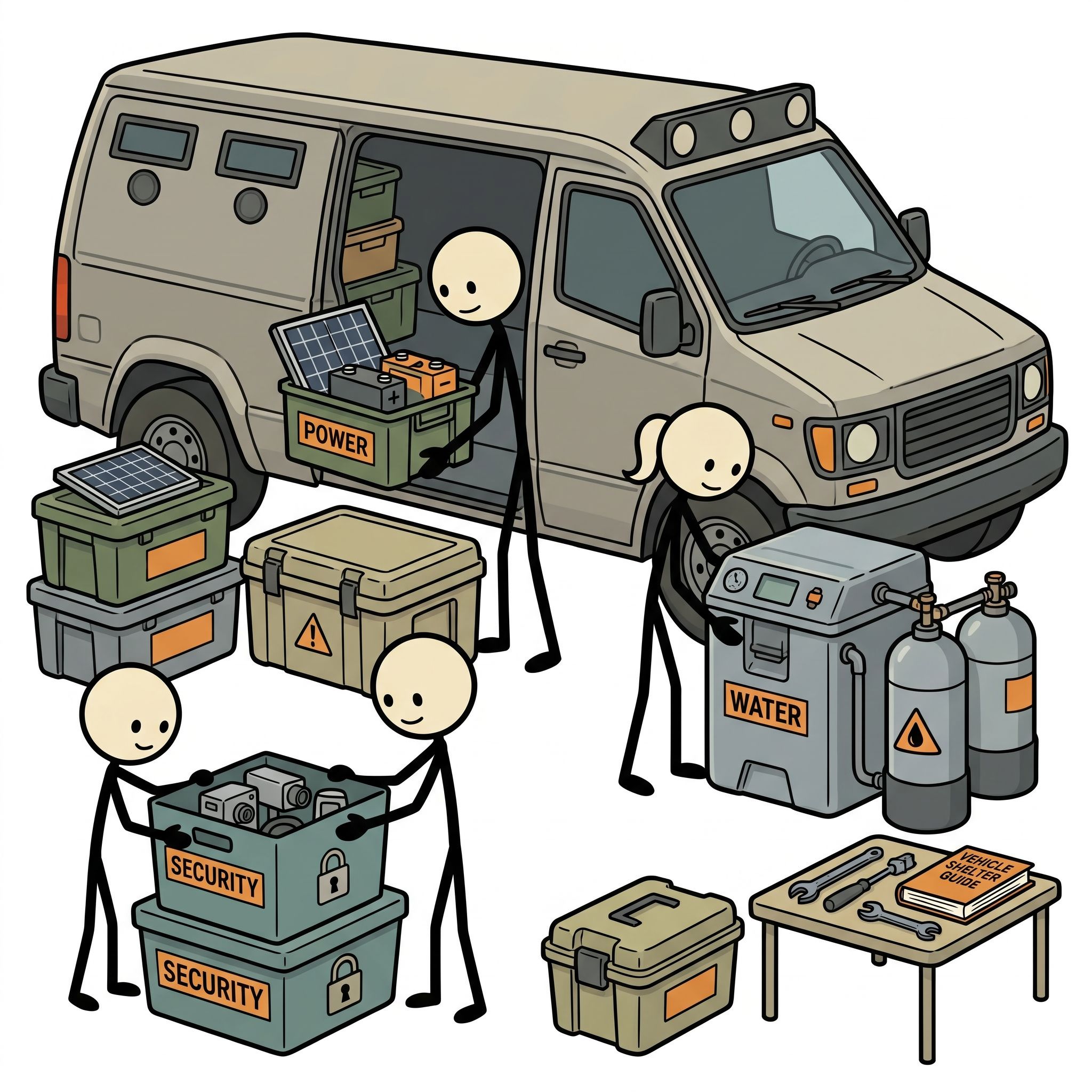
An autonomous mobile shelter requires a reliable, independent electrical system to run medical equipment, communications gear, water pumps, refrigeration, and climate control systems. To achieve true off-grid vehicle setup resilience, you must build a system characterized by multiple redundant charging inputs and robust battery chemistry.
1. Battery Chemistry: Why LiFePO4 Reigns Supreme
Traditional lead-acid or Absorbent Glass Mat (AGM) batteries are no longer viable options for serious emergency vehicle preparedness. Lithium Iron Phosphate (LiFePO4) batteries have revolutionized off-grid power systems due to several distinct engineering advantages:
- Depth of Discharge (DoD): AGM batteries can only be discharged to 50% of their capacity without suffering permanent damage. LiFePO4 batteries can be safely discharged to 90% to 100%, effectively doubling your usable power for the same rated capacity.
- Cycle Life: While a high-quality AGM battery might last for 300 to 500 cycles, LiFePO4 batteries routinely deliver 3,000 to 5,000 cycles before their capacity drops to 80% of its original rating. This translates to over a decade of daily use.
- Weight Savings: Lithium batteries weigh approximately half as much as equivalent lead-acid batteries, preserving precious vehicle payload capacity for water and fuel storage.
For a long-term grid-down survival van, a minimum battery capacity of 300 Amp-hours (Ah) at 12 Volts (or 3.6 Kilowatt-hours) is recommended. This capacity is sufficient to run a high-efficiency 12V compressor refrigerator, interior LED lighting, water pumps, ventilation fans, and personal electronics for three to five days without any solar or alternator input.
2. Solar Integration: Monocrystalline Arrays and MPPT Controllers
Solar power is your primary passive charging source during a long-term grid-down event. To maximize efficiency, utilize high-efficiency monocrystalline solar panels mounted securely to the vehicle's roof. A minimum of 400 watts of solar capacity is ideal for a 300Ah battery bank.
Never skimp on the solar charge controller. Always select a Maximum Power Point Tracking (MPPT) controller rather than a cheaper Pulse Width Modulation (PWM) controller. MPPT controllers constantly monitor the voltage and current output of your panels, adjusting the electrical input to match the battery bank's requirements. This technology is up to 30% more efficient than PWM systems, which is critical when harvesting limited sunlight during overcast winter days or when parked under partial tree cover.
3. Alternator Charging: DC-to-DC Chargers
Your vehicle's engine alternator is a highly reliable backup generator. However, you cannot safely connect a lithium battery bank directly to a modern vehicle alternator. Lithium batteries have incredibly low internal resistance and will pull as much current as possible from the alternator, which can overheat and destroy the alternator's internal components.
To prevent this, install a dedicated DC-to-DC battery charger (such as a Renogy or Victron Energy unit). This device acts as a smart gateway, regulating the current pulled from the vehicle's starting battery and alternator, and converting it into the precise multi-stage charging profile required by your LiFePO4 house batteries. This setup allows you to rapidly charge your house battery bank simply by idling or driving the vehicle.
Water Security: Harvesting, Filtration, and Storage
According to the Centers for Disease Control and Prevention (CDC), clean water is the single most critical factor in maintaining human health during a disaster. While FEMA recommends a bare minimum of one gallon of water per person per day for drinking and sanitation, a mobile survival shelter requires a more realistic allocation of 2.5 to 3 gallons per person per day to support long-term cooking, hygiene, and basic climate management.
1. Storage Infrastructure: Placement and Material
To maintain vehicle stability, water tanks must be mounted as low as possible on the chassis to keep the center of gravity low. Heavy-duty, food-grade, BPA-free linear low-density polyethylene (LLDPE) tanks are the industry standard.
For cold-weather operations, water storage presents a significant engineering challenge: freezing. A frozen water tank not only cuts off your Water Calculator but can also rupture the tank and piping. If you plan to operate in northern climates, your primary fresh water tank should be mounted inside the insulated envelope of the vehicle, rather than underslung beneath the chassis. For external tanks, you must install 12V heating pads controlled by automated thermostats to prevent freezing when temperatures drop below 32°F (0°C).
2. Multi-Stage Physical Filtration
To survive long-term grid-down scenarios, your vehicle must be capable of safely harvesting water from natural sources like rivers, lakes, and springs, or municipal sources of questionable quality. This requires an onboard, pressurized, multi-stage filtration system powered by a reliable 12V diaphragm pump (such as a Shurflo or Seaflo pump rated at 3.0 gallons per minute).
| Filtration Stage | Micron Rating / Type | Primary Targets Removed | Maintenance Interval |
|---|---|---|---|
| Stage 1: Sediment Filter | 50-Micron Spin-Down | Sand, silt, rust, and large suspended solids | Flush weekly or as needed |
| Stage 2: Carbon Block | 0.5-Micron Active Carbon | Chlorine, heavy metals, volatile organic compounds (VOCs), bad taste, and odor | Replace every 1,000 gallons |
| Stage 3: Ultrafiltration | 0.1-Micron Hollow Fiber | Bacteria (E. coli, Salmonella), protozoa (Giardia, Cryptosporidium) | Backflush monthly |
| Stage 4: UV-C Sterilization | LED Ultraviolet Clarifier | Viruses (Hepatitis A, Rotavirus, Norovirus) by disrupting cellular DNA | 10,000-hour operational life |
This comprehensive filtration array ensures that regardless of the raw water source, the output flowing from your vehicle's tap meets or exceeds CDC and Environmental Protection Agency (EPA) drinking water standards. By utilizing high-efficiency UV-C LED sterilizers instead of traditional mercury vapor bulbs, you minimize power consumption, as the LED units only draw power when water is actively flowing through the tap.
Thermal Management: Surviving Extreme Climates
Exposure to extreme heat or cold is one of the fastest ways to compromise human survival. The CDC reports that exposure to environmental cold causes over 1,000 deaths annually in the United States, while extreme heat claims even more lives. A standard sheet-metal vehicle is essentially a thermal conductor—acting as an oven in the summer sun and a freezer in the winter wind. Proper climate control is a fundamental pillar of any viable van life emergency prep strategy.
1. High-R-Value Insulation and Vapor Barriers
Insulation is your first line of defense. Standard fiberglass insulation should never be used in a vehicle; vehicle vibrations will cause it to settle over time, and it easily traps moisture, leading to rust and toxic mold growth. Instead, use hydrophobic insulation materials such as 3M Thinsulate (SM600L) or expanded cork insulation.
When insulating, pay meticulous attention to thermal bridging. Metal ribs and chassis pillars conduct heat directly from the outside environment. Cover these metal surfaces with a thin layer of closed-cell foam tape before installing your wall panels. Additionally, construct custom-fit insulated window covers using Low-E reflective materials (like Reflectix) sandwiched between durable canvas layers. Windows are the primary source of thermal loss in any vehicle; covering them can reduce your heating and cooling loads by up to 50%.
2. Active Heating: Diesel and Propane Parking Heaters
For cold-weather survival, a dry-burning forced-air diesel heater (often referred to as a parking heater) is the gold standard for off-grid vehicle setup designs. These heaters run directly on diesel fuel from your vehicle's main tank (or a dedicated auxiliary tank) and draw a minuscule amount of 12V electrical power (typically 10 to 40 watts) to run the fuel pump and internal fan.
Unlike buddy-style propane heaters, which vent moisture and toxic combustion gases directly into the living space, parking heaters utilize a sealed combustion chamber. Fresh air is drawn from outside, heated through an aluminum heat exchanger, and blown into the cabin as bone-dry air, while all combustion exhaust is vented safely outside through the vehicle's floor. This dry heat is essential for preventing interior condensation, which can ruin electronics and compromise insulation. For safety, always install a dual carbon monoxide (CO) and explosive gas detector, as recommended by the Consumer Product Safety Commission (CPSC).
3. High-Efficiency 12V Cooling Systems
Cooling a vehicle in extreme heat without a grid connection is one of the most power-intensive challenges in emergency preparedness. Traditional rooftop air conditioners run on 120V AC power and require massive, noisy generators or enormous lithium battery banks to operate.
The modern solution is a variable-speed 12V or 24V DC compressor air conditioner (such as those made by Nomadic Cooling or Mabru Power Systems). These units run directly off your house battery bank without the efficiency losses of a power inverter. When combined with a high-volume ceiling exhaust fan (like a MaxxFan Deluxe) to pull hot air out of the vehicle, a 12V air conditioner can keep the interior temperature at safe, livable levels during extreme heat events while operating within the power budget of a modest solar array.
Hardening the Mobile Shelter: Security and Communication
In a long-term grid-down scenario, maintaining situational awareness and protecting your mobile shelter from external threats are paramount. If you cannot secure your vehicle or communicate with the outside world, your physical survival is in constant jeopardy.
1. Physical Security and Stealth Hardening
Your security strategy should focus on prevention, deterrence, and delay. The goal is to make your vehicle a difficult and unappealing target.
- Security Window Films: Apply heavy-duty 8-mil or 12-mil shatterproof security film to all glass surfaces. This film prevents the glass from shattering upon impact, delaying entry from smash-and-grab attempts and giving you valuable time to start the vehicle and escape.
- Interior Partition Doors: In a cargo van or SUV, install a solid, lockable bulkhead door separating the driver’s cabin from the rear living quarters. If an intruder breaches the front windows, they are still blocked from entering your primary living and storage area.
- Deadbolts and Puck Locks: Install high-security commercial deadbolts or external "puck" locks on the sliding and rear doors. Standard factory door locks can be easily bypassed by experienced thieves using specialized lock-picking tools or electronic signal grabbers.
2. Off-Grid Communication Systems
During major disasters, local cellular towers are frequently knocked offline due to physical damage or power loss, as documented by the Federal Communications Commission (FCC) during major hurricanes. To maintain situational awareness and coordinate with family members, your vehicle must feature multiple layers of off-grid communication gear:
For localized, line-of-sight communications, install a General Mobile Radio Service (GMRS) or Amateur (HAM) radio system. A permanently mounted 25-watt GMRS radio with an external, roof-mounted antenna will provide vastly superior range compared to handheld walkie-talkies, allowing you to communicate across terrain obstacles and monitor local emergency channels.
For long-distance, global communication, integrate a mobile satellite terminal such as Starlink. Modern flat high-performance Starlink dishes can be mounted flat on your vehicle's roof and modified to run directly off 12V DC power. This system grants you high-speed internet access anywhere on earth, enabling you to monitor real-time weather updates from the National Weather Service (NWS), access critical medical databases, and coordinate rescue efforts even when local terrestrial infrastructure is completely destroyed.
3. Perimeter Monitoring and Situational Awareness
You cannot defend what you cannot see. Standard blind spots in large vehicles can be dangerous in crowded or hostile environments. Install a 360-degree, low-light security camera system connected to a dedicated, low-power LCD monitor inside your living space. This setup allows you to monitor the entire perimeter of your vehicle at night without opening windows, turning on external lights, or revealing your presence inside the vehicle.
Essential Bug Out Vehicle Gear and Maintenance Protocols
The most advanced power, water, and security systems are useless if your vehicle suffers a mechanical failure that leaves you stranded. True emergency vehicle preparedness requires a robust suite of recovery gear and a strict preventative maintenance protocol.
Your vehicle should be equipped with a dedicated off-road recovery kit. This kit must include high-quality traction boards (such as Maxtrax), a heavy-duty kinetic recovery rope, a rated tow strap, shackles, and a reliable vehicle recovery jack. If you expect to navigate remote or debris-filled routes, a front-mounted electric winch rated for at least 1.5 times the gross vehicle weight of your fully loaded vehicle is an indispensable tool for self-recovery.
Furthermore, maintain a comprehensive onboard tool kit and a stock of critical spare parts. This inventory should include:
- Spare engine belts, radiator hoses, and fuses of all ratings.
- An onboard 12V air compressor (such as an ARB dual compressor) to adjust tire pressures for traction in mud, sand, or snow, and to inflate repaired tires.
- A heavy-duty tire plug kit and a reliable spare tire matching the exact outer diameter of your running tires.
- Essential fluids: engine oil, transmission fluid, brake fluid, and coolant.
Regularly test your systems under non-emergency conditions. Turn on your solar chargers,
Frequently Asked Questions
How much water should I store in a van for an extended grid-down scenario?
Store at least one gallon of water per person per day for drinking and sanitation. For extended grid-down living, aim for a minimum of a 14-day supply per person, supplemented by high-quality gravity water filters or purification tablets.
What is the most reliable off-grid power setup for a survival vehicle?
A system combining 300W+ of solar panels, a 200Ah+ Lithium Iron Phosphate (LiFePO4) battery bank, a DC-to-DC charger to charge from the alternator while driving, and a pure sine wave inverter is ideal.
How should I handle sanitation and waste management in a grid-down vehicle?
Utilize a waterless composting toilet or a heavy-duty dry-bag toilet system. Keep an emergency supply of heavy-duty contractor bags, kitty litter or sawdust for liquid absorption, and liquid disinfectant.
What are the best climate control options for a van during a power grid failure?
For heat, use a diesel parking heater or a vented propane heater. For cooling, rely on 12V roof ventilation fans, high-R-value insulation, and custom-fit reflective window covers to block solar heat.
What recovery gear and spare parts are essential for a survival van?
Always carry a full-sized spare tire, a heavy-duty bottle jack, traction boards, a tow strap, a portable 12V air compressor, a jump starter pack, extra vehicle fluids, and a basic mechanical tool kit.