⚡ Key Facts
- Pore Size Discrepancy: Most standard portable survival filters have a pore size of 0.1 to 0.2 microns, whereas human viruses range from 0.02 to 0.1 microns, allowing them to pass directly through mechanical filtration. For the practical checklist side, use the community emergency preparedness guide.
- Chemical Vulnerability: Standard hollow-fiber membrane filters do not remove dissolved chemicals, heavy metals, pesticides, or radionuclides from water. For the practical checklist side, use the neighborhood preparedness network.
- CDC Boiling Standard: According to the Centers for Disease Control and Prevention (CDC), bringing water to a rolling boil for 1 minute (3 minutes at altitudes above 6,500 feet) kills all bacteria, protozoa, and viruses. For the practical checklist side, use the emergency communication plan.
- The Concentration Danger: Boiling water does not remove chemical contaminants or heavy metals; in fact, it concentrates them by evaporating pure water and leaving the toxins behind.
- EPA Guidelines: The Environmental Protection Agency (EPA) classifies water purifiers differently than water filters, requiring purifiers to meet strict standards for virus removal (99.99%).
Imagine the aftermath of a severe category-4 hurricane or a catastrophic municipal grid failure. The taps run dry, floodwaters submerge local infrastructure, and you are forced to rely on your emergency preparedness kit. You pull out a highly rated, point-of-use portable water filter—the kind marketed to backpackers and survivalists alike. You pump water from a nearby flooded street or stagnant pool, watch it run clear into your bottle, and take a deep drink, confident that modern technology has shielded you from harm. Hours later, you are incapacitated by severe cramping, vomiting, and dehydrating diarrhea. What went wrong? You fell victim to one of the most widespread and dangerous assumptions in the survival community: the belief that a portable water filter makes any water source safe to drink. In reality, relying blindly on mechanical filters in a complex emergency scenario can be a fatal mistake.
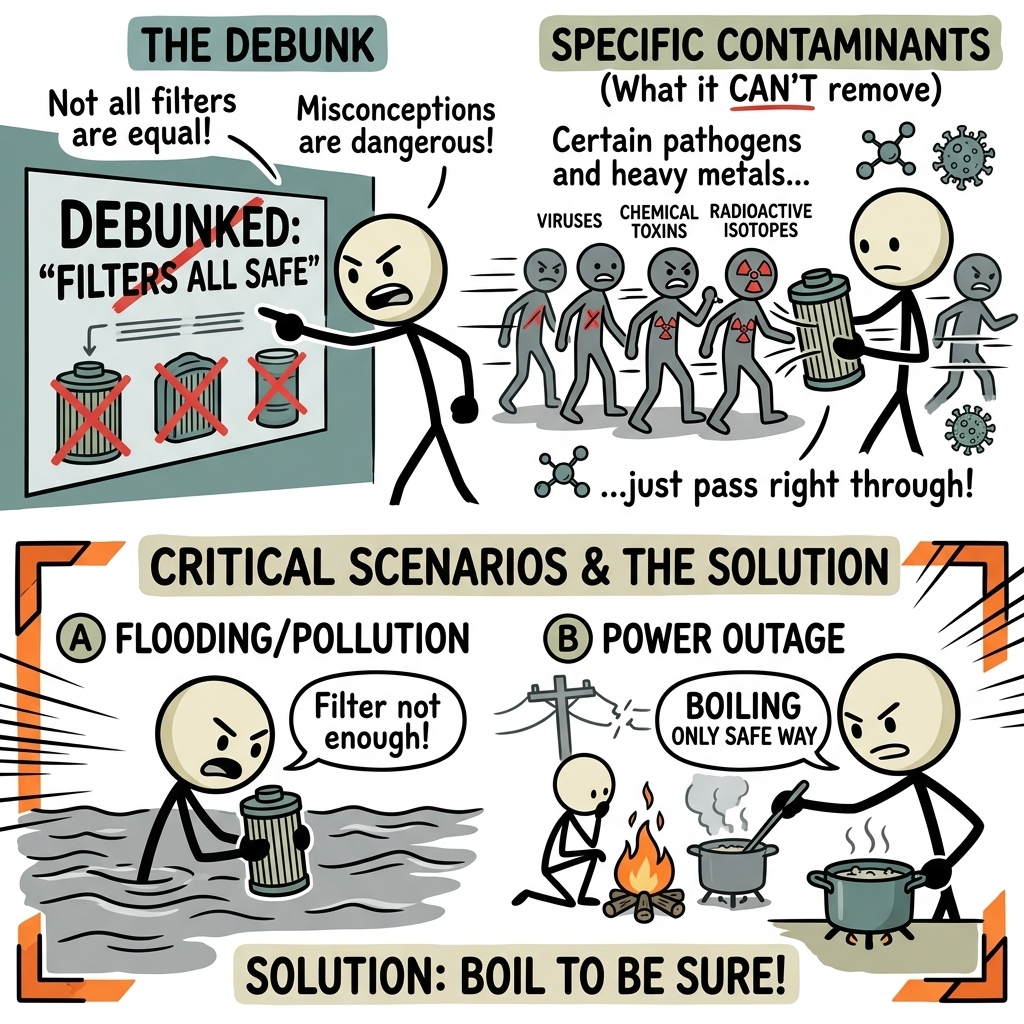
The Danger of Blind Trust: Debunking Common Water Filter Myths
In the emergency preparedness space, misinformation can spread faster than waterborne pathogens. The market is saturated with sleek marketing campaigns showcasing hikers drinking from muddy puddles using pocket-sized straw filters. While these devices are marvels of modern engineering, they are designed for specific, controlled environments—primarily pristine backcountry settings where the primary biological threats are relatively large protozoan parasites and bacteria. When these devices are imported into urban disaster zones, industrial areas, or agricultural floodways, their engineering limits are quickly overwhelmed.
Myth 1: "If the Water is Clear, It is Safe to Drink"
This is perhaps the most insidious of all water filter myths. Turbidity—the cloudiness or haziness of a fluid caused by individual particles—is an aesthetic measure, not a safety metric. A standard hollow-fiber membrane filter is exceptional at removing suspended solids, silt, and clay, resulting in crystal-clear water. However, the most lethal threats to human health are completely invisible to the naked eye and exist at a molecular or sub-micron level. Clear water can still be teeming with pathogenic viruses, dissolved heavy metals like lead and arsenic, agricultural pesticides, and volatile organic compounds (VOCs). Mechanical filtration alters the appearance of the water, but it does not guarantee its biological or chemical safety.
Myth 2: "Backcountry Filters are Built for Urban Disasters"
Outdoor recreation filters are designed with the assumption that the source water is contaminated primarily by wildlife feces. The target pathogens in these scenarios are protozoan cysts like Giardia duodenalis and Cryptosporidium parvum, alongside common wilderness bacteria like Escherichia coli (E. coli) and Salmonella. These organisms are relatively large. However, urban disaster environments present a fundamentally different contamination profile. When municipal sewage systems fail, floodwaters mix with human waste, introducing human-specific enteric viruses. Furthermore, urban runoff carries industrial solvents, petroleum products, heavy metals from roadways, and lawn chemicals. Backcountry filters are simply not engineered to address this toxic cocktail, exposing users to severe survival water filter limitations.
Myth 3: "All Portable Filters Remove Viruses"
Many consumers confuse the terms "water filter" and "water purifier." Under EPA guidelines, a device designated as a water filter only needs to remove bacteria and protozoa. To be classified as a water purifier, a device must be capable of removing or inactivating viruses to a level of 99.99% (a 4-log reduction). The vast majority of popular, affordable portable filters on the market are microfilters, not ultrafilters or purifiers. They lack the physical capability to trap viral particles due to the physics of pore size, leaving users completely unprotected against viral threats like Hepatitis A, Norovirus, and Rotavirus.
What Do Water Filters NOT Remove?
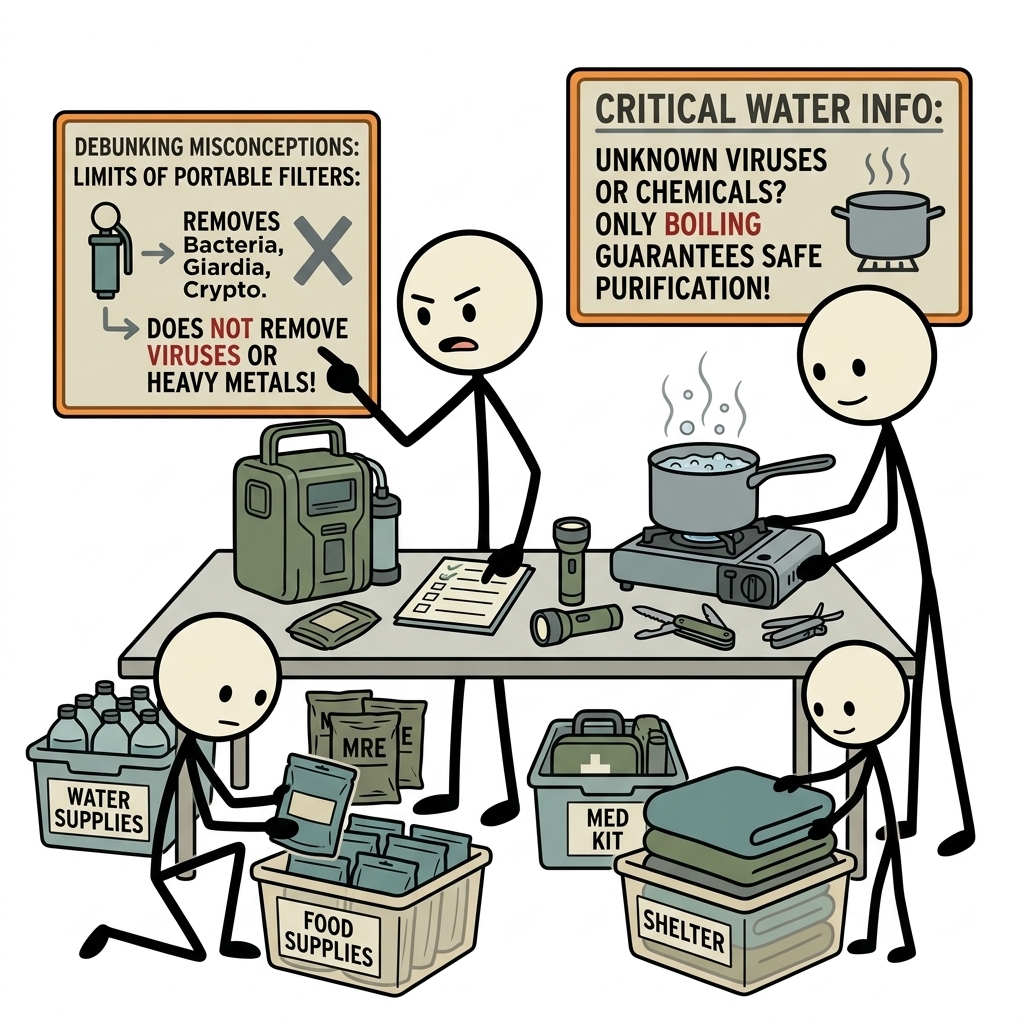
To understand the limitations of your emergency gear, you must understand the scale of the microscopic world. Mechanical filtration relies on size exclusion: water is forced through tiny pores, and any particle larger than the pore is trapped, while water molecules and smaller substances pass through. When asking what do water filters not remove, we must analyze the physical and chemical limits of these systems.
| Contaminant Class | Average Size / State | Standard 0.1-Micron Filter Capability | Primary Health Threat |
|---|---|---|---|
| Protozoa (Giardia, Crypto) | 1.0 to 15.0 microns | Highly Effective (99.999%) | Severe diarrhea, abdominal cramps |
| Bacteria (E. coli, Cholera) | 0.2 to 2.0 microns | Highly Effective (99.999%) | Dysentery, typhoid, severe dehydration |
| Viruses (Norovirus, Hep A) | 0.02 to 0.08 microns | Ineffective (Passes through) | Hepatitis, acute gastroenteritis |
| Heavy Metals (Lead, Mercury) | Atomic scale (dissolved) | Ineffective | Neurological damage, organ failure |
| Pesticides & Herbicides | Molecular scale (dissolved) | Ineffective | Endocrine disruption, carcinogenicity |
1. Pathogenic Viruses
Viruses are the smallest known infectious agents in water systems. While a bacterium like E. coli is roughly 0.5 to 2.0 microns in length, a rotavirus particle is only about 0.07 microns, and a poliovirus particle is a mere 0.03 microns. Because the standard pore size of a high-quality portable filter (such as hollow-fiber membrane models) is 0.1 microns, these viral pathogens pass through the filter completely unimpeded, like sand falling through a chain-link fence. In areas with high human population density, broken sewer lines, or active flooding, the viral load in surface water rises exponentially, rendering standard microfiltration highly dangerous.
2. Dissolved Chemical Contaminants and Industrial Runoff
Chemical pollutants exist as dissolved solutes in water, meaning they are broken down at the molecular level and integrated into the liquid itself. This category includes volatile organic compounds (VOCs), industrial solvents, petroleum derivatives, and pharmaceuticals. Mechanical filters have absolutely no effect on these dissolved molecules. Even filters equipped with basic activated carbon cores have a very limited capacity to adsorb these chemicals; they quickly become saturated and lose effectiveness when exposed to highly turbid or heavily contaminated disaster runoff. Exposure to these chemicals can cause acute poisoning, chemical burns to the digestive tract, or long-term systemic toxicity.
3. Heavy Metals and Metalloids
Heavy metals such as lead, mercury, cadmium, chromium, and arsenic are common in industrial areas and can easily leach into groundwater during floods or infrastructure collapses. Like dissolved chemicals, heavy metals exist as ions or small molecules in solution. Standard mechanical filtration cannot block them. Long-term ingestion of heavy metals leads to chronic bioaccumulation, causing neurological disorders, kidney damage, and developmental delays. In an acute survival situation, drinking water contaminated with high concentrations of industrial metals can cause rapid, debilitating systemic illness.
4. Agricultural Nitrate and Pesticide Runoff
In rural and suburban areas, agricultural runoff is a massive threat to water quality. Fertilizers contain high levels of nitrates, which are highly soluble in water and cannot be filtered out by mechanical means. High nitrate levels are particularly lethal to infants, causing "blue baby syndrome" (methemoglobinemia), which impairs the blood's ability to carry oxygen. Similarly, pesticides, herbicides (such as glyphosate), and fungicides bypass standard survival filters effortlessly. According to the United States Geological Survey (USGS), pesticides are widespread in streams and groundwater across the country, and their concentration spikes dramatically during storm and flood events.
Boiling Water vs. Filtering: The Science of Thermal Sterilization
When biological safety is the primary concern, the age-old method of boiling remains the gold standard of water treatment. However, to utilize this tool effectively in an emergency, one must understand the underlying science of boiling water vs filtering and how thermal energy interacts with living organisms.
How Thermal Sterilization Works
Unlike filtration, which attempts to physically separate pathogens from water, boiling relies on thermal denaturation. Microorganisms are composed of complex proteins, enzymes, and nucleic acids (DNA or RNA) that dictate their structure and function. When subjected to high temperatures, these delicate molecular structures are permanently disrupted—a process known as denaturing. Once these proteins are denatured, the pathogen is rendered inactive and cannot replicate or infect a host. It is important to note that boiling does not need to physically "destroy" or vaporize the pathogen; it simply needs to render it biologically dead and harmless to the human digestive system.
The CDC and FEMA Protocols for Boiling
To guarantee complete biological sterilization, emergency preparedness agencies have established strict guidelines. The CDC, FEMA, and the EPA recommend bringing water to a rolling boil for at least one continuous minute. At this temperature (212°F or 100°C at sea level), all waterborne pathogens—including the highly heat-resistant protozoan cysts of Cryptosporidium, vegetative bacteria, and enteric viruses—are instantly inactivated.
However, altitude plays a critical role in this equation. As elevation increases, atmospheric pressure decreases, which in turn lowers the boiling point of water. For instance, at 10,000 feet above sea level, water boils at approximately 193°F (89.4°C). Because the temperature of the boiling water is lower at high elevations, pathogens must be exposed to the heat for a longer duration to guarantee denaturation. Therefore, the CDC advises that at altitudes above 6,500 feet (2,000 meters), water must be kept at a continuous rolling boil for at least three minutes.
The Critical Limitation of Boiling
While boiling is the ultimate defense against biological threats, it has a major vulnerability: it is completely ineffective against chemical contamination, heavy metals, and physical debris. In fact, boiling chemically contaminated water can make it significantly more toxic. As water boils, pure water vaporizes into steam and escapes into the air, reducing the overall volume of liquid in the vessel. However, heavy metals, salts, and non-volatile chemicals do not evaporate; instead, they remain in the pot. This process concentrates the toxic substances, making each remaining sip of water more hazardous than it was before boiling. Therefore, boiling must never be used as the sole purification method if the water source is suspected of containing chemical or industrial pollutants.
Critical Scenarios Where Boiling is Mandatory
In a Survival Scenarios, situational awareness is your greatest asset. You must be able to assess your environment and immediately recognize when your portable mechanical filter is insufficient, requiring you to transition to thermal sterilization or chemical disinfection. Below are three critical scenarios where boiling is non-negotiable for emergency water purification.
Scenario A: Municipal "Boil Water Advisories" and Grid Collapse
When a municipal water treatment plant loses power, experiences a water main break, or is inundated by floodwaters, pressure in the distribution system drops. This loss of pressure creates a vacuum, drawing surrounding groundwater, soil, and untreated sewage into the clean water pipes through small cracks and joints. Municipalities issue "Boil Water Advisories" because they cannot guarantee the biological safety of the tap water.
In these situations, standard gravity-fed countertop filters or pitcher filters (which rely on simple carbon and basic sediment membranes) are entirely inadequate. They are designed to improve taste and remove chlorine, not to sterilize water contaminated with raw sewage. If you are under a boil water advisory due to system contamination or a complete grid collapse, you must boil all water intended for drinking, cooking, and oral hygiene, or utilize an EPA-certified purifier.
Scenario B: Active Flooding and Inundated Infrastructure
Flooding is the most common and destructive natural disaster worldwide. When rivers breach their banks or heavy rains overwhelm storm drainage networks, the resulting floodwaters are highly toxic. They sweep across agricultural fields, industrial parks, gas stations, and residential septic fields. This water carries a lethal mix of human and animal feces, industrial chemicals, petroleum, and fertilizers.
If your only available water source is floodwater or a shallow well that has been submerged by floodwaters, a standard backpacking filter is a hazard. The high concentration of human fecal matter guarantees the presence of enteric viruses, which will slip through a standard 0.1-micron filter. In this scenario, you must implement a multi-stage purification protocol: first, filter the water to remove sediment and debris, and then boil it to destroy the viral load.
Scenario C: High-Density Human Activity and Poor Sanitation Zones
If you find yourself in an emergency shelter, a refugee camp, or an urban area where large numbers of people are displaced without functioning sanitation infrastructure, the risk of viral outbreaks surges. Diseases like Cholera (bacterial) and Hepatitis A or Norovirus (viral) spread rapidly through the fecal-oral route when sanitation breaks down.
In these high-risk zones, surface water, shallow groundwater, and even communal water distribution points can become contaminated with human-specific viruses. Because animal-focused backpacking filters do not protect against human viruses, you cannot trust them in areas of high human density. Every drop of water harvested in these environments must be boiled or chemically treated with chlorine or chlorine dioxide after mechanical filtration.
Designing a Fail-Safe Multi-Stage Purification Protocol
To truly secure your Water Calculator during an emergency, you should move away from the concept of a "single-source solution." No single portable device can safely convert highly contaminated disaster runoff into pure drinking water in a single step. Instead, military and disaster relief agencies utilize a multi-stage purification protocol designed to address physical, biological, and chemical threats sequentially.
Step 1: Coarse Filtration and Settling (Pre-Treatment)
Raw, highly turbid water will quickly clog the microscopic pores of your survival filter, rendering it useless after processing only a few gallons. To prevent this, you must first remove large suspended solids, mud, and organic matter.
- Settling: Pour the raw water into a large container and let it sit undisturbed for 2 to 12 hours. Gravity will pull heavy sediment to the bottom. Carefully siphon or pour the clear water off the top into a clean vessel.
- Coarse Filtration: Pass the water through a clean bandanna, coffee filter, or a specialized sediment pre-filter to catch remaining suspended particles. This step dramatically extends the lifespan of your primary filter.
Step 2: Microfiltration (Biological Removal - Stage 1)
Once the water is clear of heavy sediment, pass it through your high-quality portable microfilter (such as a 0.1-micron hollow-fiber membrane filter). This step physically removes 99.999% of all bacteria (E. coli, Salmonella, Cholera) and protozoan parasites (Giardia, Cryptosporidium). By removing these larger organisms mechanically, you reduce the biological load on subsequent sterilization steps, making them far more effective.
Step 3: Thermal Sterilization or Chemical Disinfection (Biological Removal - Stage 2)
Now that the water is physically clear and free of bacteria and protozoa, you must eliminate the remaining viral threat.
- Boiling: Bring the pre-filtered water to a rolling boil for 1 minute (3 minutes above 6,500 feet). This is the preferred method as it requires no chemical additives and is 100% effective against all viral strains.
- Chemical Treatment: If fuel is scarce and boiling is not an option, treat the filtered water with an EPA-approved chemical disinfectant, such as chlorine dioxide tablets or liquid sodium hypochlorite (unscented household bleach). Because the water was pre-filtered in Step 2, the chemicals do not have to fight organic debris and can target viruses with maximum efficiency. Follow the manufacturer's instructions or CDC guidelines (typically 8 drops of 6% bleach per gallon of clear water, leaving it to stand for 30 minutes).
Step 4: Adsorption (Chemical and Taste Conditioning)
If you suspect the water contains dissolved chemicals, heavy metals, or pesticide runoff, the final step is to pass the sterilized water through a high-quality activated carbon filter. Activated carbon utilizes chemical adsorption to attract and lock dissolved organic compounds, chlorine, pesticides, and certain heavy metals into its porous structure. This stage also removes any unpleasant tastes or odors caused by chemical treatments or biological decay, leaving you with safe, palatable, and truly purified water.
The Preparedness Mindset: Knowledge is Your Ultimate Filter
In a survival situation, your gear is only as effective as your understanding of its engineering limits. Believing that a pocket-sized backpacking filter can safely transform chemical-laden floodwaters or virus-ridden urban runoff into pristine drinking water is a dangerous misconception that can lead to severe illness when medical help is unavailable. True self-reliance requires looking past marketing claims and embracing the hard science of water purification. By understanding what your mechanical filters can and cannot remove, recognizing the critical scenarios where boiling is the only safe path to sterilization, and implementing a rigorous multi-stage purification protocol, you protect yourself and your family from the invisible threats that emerge when the grid goes dark. Equip your kit with high-quality filters, but back them up with the knowledge, fuel, and tools required to boil and disinfect your water. In the realm of survival, a well-informed mind is the ultimate filter.
Frequently Asked Questions
Do standard portable water filters remove viruses?
No. Most standard outdoor microfilters only remove bacteria and protozoa (like Giardia and Cryptosporidium). They do not remove viruses because viruses are too small; you need a certified water purifier, chemical treatment, or boiling to eliminate them.
Does boiling water remove chemical contaminants or heavy metals?
No. Boiling only kills biological pathogens like bacteria, viruses, and parasites. It does not remove chemicals, heavy metals, or salt, and can actually concentrate these contaminants as water evaporates.
When is boiling water safer than filtering it?
Boiling is safer when you suspect viral contamination—common after flooding, sewage overflows, or in areas with poor sanitation—and you only have a standard microfilter rather than a virus-rated purifier.
How long do I need to boil water to make it safe to drink?
Bring the water to a rolling boil for at least 1 minute. At elevations above 6,500 feet (2,000 meters), you must boil the water for a full 3 minutes.
Can activated carbon filters make chemically poisoned water safe?
No. While activated carbon improves taste and reduces some organic compounds, it cannot reliably remove high concentrations of industrial chemicals, heavy metals, or radiological hazards in an emergency scenario.