⚡ Key Facts
- Massive Financial Impact: According to the Insurance Information Institute (III), water damage and freezing account for roughly 24% of all homeowner insurance claims, with the average claim exceeding $12,500.
- Critical Threshold: Research conducted by the Insurance Institute for Business & Home Safety (IBHS) demonstrates that uninsulated pipes face severe rupture risk when outdoor temperatures plummet to 20°F (-6°C) or lower, especially during sustained cold snaps.
- The Wi-Fi Failure Point: During winter weather disasters—such as the 2021 Texas freeze documented by NOAA and FEMA—grid instability, rolling blackouts, and ISP outages render standard cloud-tethered smart sensors completely inoperable right when they are needed most.
- Hydraulic Pressure Dynamics: Pipes do not typically burst at the exact point of freezing; rather, expanding ice creates an enclosed hydraulic pressure chamber downstream between the blockage and a closed faucet, causing structural failure up to several feet away.
- Immediate Flow Volume: A single 1/2-inch ruptured copper or PEX supply line can discharge between 350 and 500 gallons of water per hour at standard residential pressure (40–60 PSI), turning a finished basement into a disaster zone within minutes.
When an unprecedented Arctic blast drops ambient temperatures below freezing, the primary threat to your home isn’t just the cold air outside—it is the pressurized water lines running through your walls, floors, and crawlspaces. During severe winter weather, severe cold frequently coincides with grid disruption, knocking out power, home Wi-Fi networks, and cellular broadband towers. In these high-stress situations, consumer-grade smart home devices tied to remote cloud servers fail silently. Understanding the physics of thermal bridging, implementing a tactical leak detector placement guide, and deploying resilient offline water leak sensors are the operational cornerstones required to prevent burst pipe damage when the municipal infrastructure collapses around you. For the practical checklist side, use the community emergency preparedness guide.
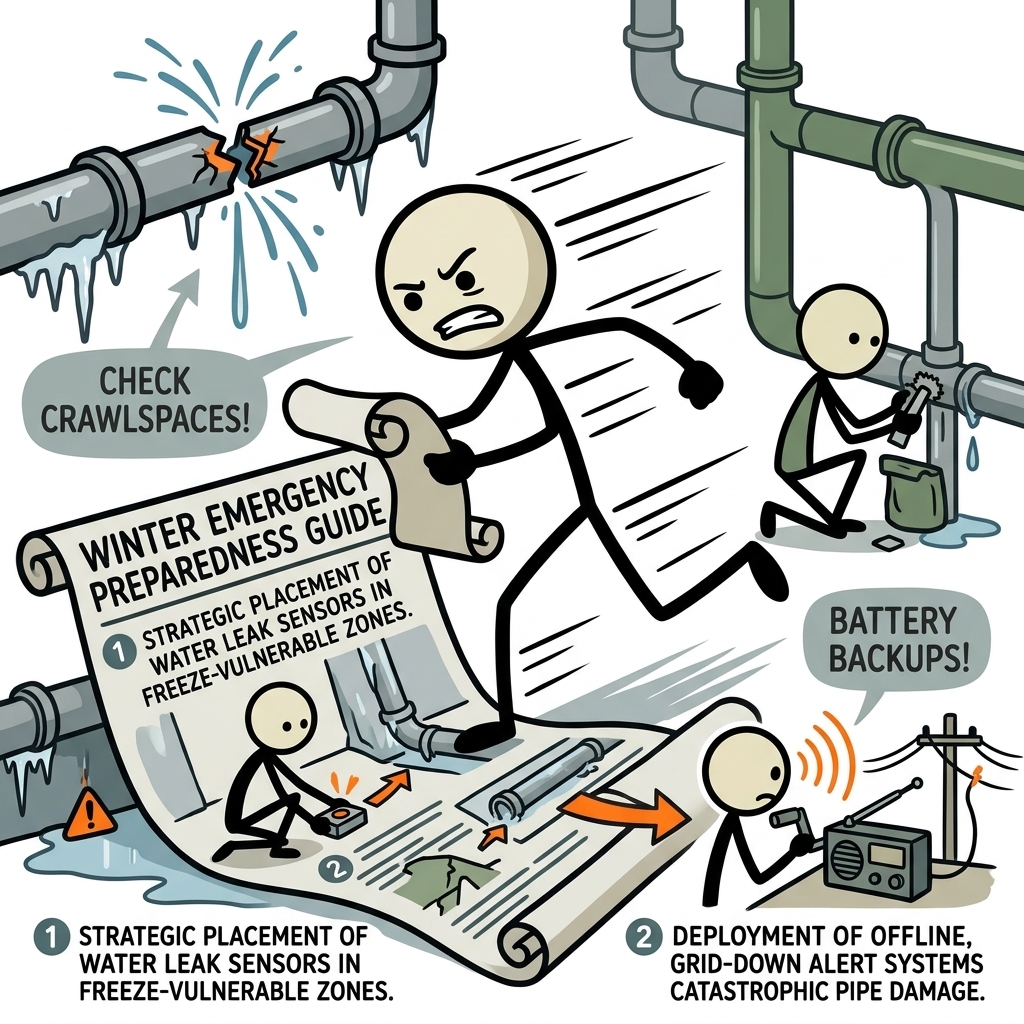
The Thermodynamics of Freeze-Vulnerable Plumbing Zones
To deploy detection hardware effectively, you must understand how and why plumbing infrastructure fails during deep winter freezes. Water possesses the unique physical property of expanding by approximately 9% in volume as it transitions from liquid to solid ice. However, contrary to popular belief, the outward radial expansion of ice inside a pipe is rarely what causes the pipe wall to rupture. For the practical checklist side, use the family emergency planning guide.
Extensive forensic engineering studies by the Building Research Council at the University of Illinois reveal that the true mechanism of pipe failure is hydraulic pressure spike. When an ice plug forms within an exposed pipe segment, it completely occludes the conduit. As the freeze advances along the pipe, it acts like a piston, forcing the remaining liquid water downstream against a closed fixture, pressure-reducing valve, or check valve. Because water is essentially incompressible, the trapped water pressure escalates exponentially—often exceeding 2,000 to 4,000 pounds per square inch (PSI), far beyond the ASTM-rated burst thresholds of standard Schedule 40 PVC, Type L copper, or cross-linked polyethylene (PEX) tubing.
The danger multiplies exponentially during freeze-thaw cycles. In many Survival Scenarioss, the actual rupture occurs while the line is solidly frozen, but the catastrophe remains invisible because the ice plug acts as a temporary stopper. The full-scale flood only unleashes once ambient temperatures rise or secondary heating is restored, melting the ice dam and allowing high-pressure water to escape unchecked through the fractured pipe walls.
Thermal Bridging and Microclimates in Residential Framing
Every home contains architectural vulnerabilities known as thermal bridges—pathways where structural framing components permit heat to bypass insulation layers. Exterior wall cavities, cantilevered floors, roof overhangs, and recessed plumbing runs create microclimates where interior ambient heat fails to penetrate, even when your central thermostat displays a comfortable 70°F (21°C).
Cold outdoor air infiltration dramatically accelerates this process. Data from the Federal Emergency Management Agency (FEMA) underscores that high winds amplify heat loss through tiny structural gaps. A 15-mile-per-hour wind whistling through an unsealed rim joist or dryer vent penetration can drop the local microclimate around a domestic copper water line below 20°F within hours, initiating rapid ice nucleation.
Leak Detector Placement Guide: Strategic Freeze-Vulnerable Zones
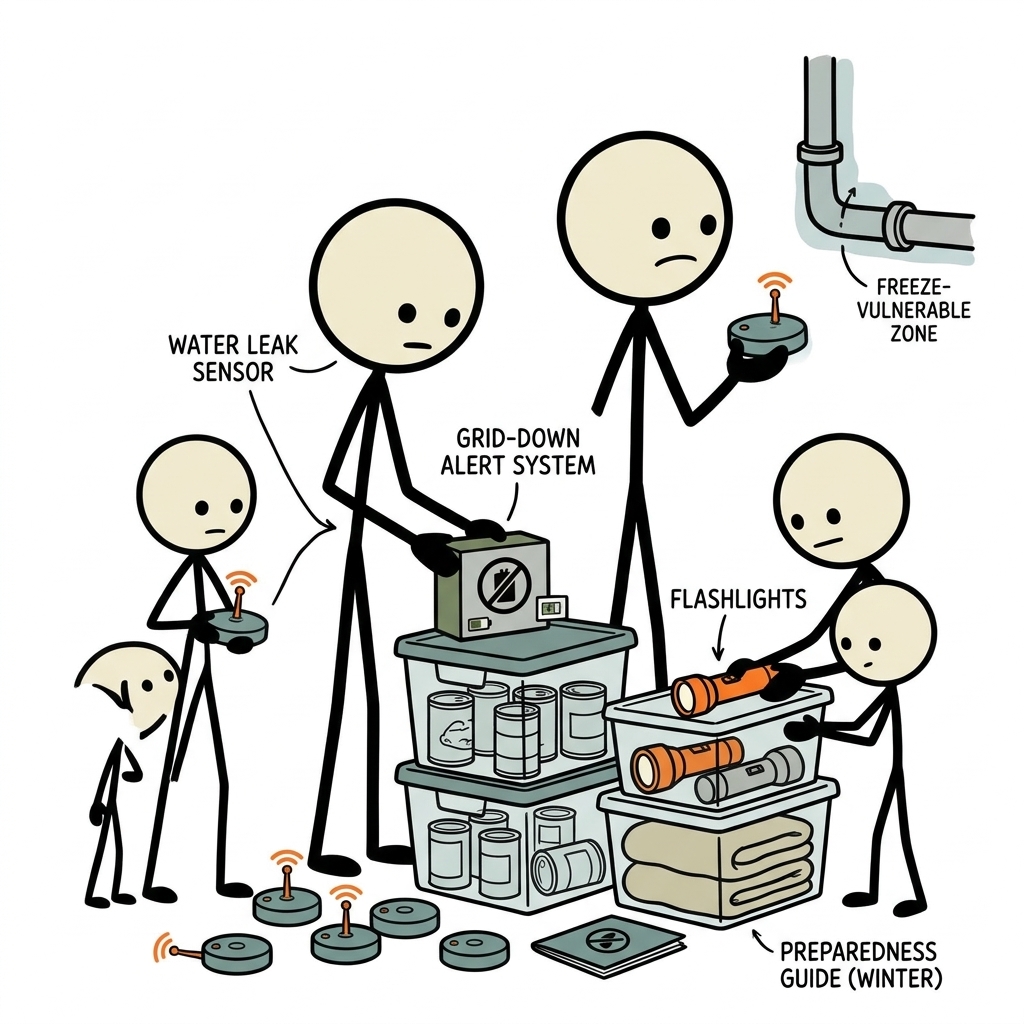
Strategic deployment of winter water leak detectors requires a layered defense model. Placing a solitary sensor next to your water heater is insufficient when the true freeze hazards lurk inside dark interstitial architectural spaces. Use the following tactical placement protocols to secure your plumbing envelope.
1. Crawlspaces, Unconditioned Basements, and Rim Joists
Unconditioned spaces beneath your primary living area are prime failure zones. Cold air pooling, coupled with perimeter foundation venting, exposes foundational supply lines and main risers to sub-freezing temperatures.
- Rim Joist Chases: Position water sensors directly beneath the rim joists where supply lines run parallel to exterior foundations before turning upward into exterior walls.
- Perimeter Foundation Walls: Place probe-based sensors on the floor along the windward foundation perimeter, directly beneath any suspended horizontal supply runs.
- Well Pressure Tanks and Sump Pits: Place surface sensors adjacent to the mechanical pressure tank and check-valve assemblies, which are prone to freezing if crawlspace skirt seals degrade.
2. Exterior-Facing Wall Cavities (Kitchen Sinks and Wet Bars)
Kitchen sinks located along exterior walls are classic failure vectors. Cabinet doors insulate the under-sink cavity from ambient room heat, trapping cold air leaking through wall sheathing.
- Back-Cabinet Flooring: Place sensors on the cabinet floor pushed firmly against the rear backboard, directly beneath the cold and hot shut-off valves (angle stops).
- In-Wall Cavity Probes: For high-risk homes in severe northern zones, route external flat-ribbon or rope sensors directly through access cutouts into the stud cavity where the PEX or copper risers transition through the exterior framing.
3. Attics, Knee Walls, and Unconditioned Interstitial Runs
Plumbing runs routed through attics—such as lines feeding second-story bathrooms, whole-house humidifiers, or modern fire sprinkler systems—face catastrophic exposure. The Red Cross explicitly highlights attic lines as major freeze risks because rising heat from the living envelope is quickly vented by modern attic soffit-and-ridge ventilation systems.
- Attic Floor Below Fixture Risers: Deploy rope-style sensors coiled along the drywall floor plates directly below any plumbing manifold or supply run running through cellulose or fiberglass batts.
- HVAC Condensate Drain Pans: High-efficiency furnace condensate drain lines frequently exit through attic eaves or unheated utility closets. If these freeze, condensate backs up, causing ceiling collapse and electrical shorts.
4. Foundation Penetrations and The Main Meter Vault
The municipal or private well entrance point represents the single highest-consequence failure point on your property. If a rupture occurs upstream of your internal distribution manifold, you are facing an unmetered, maximum-flow event that can flood thousands of gallons into your basement before municipal utility crews can respond.
- Main Shutoff Ingress: Place a dedicated sensor within 6 inches of the primary manual isolation valve where the water service lateral penetrates the foundation wall or concrete slab.
- Exterior Meter Pits: For rural or suburban homes with yard meter vaults, secure a cold-tolerant, sealed sensor inside the underground meter box lid to catch frozen meter bodies before the freeze travels into your service lateral.
| Placement Location | Primary Freeze Risk Mechanism | Recommended Sensor Architecture | Critical Distance / Positioning |
|---|---|---|---|
| Crawlspace Rim Joists | Thermal bridging & wind infiltration | Sub-GHz RF with remote wired probe | Directly beneath horizontal line runs |
| Exterior Kitchen Cabinets | Cabinet door heat isolation | Standalone local piezo surface sensor | Back floor edge below angle stops |
| Attic Plumbing Chases | Unconditioned passive ventilation airflow | LoRa long-range rope sensor | Wrapped along lowest elevation of the run |
| Main Water Service Entrance | High pressure lateral line rupture | Hardwired contact to automated shutoff | Within 6 inches of the primary slab penetration |
| Finished Basements (Ceiling Plenums) | Overhead radiant freeze from overhangs | Wired droplet-tray sensor in subfloor | Directly beneath cantilevered upper rooms |
Sensor Technology: The Fatal Flaw of Cloud-Tethered Systems
The modern consumer market is flooded with consumer Wi-Fi leak detectors that promise push notifications to your smartphone. While convenient under normal operating conditions, relying on these cloud-dependent devices for frozen pipe leak detection during winter emergencies represents a catastrophic single point of failure.
Winter storms that drop temperatures to hazardous levels routinely cause wide-area power outages. Even if your home has an uninterruptible power supply (UPS) running your local router, local ISP nodes, fiber neighborhood preparedness network cabinets, and cell towers routinely go dark when backup generator fuel runs dry. When a Wi-Fi sensor cannot ping its off-site Amazon Web Services (AWS) or proprietary cloud broker, the alert silently dissolves into the ether. You remain completely unaware that an attic pipe has split until drywall collapses into your living space.
Offline Water Leak Sensors: Evaluating Resilient Architectures
A true survivalist mindset mandates completely local, off-grid emergency communication plan stacks. If the municipal grid fails and the internet collapses for a week, your alert network must function autonomously on internal battery or localized direct-current (DC) power.
- Sub-GHz Point-to-Point RF (433 MHz / 868 MHz / 915 MHz): These systems use unlicensed industrial, scientific, and medical (ISM) radio bands. Unlike Wi-Fi, which operates at high-attenuation 2.4 GHz or 5 GHz frequencies, sub-GHz signals penetrate concrete foundation walls, crawlspaces, and dense insulation with minimal signal loss. Sensors communicate directly with an offline, battery-backed base station that triggers loud local alarms without needing an active internet connection.
- LoRa and LoRaWAN (Long Range Radio): Operating on spread-spectrum technology, LoRa devices can transmit low-bandwidth sensor telemetry over miles of rugged terrain using milliwatt transmission power. A single off-grid LoRa receiver powered by a 12V battery can monitor multiple outbuildings, wellheads, detached garages, and your primary residence simultaneously.
- Hardwired Dry-Contact Relays: The ultimate standard in mission-critical reliability. In this setup, physical pair-wires run from gold-plated moisture contact probes directly into the digital auxiliary inputs of an off-grid security system, home automation controller, or direct relay panel. There are no wireless frequencies to jam, no pairing handshakes to drop, and zero wireless interference.
Extreme Cold Chemistry: Battery Selection Matters
Hardware placement in freeze zones introduces another significant technical challenge: electro-chemical battery failure. Standard alkaline batteries rely on water-based potassium hydroxide electrolytes. As temperatures dip below freezing, the internal resistance of alkaline chemistry spikes violently, causing available capacity to drop by 40% to 60% at 32°F (0°C), and rendering them practically dead at 0°F (-18°C).
For any sensor deployed in crawlspaces, attics, unheated basements, or well vaults, you must strictly specify Lithium Iron Disulfide (LiFeS2) cells (such as standard Energizer Ultimate Lithium AA/AAA batteries). These cells operate reliably down to -40°F (-40°C), maintaining stable voltage output and ensuring the sensor actually has the required milliamp-hours to drive its radio transmitter when an emergency occurs.
Deploying Offline, Grid-Down Alert Architectures
Detecting a moisture event in an unheated basement is useless if the notification cannot break through sleep, distance, or the chaotic noise of an emergency winter storm. You need an autonomous signaling topology that scales from localized alarms to automated active mitigation.
Audible Alert Topologies: Piercing the Noise
A tiny 70-decibel (dB) buzzer buried deep inside an insulated crawlspace or attic will not wake you through two layers of subflooring, especially when high winds, portable generators, or wood stoves are running. Your system design must incorporate high-output audio escalation.
Use local RF or hardwired output relays to trigger remote 110–120 dB industrial piezo sounders strategically placed in living areas and master bedrooms. Standardize your alarm signals: ensure the tone used for water intrusion is distinctly different from smoke or carbon monoxide alarms, allowing for immediate, split-second diagnostic response when awakened in the middle of the night.
Automated Water Main Shutoff: The Definitive Failsafe
Alerts require human intervention, but human intervention is not guaranteed. You might be clearing snow from the driveway, checking on livestock, helping an elderly neighbor, or fast asleep. An effective emergency preparedness strategy bridges the gap between detection and isolation using automated shutoff valves.
To prevent burst pipe damage definitively, pair your winter water leak detectors with an automated main-line shutoff valve designed for off-grid resilience:
- Motorized Ball Valves with Internal Supercapacitor or Battery Backup: Install a full-port, lead-free brass motorized ball valve directly downstream of your main domestic shutoff. Avoid plastic valves or restrictive gate-valve mechanisms. High-end off-grid valves operate on 12V DC power backed by a deep-cycle battery or internal supercapacitors that automatically cycle the valve closed if the operating voltage drops or an alarm condition triggers.
- Direct RF-to-Valve Linkage: Select a system where the leak sensors pair directly to the valve control unit via local RF, bypassing home Wi-Fi routers entirely. When Sensor 3 (crawlspace) detects standing water or ice melt, it sends a direct-cast command to the valve servo, closing the main water supply in under 10 seconds.
- Mechanical Spring-Loaded Valves: For complete independence from electrical circuits, mechanical safety shutoffs rely on thermal expansion pellets or integrated flow-differential pressure triggers. If flow exceeds continuous thresholds or temperatures directly at the valve head reach freezing, the internal latch triggers a mechanical spring that drives the valve shut automatically.
Winterization Protocol: Hardening Infrastructure Beyond Detection
Detection and automated shutoffs serve as your tactical fallback, but real resilience starts with structural mitigation. Reducing your home's thermal vulnerability lessens the operational burden on your sensor network.
Targeted Air Sealing: Neutralizing Infiltration
Cold outdoor air currents do far more damage to interior pipes than ambient cold alone. Conducting a meticulous pre-winter sweep of your perimeter is one of the highest-return actions you can take.
- Expanding Foam for Penetrations: Inspect exterior walls where hose bibbs, air-conditioning lines, electrical conduits, and exhaust flues enter the building envelope. Seal every annulus using closed-cell, low-expansion polyurethane foam.
- Rim Joist Insulation: Insulate your basement and crawlspace rim joists with cut-and-cobble rigid polyisocyanurate foam panels, air-sealing the perimeter edges with specialized silicone or acoustic caulk to eliminate cold air intrusion directly over horizontal pipe runs.
- Sill Gaskets: Check for gaps between the top of the concrete foundation and the wooden sill plate. Caulk or pack these interfaces with rockwool insulation to block persistent ground-level draft channels.
Advanced Pipe Insulation: Material Selection
Cheap open-cell polyethylene foam tubes (the standard grey pipe insulation sold at home improvement stores) offer very modest thermal resistance (roughly R-2 to R-3). They are easily crushed, and moisture condensation quickly compromises their performance.
Upgrade to dense closed-cell elastomeric rubber insulation (such as Armaflex) with a wall thickness of at least 3/4-inch to 1-inch on high-vulnerability runs. Ensure every single longitudinal seam and butt joint is permanently bonded using rubber contact adhesive and vapor-barrier tape. Never leave the elbows, tees, or brass valves uninsulated; thermal energy bleeds rapidly from bare metal fittings through thermal conduction, instigating localized ice formation that rapidly spreads down insulated straight runs.
Thermal Management and Air Circulation Protocols
When the National Weather Service (NOAA) issues winter storm warnings or extreme freeze watches, operational protocols within your living space must adapt immediately:
- Open Interior Cabinet Doors: Open all kitchen and bathroom vanity cabinets along exterior walls. This allows warmed room air to circulate directly around interior supply traps and angle stops.
- The Trickle Myth vs. Science: The Red Cross and FEMA often recommend allowing a faucet to drip slowly during deep freezes. From a physics perspective, this does two things: it maintains kinetic movement within the water column (making freezing slightly slower), but more importantly, it provides an open relief path. If an ice plug forms, the downstream expanding water escapes out the open tap, eliminating the hydraulic pressure spike that actually fractures the pipe. Drip from the fixture located at the furthest structural point from your main water service entrance.
- Thermostat Management: Never drop your interior thermostat below 55°F (13°C) when leaving the home unattended during the winter. During severe Arctic vortex events, increase your baseline temperature to 68°F (20°C) or higher. This creates a thermal buffer in your wall framing that helps resist external cold-soak when outside temperatures drop below zero.
Emergency Response Protocol: When the Alarm Sounds at 3 AM
If your offline water leak sensors trigger during a severe winter storm, you must take immediate, calculated action. Confusion and panic in the middle of the night can turn a minor leak into a catastrophic total home loss.
Step 1: Immediate Hydraulic Isolation
Do not search for the leak first. Proceed straight to your primary manual shut-off valve and isolate the house from the water grid. If you have an automated valve system, verify visually that the actuator has fully seated the ball valve into the closed position. If the valve is frozen or stuck, quickly proceed to the outside street-side meter vault with a water meter curb key to isolate the line at the corporation stop.
Step 2: Depressurize the Distribution Manifold
Once the main supply is secured, immediately open all lowest-level interior faucets (such as basement laundry sinks or utility taps) followed by highest-level faucets. This gravity-drains the pressurized domestic plumbing, removing mechanical stress from vulnerable fittings and preventing remaining water from dumping out through any fractures higher up in the structure.
Step 3: Safe Thawing Procedures
If you locate an intact line that is solidly frozen but not yet actively spraying water, caution is critical. Never use open-flame propane torches, kerosene heaters, or butane lighters to thaw frozen pipes. The Centers for Disease Control and Prevention (CDC) and fire safety agencies report thousands of structure fires each winter sparked by homeowners frantically applying torches to copper pipes inside framing bays. The rapid heat application vaporizes trapped water within the pipe, creating steam explosions, or ignites structural wood fibers, dry paper backings on insulation, and dust bunnies inside wall cavities.
- Safe Heat Application: Use electrical heat guns on medium settings, hair dryers, silicone heating pads, or warm towels wrapped around the pipe.
- Direction of Thawing: Always start thawing from the faucet side working backward toward the frozen blockage. This gives melting water and expanding steam an open exit path. If you thaw the middle of the ice blockage first, trapped hydraulic pressure between the ice walls can cause the very rupture you are working to prevent.
Step 4: Systematic Damage Assessment and Cold-Weather Patching
Inspect the entire line segment with high-intensity work lights before restoring line pressure. Look for pinhole leaks, subtle bulges in copper, splits in PEX longitudinal ribs, or hairline cracks on brass fittings. Keep an emergency plumbing repair kit ready on your workbench, including:
- Emergency self-amalgamating silicone repair tape (rated to 900+ PSI).
- Heavy-duty hinged mechanical pipe repair clamps with thick neoprene gaskets matching your exact pipe diameters (1/2-inch, 3/4-inch, 1-inch).
- Push-to-connect end-stop plugs and slip couplings (such as SharkBite or equivalent) along with a clean pipe cutter, allowing you to instantly sever a split pipe section and cap the run without needing soldering torches or solvent cements that fail to cure in sub-freezing ambient temperatures.
Long-Term Resilience Through Layered Redundancy
True emergency preparedness relies on redundant, fail-safe layers rather than single-point fixes. Combining thermal insulation, strategic air-sealing, reliable sub-GHz offline water leak sensors, and automated mechanical shutoffs gives you an engineered defense that operates seamlessly whether you are home or away, on-grid or off-grid.
Winter storms are an inevitable certainty of nature, but catastrophic property destruction inside your home is entirely preventable. By applying methodical placement protocols, upgrading to dependable offline monitoring, and understanding the physical dynamics of hydraulic freezing, you protect your shelter, your assets, and your family's safety against the worst deep-freeze disasters winter can deliver.
Frequently Asked Questions
Where are the most critical locations to place water leak detectors during winter?
Place detectors in unheated or vulnerable zones where pipes are prone to freezing: uninsulated crawlspaces, basements, attics, beneath sinks along exterior walls, near the main water shutoff valve, and adjacent to water heaters and washing machines.
How do offline water leak detectors alert you during a winter storm power outage?
Offline-capable detectors rely on battery power and utilize high-decibel local audible sirens (typically 85 to 105 dB), local radio frequency (RF) pairing, or independent cellular and LoRaWAN networks that do not require home Wi-Fi or grid electricity.
Can water leak sensors warn you before pipes actually freeze and burst?
Yes, many environmental leak sensors include integrated temperature monitoring that triggers low-temperature frost alerts (often set around 37°F to 40°F) to give you time to insulate pipes or open faucets before freezing occurs.
What is the difference between passive and active winter leak detection systems?
Passive systems only trigger sound or digital notifications to warn occupants of a leak, whereas active systems automatically actuate an inline motorized shutoff valve to cut off the main water supply immediately upon moisture detection.
How should you maintain and test water leak detectors before cold weather arrives?
Test detectors by touching the metal sensor probes with a damp paper towel to ensure the siren sounds, clean any corrosion or dust off the contact points, replace depleted batteries, and verify offline siren audibility from bedrooms.