⚡ Key Facts
- Mass Relocation is Common: According to the Federal Emergency Management Agency (FEMA), millions of Americans are ordered to evacuate their homes annually due to hurricanes, wildfires, and floods.
- The Gridlock Factor: The Department of Energy (DOE) notes that localized fuel shortages and severe traffic congestion are the two most common hurdles during regional disaster evacuations.
- Breakdowns are Preventable: Data from the American Automobile Association (AAA) shows that battery failures, flat tires, and cooling system issues account for over 60% of emergency roadside service calls—all of which are easily mitigated.
- The Half-Tank Rule: FEMA and the American Red Cross strongly advise keeping your vehicle’s gas tank at least half full at all times to ensure immediate readiness for sudden evacuation orders.
- Idling Consumes Reserves: A typical passenger vehicle burns between 0.2 and 0.5 gallons of fuel per hour while idling. In a 12-hour evacuation gridlock, you could lose up to 6 gallons of fuel just sitting in traffic.
If you want a complete step-by-step framework, start with our Bug Out 101 course to build a practical evacuation plan fast.
When an emergency strikes, the instinct to grab your keys and flee is overwhelming. Whether it is a rapidly advancing wildfire, a looming Category 4 hurricane, or an industrial chemical spill, your vehicle is your primary life raft. However, a successful evacuation requires far more than just a full tank of gas and good intentions. Without a structured car bug out plan, evacuees often find themselves stranded on congested highways, vulnerable to the elements, and lacking basic necessities. See preparedness guides for related planning. See Spanish courses for additional options. See French courses for additional options. See Spanish pricing page for additional options. See French pricing page for additional options.
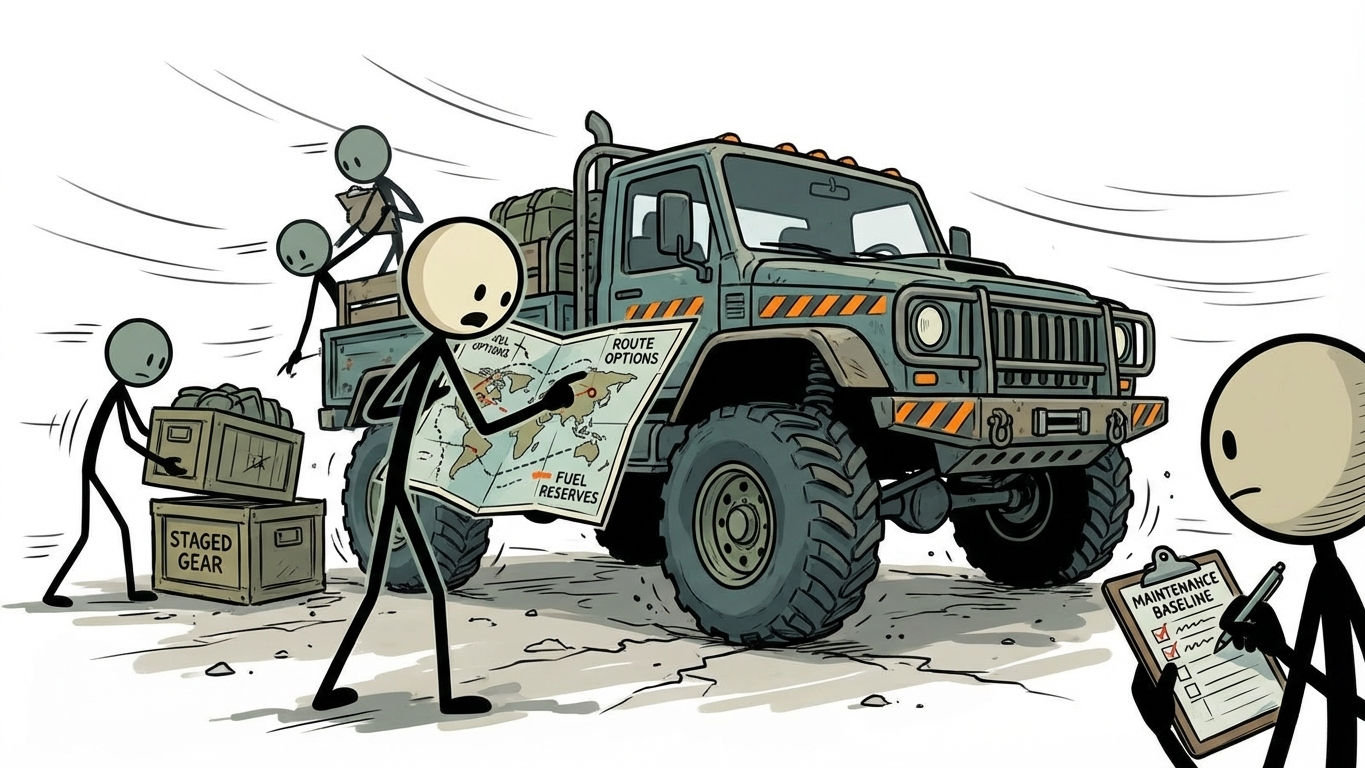
The reality of a regional crisis is that infrastructure fails quickly. Gas stations run dry, cellular networks become overloaded, and major interstates transform into parking lots. To navigate this chaos safely, you must shift your mindset. Your daily driver needs to be viewed as a mobile sustainment platform. By methodically preparing your vehicle, you transition from a reactive victim of circumstance to a proactive, self-reliant survivor. See survival scenarios for related planning.
This comprehensive guide breaks down the essential components of vehicle-based evacuation. We will explore how to establish a rigorous maintenance baseline, manage fuel reserves, map out resilient route options, and build a highly effective vehicle emergency loadout. By implementing these strategies, you will ensure that when the order to evacuate comes, you and your family can depart swiftly, safely, and with absolute confidence. See training options for related planning.
The Foundation of a Disaster Evacuation Car
A disaster evacuation car is not necessarily a heavily modified, off-road tactical truck. While high clearance and four-wheel drive are advantageous, the most critical attribute of any evacuation vehicle is absolute reliability. A well-maintained sedan will always outperform a neglected 4x4 when it matters most. See family resilience course for related planning.
The goal is to create a seamless integration between your daily commuting needs and your emergency preparedness strategy. You do not need a dedicated, secondary vehicle sitting in your driveway solely for emergencies. Instead, you need to elevate the operational readiness of the vehicle you drive every single day. See bug out bag checklist for related planning.
This begins with understanding the specific threats in your region. A coastal resident preparing for hurricane storm surges has different vehicle needs than a mountain resident preparing for sudden winter blizzards or fast-moving wildfires. Regardless of the specific threat, the baseline requirements for a reliable evacuation vehicle setup remain universal: mechanical integrity, fuel security, navigational redundancy, and life-sustaining cargo. See power outage survival guide for related planning.
Establishing a Non-Negotiable Maintenance Baseline
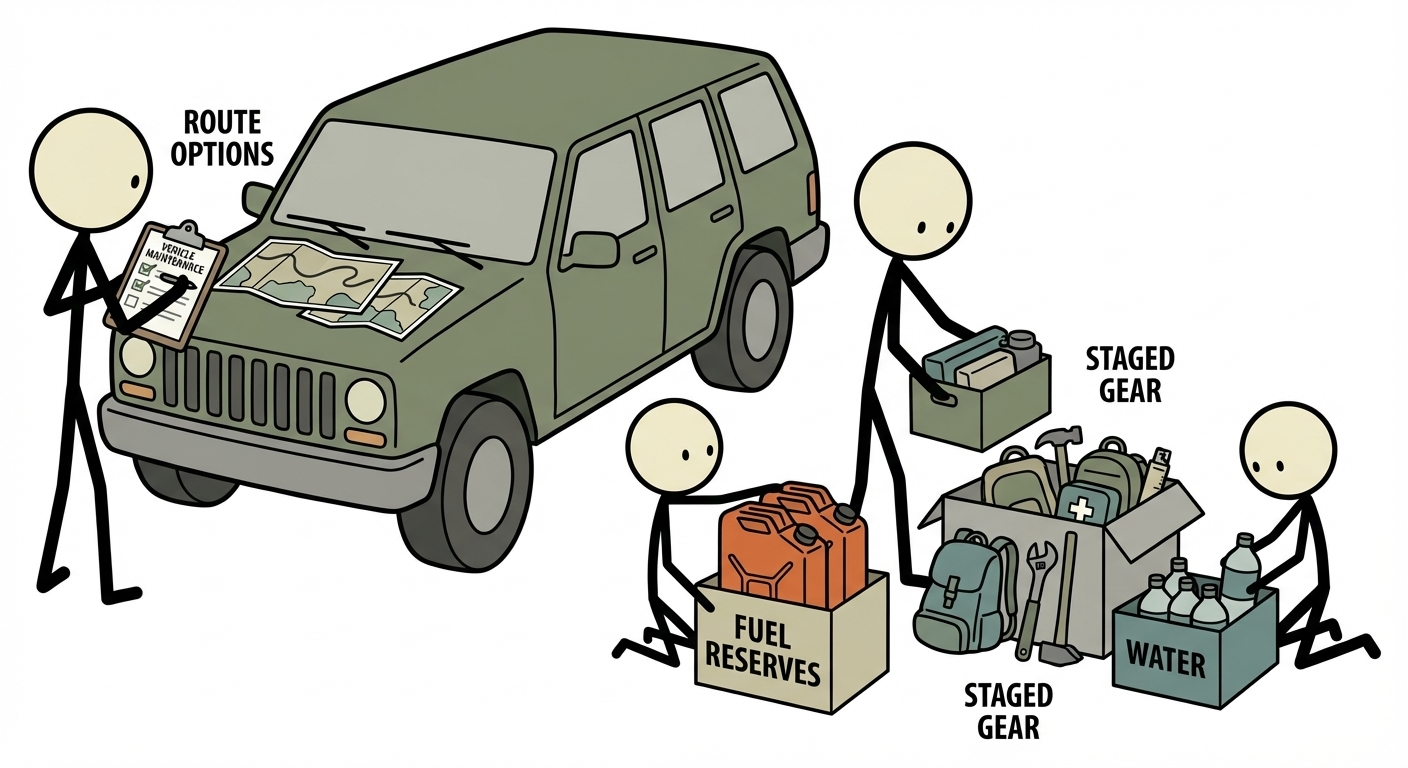
Your family emergency plan is entirely dependent on the mechanical health of your vehicle. A breakdown during a crisis is not just an inconvenience; it is a critical vulnerability. When tow trucks are unavailable and emergency services are overwhelmed, a blown tire or an overheated engine can leave you stranded in the path of danger. Establishing a strict maintenance baseline is your first line of defense.
Tires: The Only Contact with the Road
Tires are the most critical safety component of your vehicle. During an evacuation, you may be forced to drive over debris, through standing water, or onto unpaved shoulders to bypass accidents. Inspect your tire tread monthly using a tread depth gauge, ensuring it is well above the Department of Transportation (DOT) recommended minimum of 2/32 of an inch. For evacuation purposes, replacing tires at 4/32 of an inch is a much safer standard.
Tire pressure must be checked regularly, including the spare. A flat spare tire is useless in an emergency. If your vehicle utilizes a compact "donut" spare, understand its limitations: they are typically rated for a maximum speed of 50 mph and a distance of 50 miles. If your vehicle allows, upgrading to a full-size matching spare provides immense peace of mind during long-distance evacuations.
Fluid Levels and Cooling Systems
Evacuation traffic frequently involves hours of stop-and-go driving, which places immense stress on a vehicle's engine and cooling system. Check your engine oil, transmission fluid, brake fluid, and power steering fluid regularly. Ensure they are clean and filled to the appropriate levels.
Pay special attention to your engine coolant (antifreeze). The cooling system prevents your engine from destroying itself during prolonged idling in hot weather. Inspect the radiator for leaks and ensure the coolant reservoir is full. Furthermore, physically inspect all rubber hoses and serpentine belts for cracks, fraying, or bulging. A snapped belt will disable your alternator and water pump, rendering the vehicle dead within minutes.
Electrical Systems and Battery Health
Modern vehicles are heavily dependent on electrical systems. According to AAA, battery-related issues are the leading cause of roadside breakdowns. Car batteries typically have a lifespan of three to five years, depending on your climate. Extreme heat and extreme cold both degrade battery internals rapidly.
Do not wait for your battery to fail before replacing it. Have it load-tested at a local auto parts store twice a year, ideally before the peak of summer and the dead of winter. Additionally, inspect the battery terminals for corrosive buildup. Clean terminals ensure a strong connection, guaranteeing your vehicle will start immediately when you turn the key under pressure.
Fuel Reserves and Range Management
Fuel is the currency of evacuation. Without it, your carefully planned route and staged gear mean nothing. During regional disasters, the supply chain is immediately disrupted. Gas stations lose power, fuel trucks cannot navigate closed highways, and panic buying drains available underground tanks within hours. You must manage your fuel proactively.
The FEMA Half-Tank Rule
The golden rule of vehicle preparedness, endorsed by FEMA and emergency management agencies nationwide, is to never let your gas tank fall below half full. Treat the half-way mark on your fuel gauge as the new "empty." This requires a behavioral shift, but it guarantees that you will always have at least 150 to 200 miles of range available at a moment's notice.
In the context of a sudden evacuation, that half-tank is the difference between escaping the immediate danger zone and waiting in a three-hour line at a chaotic gas station. When an alert sounds, your only focus should be loading your family and executing your route, not hunting for fuel.
Calculating Realistic Evacuation Range
It is vital to understand that your vehicle's advertised miles-per-gallon (MPG) will plummet during an evacuation. Stop-and-go traffic, heavy cargo loads, and running the air conditioning all degrade fuel efficiency. As previously noted, an idling engine consumes up to half a gallon of fuel per hour.
Calculate your vehicle's "Survival Scenarios scenario" range. If you have a 16-gallon tank and average 25 MPG, your normal range is 400 miles. In an evacuation scenario, assume a 40% reduction in efficiency due to gridlock and idling. Plan your routes and safe havens based on this reduced range to avoid being stranded.
Safe Storage of Extra Fuel
Carrying extra fuel can extend your range, but it must be done safely. Gasoline is highly volatile. If you choose to carry extra fuel, use only high-quality, EPA and OSHA-approved jerry cans or fuel jugs. Store them securely outside the passenger compartment, such as in a truck bed or on a roof rack, to prevent toxic fumes from accumulating in the cabin.
Remember that gasoline degrades over time. If you store fuel at home to top off your vehicle before departing, use a fuel stabilizer to extend its shelf life. Rotate this stored fuel into your vehicle every six months to ensure you always have fresh, combustible gasoline available for an emergency.
Strategic Route Options and Navigation
A destination is useless without a viable way to get there. Relying solely on your daily commute routes or a single interstate highway is a critical failure point in any car bug out plan. Evacuation routes become choked with traffic, accidents, and sometimes the very hazards you are trying to escape, such as floodwaters or wildfire smoke.
The PACE Methodology for Routing
Adopt the military's PACE methodology for your evacuation routes. This stands for Primary, Alternate, Contingency, and Emergency. You should map out four distinct ways to reach your safe haven or exit your region.
- Primary Route: The fastest, most direct path, usually utilizing major interstates and highways. This is the route you take if you evacuate early, ahead of the masses.
- Alternate Route: A secondary path using state highways and major surface streets. It may take longer, but it avoids the main interstate chokepoints.
- Contingency Route: A complex route utilizing backroads, county roads, and less-traveled paths. This is used when major arteries are completely gridlocked or closed by law enforcement.
- Emergency Route: The absolute last resort. This may involve unpaved roads, forest service trails, or heading in a counter-intuitive direction to temporarily bypass a localized threat.
Identifying and Bypassing Chokepoints
A chokepoint is any geographical or infrastructural feature that forces traffic into a narrow corridor. Bridges, tunnels, mountain passes, and toll booths are classic examples. During an evacuation, a single accident at a chokepoint can halt traffic for hours.
Study your local maps and identify every chokepoint within a 50-mile radius of your home. Ensure your Alternate and Contingency routes bypass these areas entirely. Sometimes, driving 30 miles out of your way to cross a smaller, lesser-known bridge is vastly faster than sitting in gridlock at the main interstate crossing.
The Necessity of Paper Maps
Do not trust your life exclusively to your smartphone or vehicle's GPS. The Federal Communications Commission (FCC) frequently reports massive cellular network outages during hurricanes, wildfires, and power grid failures. When the cell towers go dark, your cloud-based mapping apps become useless.
Every evacuation vehicle setup must include physical, waterproof paper maps. Keep a current state atlas in your vehicle, along with detailed United States Geological Survey (USGS) topographical maps of your immediate county and surrounding areas. Furthermore, download offline maps to your smartphone (via apps like Google Maps or specialized overlanding apps) while you still have Wi-Fi, providing a digital backup that does not require a cell signal.
Staged Gear: Building Your Evacuation Vehicle Setup
Your vehicle is not just transportation; it is a rolling shelter. The gear you stage inside it dictates how comfortably and safely you can survive if your evacuation takes days instead of hours. The goal is not to hoard random survival items, but to curate a systematic vehicle emergency loadout based on likely scenarios.
To keep your daily driver functional, avoid clutter. Utilize modular storage solutions like hard-sided cases, soft duffel bags, or under-seat organizers. This keeps your gear secure, prevents it from becoming dangerous projectiles during a crash, and allows for rapid access. We break the bug out vehicle checklist into four distinct categories: Recovery, Sustainment, Medical, and Security.
Category 1: Vehicle Recovery and Maintenance
If your vehicle suffers a minor failure or gets stuck, you must be able to self-rescue. Waiting for a tow truck during a disaster is not a viable strategy. Your vehicle emergency loadout should include tools to handle common roadside emergencies independently.
- Jump Starter / Cables: A lithium-ion jump starter pack is superior to traditional jumper cables, as it allows you to start your car without needing a donor vehicle.
- Tire Repair: Pack a portable 12V air compressor, a tire plug kit, and ensure your jack and lug wrench are easily accessible.
- Basic Tool Roll: Include pliers, a wrench set, screwdrivers, zip ties, duct tape, and WD-40 for field-expedient repairs.
- Traction Aids: If you live in areas prone to snow or deep mud, traction boards, a folding shovel, and a kinetic recovery strap can help unstick your vehicle quickly.
Category 2: Human Sustainment (Water, Food, Shelter)
Evacuations can turn into multi-day ordeals. You must be prepared to shelter in your vehicle overnight. The Centers for Disease Control and Prevention (CDC) recommends one gallon of Water Calculator, per day. While storing massive amounts of water in a car is difficult, you must have a baseline supply.
Keep a case of bottled water or several heavy-duty water bladders in the vehicle. Supplement this with a portable water filter (like a LifeStraw or Sawyer Squeeze) so you can safely process water from streams or public taps if your supply runs out. For food, focus on calorie-dense, non-perishable items that do not require cooking. Energy bars, jerky, trail mix, and MREs (Meals Ready-to-Eat) are excellent choices that withstand temperature fluctuations in a car trunk.
For shelter and warmth, pack high-quality wool blankets or sleeping bags. Mylar emergency blankets are excellent for reflecting body heat and take up minimal space. Include a change of durable clothing, sturdy walking shoes, and weather-appropriate gear (rain jackets, winter hats) for every family member. If you are forced to abandon the vehicle and proceed on foot, you must be dressed for the elements.
Category 3: Medical and First Aid
A standard drugstore first aid kit is insufficient for an evacuation scenario. You need a medical kit capable of addressing both minor ailments and severe trauma. Stress and fatigue lead to accidents, and emergency medical services (EMS) will be severely delayed.
Build or purchase a comprehensive trauma kit. This must include bleeding control items such as a genuine CAT tourniquet, hemostatic gauze (like QuikClot), and pressure dressings. Ensure you know how to use these items; equipment is useless without training.
Alongside trauma gear, maintain a robust "boo-boo" kit. This should include bandages, antiseptic wipes, burn gel, and over-the-counter medications (ibuprofen, antihistamines, anti-diarrheals). Most importantly, ensure you have at least a two-week supply of any critical prescription medications required by your family members.
Category 4: Navigation, Comms, and Illumination
Information is a critical resource during an evacuation. You need to know where the hazard is moving, which roads are closed, and where shelters are opening. A battery-powered or hand-crank NOAA weather radio is essential for receiving emergency broadcasts when cell networks fail.
Keep multiple ways to charge your devices. Have 12V USB chargers plugged into your car, but also pack portable power banks. A power inverter that plugs into your cigarette lighter can charge laptops or power small AC devices.
For illumination, rely on headlamps rather than handheld flashlights. Headlamps keep your hands free for changing tires, reading maps, or wrangling children in the dark. Pack extra lithium batteries, as they perform much better in extreme temperatures than standard alkaline batteries. A few chemical glow sticks are also great for marking your vehicle if you have to pull over on a dark shoulder.
Tailoring Your Strategy to Specific Threats
While the baseline vehicle emergency loadout remains consistent, your car bug out plan should be adapted to the specific natural disasters most likely to strike your geographic region. Understanding the nuances of different threats allows you to make life-saving adjustments to your strategy.
Wildfire Evacuations
Wildfires move with terrifying speed, often leaving residents with only minutes to escape. In wildfire zones, early departure is the only safe option. Your vehicle must be backed into the driveway, facing the street, with the gas tank full. Never park in a garage if the power grid might fail, trapping your car inside.
Smoke inhalation is a massive hazard during a wildfire evacuation. Keep N95 or P100 particulate respirators in your vehicle’s glovebox for every passenger. Additionally, ensure your vehicle's cabin air filter is clean, and set your climate control to "recirculate" to prevent drawing thick smoke into the car. Keep 100% cotton clothing or wool blankets accessible; synthetic materials can melt to your skin if exposed to extreme radiant heat.
Hurricane Evacuations
Unlike wildfires, hurricanes provide days of warning. However, this often leads to a false sense of security, resulting in massive, region-wide traffic jams as millions attempt to leave simultaneously. The National Oceanic and Atmospheric Administration (NOAA) emphasizes that inland flooding is often deadlier than coastal storm surges.
For hurricane evacuations, range and fuel management are your biggest priorities. You may need to drive hundreds of miles inland to find an available hotel or shelter. Never attempt to drive through moving floodwaters. It takes only 12 inches of rushing water to sweep a small car off the road, and 18 inches to move larger vehicles. If your route is flooded, immediately switch to your Alternate or Contingency route.
Winter Storms and Blizzards
Evacuating during a severe winter storm presents unique challenges, primarily the risk of hypothermia if your vehicle becomes stranded in a snowdrift. In these scenarios, your vehicle is a mobile warming shelter.
Your winter loadout must include heavy-duty sleeping bags, chemical hand warmers, and extra layers of fleece or wool. Carry a snow shovel, an ice scraper, and a bag of sand or non-clumping kitty litter for traction. If you are stranded, ensure your exhaust pipe is clear of snow to prevent deadly carbon monoxide from backing up into the cabin. Run the engine for only 10 minutes every hour to conserve fuel while maintaining a survivable temperature.
The Psychology of the Evacuation Drive
The final, and perhaps most overlooked, component of a car bug out plan is the mental state of the driver. Evacuating under the threat of a disaster is an incredibly high-stress event. You will encounter panicked drivers, aggressive behavior, and terrifying environmental conditions. Maintaining emotional control is vital for the safety of your passengers.
A well-prepared vehicle provides immense psychological armor. Knowing that you have fuel, alternative routes, medical supplies, and food allows you to remain calm and make rational decisions. You are not at the mercy of the mob; you are executing a premeditated plan.
Communicate clearly with your passengers. Assign tasks to keep them engaged and calm—have someone manage the paper maps, another monitor the NOAA weather radio, and another handle hydration and snacks. Transforming the environment inside the vehicle from one of panic to one of focused teamwork drastically improves your chances of a safe, successful relocation.
Taking Control of Your Journey
A vehicle-based evacuation does not have to be a chaotic, desperate flight from danger. By taking the time to establish a strict maintenance baseline, manage your fuel reserves, map out redundant routes, and stage a comprehensive vehicle emergency loadout, you transform your daily driver into an incredibly capable lifeline.
Disasters are inherently unpredictable, but your response to them does not have to be. The effort you put into your disaster evacuation car today directly correlates to the safety and security of your family tomorrow. Do not wait for an emergency alert to test your readiness. Inspect your tires, fill your gas tank, pack your gear, and take absolute control of your preparedness journey.
Prepare your bug-out vehicle using our bug-out evacuation guide. Review vehicle essentials in our car emergency kit guide. Pack your vehicle with our go-bag builder. Calculate vehicle supplies with our supply calculator. Master vehicle evacuation through our preparedness courses.
Frequently Asked Questions
What is the first step to prepare for this scenario?
Start with a realistic risk assessment for your location, then build a simple written plan your whole household can follow.
How much should beginners spend initially?
Begin with high-impact basics and a phased budget. Small consistent upgrades beat expensive one-time purchases.
How often should plans and gear be reviewed?
Audit every 6 to 12 months and after every real incident to capture lessons learned.
What should go in every emergency kit?
Water, food, first aid, lighting, communication, documents, and essential medications.
How do I get family buy-in for preparedness?
Keep it practical, avoid fear language, and run short drills that show clear everyday value.