- High Upfront Investment: A quality home freeze dryer requires a capital outlay of $2,000 to $5,000, alongside ongoing maintenance and utility expenses.
- Unmatched Preservation: When executed correctly, freeze-drying retains up to 97 percent of nutritional value and can yield a shelf life of 15 to 25 years.
- Infrastructure Demands: These appliances require dedicated electrical circuits, produce steady ambient heat and noise, and demand consistent vacuum pump maintenance.
- Packaging is Paramount: The long-term viability of freeze-dried food depends entirely on high-barrier Mylar packaging and high-capacity oxygen absorbers.
- A Tiered Strategy: A freeze dryer is an advanced preservation tool; it should complement, not replace, a foundational pantry of basic canned and dry goods.
For those committed to long-term family resilience, food preservation is a continuous pursuit. While traditional canning, freezing, and dehydrating have served households for generations, the rise of the home freeze dryer has introduced a commercial-grade preservation method directly into the domestic kitchen. Once restricted to industrial facilities, these machines allow families to preserve garden harvests, leftovers, and specialized dietary meals with unparalleled nutrient retention and longevity.
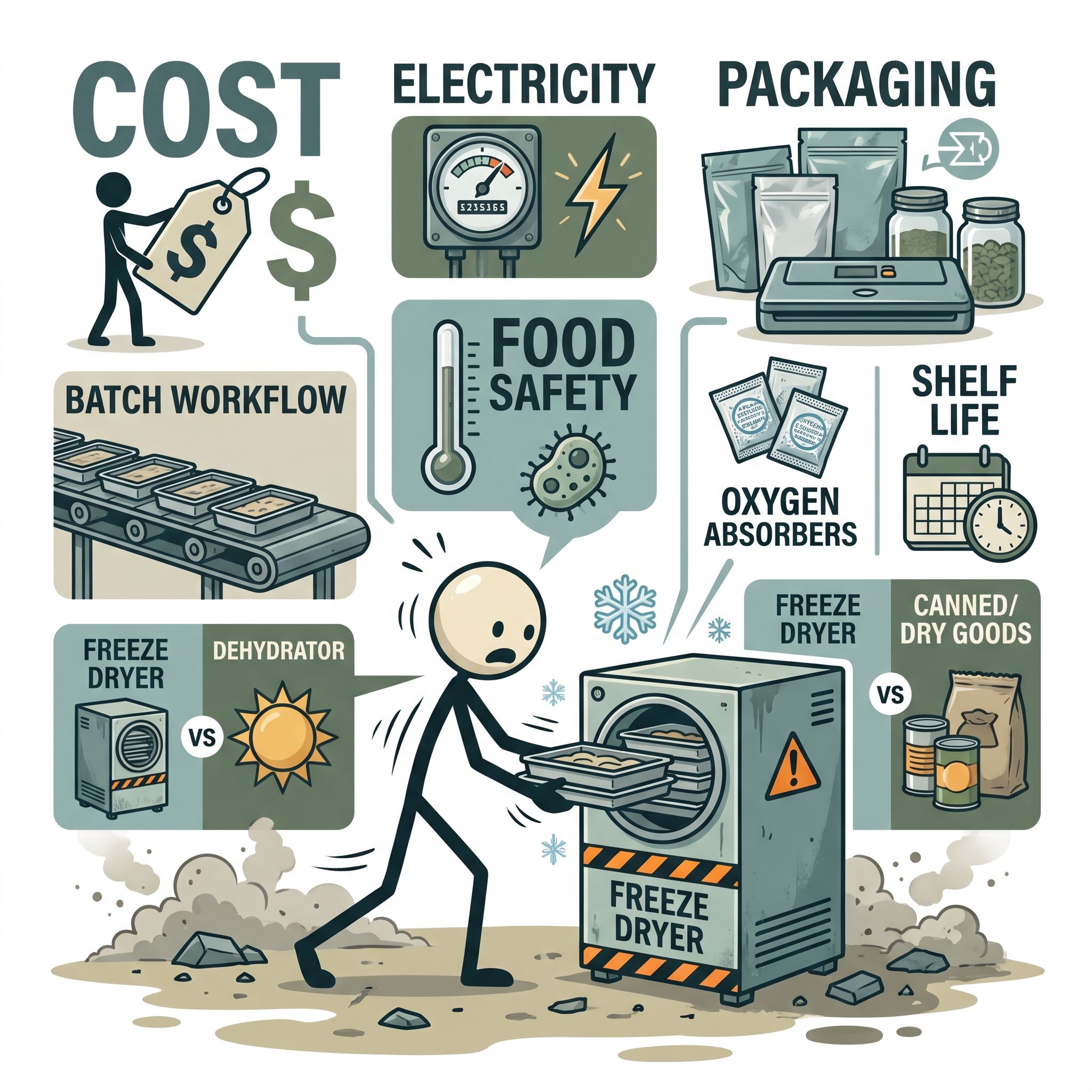
However, purchasing a freeze dryer is one of the most significant financial decisions an emergency preparedness planner will make. It is not a simple kitchen appliance that you plug in and forget. It is a complex piece of laboratory-grade machinery that requires physical space, dedicated electrical infrastructure, routine maintenance, and a clear understanding of food chemistry. This guide provides a balanced, practical evaluation of home freeze dryers, helping you determine if this technology aligns with your household budget, preparation goals, and daily workflow.
The Reality of Owning a Home Freeze Dryer: Costs and Infrastructure
Before examining the food preservation capabilities of a home freeze dryer, it is necessary to understand the physical and financial realities of operating one. Many prospective buyers focus solely on the end product, overlooking the logistical footprint these machines require.
Upfront and Ongoing Financial Costs
The initial purchase price of a home freeze dryer is substantial. Entry-level small units typically start around $2,000, while medium and large units range from $2,800 to over $5,000. These prices generally include the freeze dryer itself, a vacuum pump, a selection of trays, and a starter pack of Mylar bags and sealant tools.
Beyond the purchase price, you must budget for ongoing operational costs. These include:
- Vacuum Pump Oil: Standard oil-sealed pumps require high-grade vacuum pump oil. This oil must be filtered or changed frequently (often after every 5 to 10 batches) to protect the pump from moisture damage. A gallon of quality vacuum pump oil costs between $30 and $50.
- Oil-Free Pump Alternative: You can opt for an oil-free (scroll) pump to eliminate the hassle of oil changes, but these pumps add $1,500 to $2,000 to the initial purchase price and must eventually be sent to a service center for rebuilding.
- Packaging Consumables: Every batch of food destined for long-term storage requires heavy-duty Mylar bags and fresh oxygen absorbers. Depending on the size of your batches, this can add $0.50 to $2.00 in packaging costs per tray.
Electrical Infrastructure and Power Consumption
A home freeze dryer is a high-power appliance that runs continuously for long periods. A typical freeze-drying cycle lasts anywhere from 20 to 50 hours, depending on the moisture content and density of the food. During this time, the machine cycles a refrigeration compressor, heating elements inside the chamber, and a high-draw vacuum pump.
Most small and medium home freeze dryers run on a standard 110-volt household circuit, but they require a dedicated outlet. Sharing a circuit with other high-draw appliances, such as a refrigerator or microwave, will likely trip your circuit breaker. Large and extra-large models often require a dedicated 20-amp, 110-volt circuit, or even a 220-volt outlet similar to a clothes dryer.
In terms of consumption, a medium freeze dryer averages about 1.5 to 2.0 kilowatt-hours (kWh) of electricity per hour of operation. If your local utility rate is $0.16 per kWh, a single 36-hour batch will consume roughly 54 to 72 kWh, costing between $8.64 and $11.52. If you run three batches a week, your monthly utility bill will increase by $100 to $140. It is crucial to factor these utility costs into your long-term calculations.
Space, Noise, and Ambient Temperature
A home freeze dryer is heavy, typically weighing between 100 and 250 pounds. It requires a sturdy, level countertop or a heavy-duty utility cart. The physical footprint is comparable to a large commercial microwave or a countertop convection oven, but you must also allocate space next to or below the unit for the external vacuum pump.
Operating noise is another key consideration. The vacuum pump produces a steady, low-frequency hum, and the internal cooling fans run constantly. The noise level is comparable to a loud dishwasher or a portable air conditioner. For this reason, many families choose to house their freeze dryer in a garage, basement, utility room, or enclosed porch rather than the main kitchen.
Furthermore, the room's ambient temperature directly impacts the machine's efficiency. Freeze dryers operate by freezing the chamber to -30 degrees Fahrenheit or lower, then using a condenser to collect water vapor. If the ambient room temperature exceeds 80 degrees Fahrenheit (such as in an unconditioned garage during summer), the cooling system must work significantly harder. This extends the cycle times, increases electricity usage, and accelerates wear on the compressor.
The Batch Workflow: From Prep to Storage
Operating a freeze dryer for preppers is a hands-on process that requires careful planning and a structured workflow. You cannot simply throw random foods into the machine and expect perfect results. The process demands attention to detail at every stage.
Step 1: Food Preparation and Pre-Freezing
Uniformity is the key to successful freeze-drying. Food must be sliced to a consistent thickness, ideally between 1/4 and 1/2 inch. Slices that are too thick will retain moisture in their centers, which will ruin the batch during storage. Raw meats, cooked stews, fruits, and vegetables must all be arranged flat on the metal trays without overlapping excessively.
While home freeze dryers can freeze the food from room temperature inside the chamber, it is highly recommended to pre-freeze your loaded trays in a standard chest freezer first. Pre-freezing accomplishes two things: it reduces the freeze dryer's cycle time by several hours, and it prevents liquid foods (like soups or raw eggs) from bubbling or spilling when the vacuum pump engages. This simple step saves electricity and reduces wear on your machine's vacuum system.
Step 2: The Freeze-Drying Cycle
Once the pre-frozen trays are loaded into the chamber, the door is sealed, and the drain valve is closed, the machine begins its automated cycle. This cycle consists of three distinct phases:
- Deep Freezing: The machine lowers the chamber temperature to between -30 and -50 degrees Fahrenheit. This ensures that all water within the food is completely frozen into solid ice crystals.
- Primary Drying (Sublimation): The vacuum pump turns on, lowering the atmospheric pressure inside the chamber to a near-vacuum. The heating elements beneath the trays gently warm up. Under vacuum, ice bypasses the liquid phase and turns directly into water vapor (sublimation). This vapor travels to the freezing chamber walls, where it condenses back into ice.
- Secondary Drying (Desorption): The temperature is raised slightly higher (often around 110 to 125 degrees Fahrenheit) to drive off any remaining bound water molecules. This phase ensures the food reaches a state of absolute dryness.
Step 3: Post-Cycle Inspection and Defrosting
When the machine signals that the cycle is complete, you must test the food immediately before packaging. Open the drain valve slowly to release the vacuum, open the door, and select the thickest pieces of food on the trays. Break them in half and feel the center. If the center feels cold to the touch, or if there is any visible moisture, the food is not finished. You must reseal the chamber, pull the vacuum again, and run the machine for an additional 2 to 4 hours of dry time.
Once the food is verified dry, you must defrost the machine. The ice that sublimated off your food is now frozen to the inside walls of the chamber. You can let it melt naturally over several hours with the door open, or use the machine's built-in defrost heater to speed up the process. The meltwater drains out of a hose into a bucket, which must be emptied after every run.
Food Safety and Shelf Life Expectations
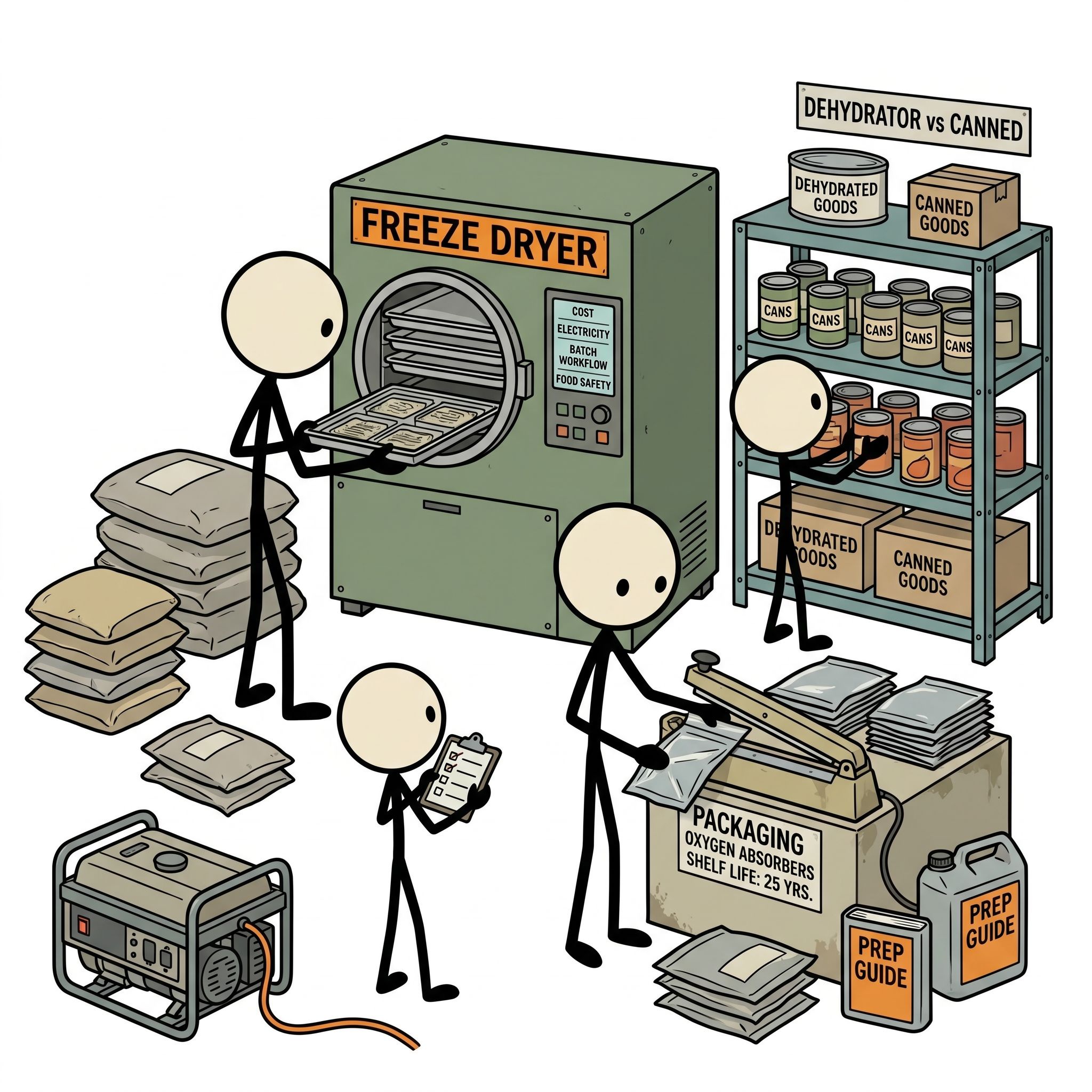
When discussing long-term food preservation, conservative safety standards must guide every decision. While commercial freeze-dried foods are often advertised with a 25-year shelf life, achieving this milestone at home requires strict adherence to food safety protocols and proper environmental controls.
The Science of Moisture and Microbial Growth
The primary reason freeze-dried food lasts so long is the near-complete removal of water. Bacteria, mold, and yeast require moisture to survive and multiply. By reducing the water activity level of the food to below 1 percent, you effectively halt the biological processes that cause spoilage.
However, freeze-drying does not sterilize the food. It merely pauses microbial activity. If you freeze-dry raw chicken, any salmonella present on the meat will survive the freezing and drying process. Once you rehydrate that chicken with warm water, the bacteria will wake up and begin multiplying immediately. Therefore, maintaining strict kitchen hygiene during preparation is vital. Cooked foods must be handled with clean utensils, and raw meats must be treated with the same caution as fresh raw meat.
What Can and Cannot Be Safely Freeze-Dried
While a home freeze dryer is incredibly versatile, certain ingredients cannot be safely processed for long-term storage. The primary limiting factor is fat content.
| Highly Suitable Foods | Unsuitable/High-Risk Foods | ||
|---|---|---|---|
| Lean meats (chicken breast, lean beef, turkey) | High-fat meats (bacon, sausage, marbled steaks) | Fruits and vegetables (berries, corn, peas, apples) | Butter, margarine, and cooking oils |
| Low-fat dairy (skim milk, low-fat yogurt) | Peanut butter and high-oil nuts | ||
| Soups, stews, and casseroles (with minimal oil) | Chocolate, honey, and high-sugar syrups |
Fat does not freeze-dry. When subjected to the vacuum chamber, fat remains in its liquid or semi-solid state. If you attempt to freeze-dry fatty foods, the fat will coat the dry food particles, preventing complete moisture removal. Over time, this fat will oxidize and go rancid, ruining the flavor, aroma, and safety of the food within months, even if stored in an airtight container.
Realistic Shelf Life Expectations
To achieve a reliable 10 to 25-year shelf life, your home-processed foods must meet three criteria: they must be completely dry (less than 1 percent moisture), they must be sealed in high-barrier packaging with oxygen absorbers, and they must be stored in a cool, dark, temperature-stable environment.
If you store your sealed Mylar bags in a garage that reaches 95 degrees Fahrenheit in the summer, the heat will break down the proteins, vitamins, and packaging materials rapidly, reducing the actual shelf life to a fraction of its potential. For realistic family emergency planning, assume a highly dependable shelf life of 10 to 15 years for home-processed lean meats and vegetables stored in a cool basement, rather than relying on the idealized 25-year commercial standard.
Packaging and Preservation: Mylar and Oxygen Absorbers
The freeze dryer only performs half of the preservation process; the packaging performs the other half. The moment dry food is exposed to the air, it begins to absorb moisture from the surrounding humidity. If left unprotected, freeze-dried food will soften and spoil within days.
Selecting High-Quality Mylar Bags
Do not compromise on your packaging materials. Standard clear vacuum bags or thin plastic containers are permeable to oxygen and moisture over time. You must use genuine Mylar (metalized polyester) bags.
When purchasing Mylar bags, pay close attention to the thickness, which is measured in mils (one-thousandth of an inch). For long-term emergency storage, use bags that are at least 7 mils thick. Thinner bags (such as 3 or 4 mil) are prone to developing microscopic pinholes, especially at the sharp corners of freeze-dried foods like pasta, broccoli, or dried meats. These tiny punctures allow oxygen and moisture to slowly seep inside, neutralizing your preservation efforts. For more details on alternative sealing methods, consult our vacuum sealing emergency food storage guide guide.
The Critical Role of Oxygen Absorbers
Oxygen is the primary catalyst for food degradation. It causes fats to oxidize, destroys vitamins, and allows any surviving aerobic mold spores to grow. To prevent this, you must place food-grade oxygen absorbers inside every package before sealing.
Oxygen absorbers are small packets containing iron powder. When sealed inside a bag, the iron reacts with the trapped oxygen, rusting and locking the oxygen away in the form of iron oxide. This process reduces the oxygen level inside the bag to less than 0.01 percent.
You must match the capacity of the oxygen absorber (measured in cubic centimeters, or cc) to the volume of the container:
- 1-Quart Mylar Bag: Use a 300cc oxygen absorber.
- 1-Gallon Mylar Bag: Use a 300cc to 500cc oxygen absorber (use 500cc for loose, airy foods like freeze-dried fruit slices).
- 5-Gallon Mylar Bag/Bucket: Use a 2000cc to 3000cc oxygen absorber.
When packaging your food, work in small batches. Open your package of oxygen absorbers and place them into the bags immediately, then seal the bags using a high-quality impulse sealer or a flat household iron. Any exposure of the absorbers to open air for more than 10 to 15 minutes will exhaust their capacity before they are even sealed inside the bags.
Freeze Dryer vs. Dehydrator: Which is Best?
Many people confuse freeze-drying with traditional dehydration, but the two methods are fundamentally different in terms of science, cost, and final product quality. Understanding the freeze dryer vs dehydrator debate is essential for choosing the right tool for your kitchen.
The Dehydration Process
Dehydration relies on low heat and continuous airflow to evaporate water from food. This process typically removes about 85 to 95 percent of the moisture. Because some water remains, dehydrated foods have a shorter shelf life, typically ranging from 1 to 2 years when stored at home. For a comprehensive look at this simpler method, refer to our home food dehydrator guide.
Dehydration also alters the physical structure of the food. Heat causes the food to shrink, shrivel, and harden, resulting in a tough, leathery texture. Furthermore, the heat used in dehydration can destroy heat-sensitive vitamins, such as Vitamin C and Vitamin A, reducing the overall nutritional value of your stored food.
The Freeze-Drying Advantage
Because freeze-drying bypasses liquid water entirely through sublimation under a vacuum, the physical structure of the food remains unchanged. A freeze-dried strawberry retains its original shape, vibrant color, and size. It becomes incredibly light and porous, with a texture similar to honeycomb.
This porous structure allows for rapid rehydration. When you add water to freeze-dried food, it absorbs the moisture almost instantly, returning to its original fresh state in terms of texture, flavor, and appearance. Additionally, because the process uses minimal heat, over 97 percent of the food's vitamins, minerals, and enzymes are preserved intact.
| Feature | Dehydrator | Home Freeze Dryer |
|---|---|---|
| Initial Appliance Cost | $50 to $300 | $2,000 to $5,000+ |
| Moisture Removed | 85% to 95% | 98% to 99% |
| Typical Shelf Life | 1 to 2 years | 15 to 25 years |
| Nutrient Retention | Moderate (approx. 60%) | Excellent (approx. 97%) |
| Rehydration Speed | Slow (requires soaking/cooking) | Extremely fast (seconds to minutes) |
When Ordinary Canned or Dry Goods Are Smarter
While a home freeze dryer is an exceptional tool, it is not the starting point for emergency preparedness. It is a high-tier addition to an already established food storage system. For many households, investing thousands of dollars in a freeze dryer is financially counterproductive when compared to simpler, time-tested alternatives.
The Cost-Benefit of Commercial Canned Goods
If your goal is simply to secure a 3-month supply of food for your family, buying a freeze dryer is highly inefficient. You can purchase a substantial quantity of commercial canned soups, vegetables, fruits, and meats for a fraction of the cost of a freeze-drying machine.
For example, $3,000 spent at a wholesale grocery store will buy thousands of cans of high-calorie, shelf-stable food. These commercial canned goods require no electricity to store, no labor to package, and can sit safely on your shelves for 2 to 5 years (and often much longer) without any maintenance. For structured guidance on building this foundational layer, see our 3-month food storage plan.
The Simplicity of Dry Goods
Basic dry goods like white rice, pinto beans, rolled oats, and hard red wheat berries are naturally low in moisture and have an incredibly long shelf life when packaged correctly. A 50-pound bag of
Frequently Asked Questions
Is a home freeze dryer worth it for preppers?
It can be worth it for families preserving large amounts of food they already eat, but most beginners should build water, pantry, medical, and power basics first.
Does freeze drying kill bacteria?
No. Freeze drying removes moisture, but safe handling before drying, complete drying, proper packaging, and safe rehydration still matter.
What packaging do freeze-dried foods need?
Use moisture-barrier mylar bags or jars, oxygen absorbers where appropriate, clear labels, and cool dark storage. Moisture is the enemy.
Is a freeze dryer better than a dehydrator?
Freeze dryers usually preserve texture and nutrients better and support longer storage, but dehydrators are cheaper, simpler, and excellent for many foods.
What should I buy before a home freeze dryer?
Buy reliable water storage, a rotating pantry, a manual can opener, basic medical gear, mylar bags, oxygen absorbers, and backup power before a premium appliance.