⚡ Key Facts
- Rapid Degradation: Untreated modern gasoline can begin to chemically degrade and lose its volatility in as little as 30 to 60 days, potentially clogging fuel systems with gum and varnish. For the practical checklist side, use the community emergency preparedness guide.
- Strict Storage Limits: The National Fire Protection Association (NFPA) Code 30 limits residential storage of Class I flammable liquids (like gasoline) to a maximum of 25 gallons inside a utility room, or 10 gallons in an attached garage, though local municipal codes are often stricter. For the practical checklist side, use the neighborhood preparedness network.
- Thermal Expansion Hazards: Gasoline expands by approximately 1.5% for every 10°F rise in temperature, making it critical to leave at least 5% to 10% headspace (ullage) in any storage container to prevent rupture or vapor leaks. For the practical checklist side, use the emergency communication plan.
- Phase Separation Risk: Standard E10 gasoline (10% ethanol) can absorb moisture from the air; once water content reaches just 0.5%, the ethanol and water separate from the gasoline, sinking to the bottom of the tank and rendering the fuel unusable. For the practical checklist side, use the family emergency planning guide.
- Safety Approvals: Legally compliant home gasoline storage requires containers that are certified by Underwriters Laboratories (UL), Factory Mutual (FM), or the American Society for Testing and Materials (ASTM).
Imagine a severe winter storm, an grid-down cyberattack, or a Category 4 hurricane that knocks out regional electrical infrastructure for two weeks. Your emergency generator sits ready in the shed, but when you pull the starter cord, the engine sputters, coughs, and dies. The culprit isn't a mechanical failure; it is the fuel in the tank, which has degraded into a stale, varnish-laden liquid during months of storage. Gasoline is the lifeblood of modern emergency preparedness, powering portable generators, chainsaws, and evacuation vehicles when the utility grid fails. Yet, despite its critical role in survival planning, it is one of the most volatile, hazardous, and chemically unstable substances a homeowner can store. To build a truly resilient household, you must master the science and safety of long-term fuel preservation.
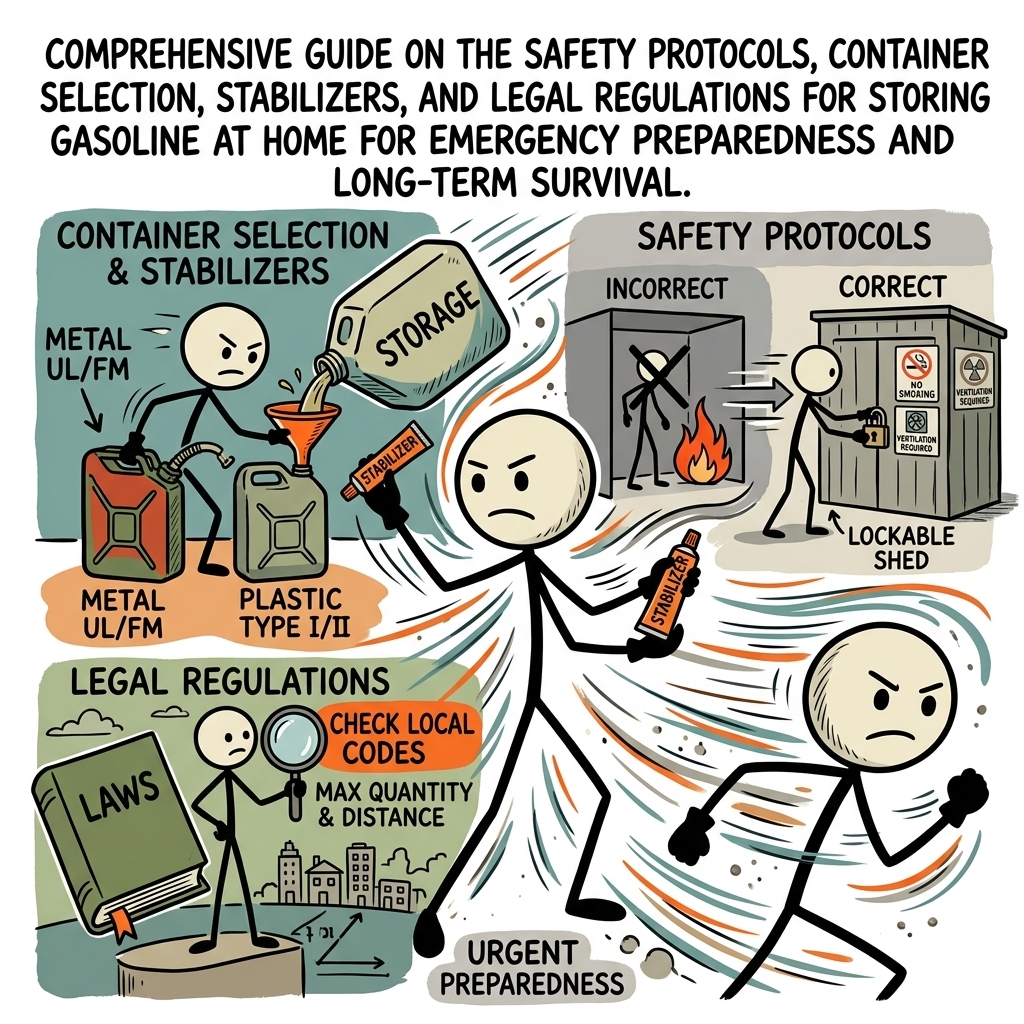
The Chemistry of Gasoline Degradation: Why Fuel Spoils
To understand how to store gasoline long term, you must first understand why modern fuel is inherently unstable. Unlike the crude oil from which it is refined, commercial gasoline is a highly engineered cocktail of over 150 different hydrocarbons, performance additives, and anti-knock agents. This complex chemical blend begins to break down the moment it leaves the refinery pipeline, driven by three primary destructive forces: oxidation, volatility loss, and hydrolysis.
Oxidation and Gum Formation
When gasoline is exposed to oxygen, the hydrocarbons within the fuel undergo a series of free-radical chain reactions. This process, known as autoxidation, transforms light, volatile liquid hydrocarbons into heavy, sticky polymers. Over time, these polymers precipitate out of the liquid as sticky gums, varnishes, and resins. When this degraded fuel is introduced into an engine, these residues quickly clog fuel filters, coat carburetor jets, and coat fuel injector nozzles, rendering the engine inoperable. The rate of oxidation accelerates exponentially as temperatures rise, meaning hot summer storage conditions can ruin untreated fuel in less than two months.
Loss of Volatility (Evaporation)
Gasoline is formulated with highly volatile, low-boiling-point compounds—such as butane and pentane—which are essential for cold-engine starting. Because portable fuel containers are rarely 100% vapor-tight over long periods, these light chemical fractions are the first to evaporate into the atmosphere. As these volatile compounds escape, the remaining liquid fuel becomes denser, less flammable, and far more difficult to ignite. This loss of volatility is why stale gas makes engines incredibly difficult to start, particularly in cold-weather Survival Scenarioss.
Ethanol and Phase Separation
According to the U.S. Energy Information Administration (EIA), more than 98% of the motor gasoline sold in the United States contains up to 10% ethanol (E10). Ethanol is highly hygroscopic, meaning it actively attracts and absorbs moisture from the surrounding air. In a vented or semi-sealed storage container, the ethanol in the fuel will continuously draw in atmospheric humidity.
Once the water content in the fuel reaches a critical threshold—approximately 0.5% by volume at 60°F—the water and ethanol chemically bind together and drop out of suspension. This phenomenon, known as phase separation, creates two distinct layers in your container: a highly corrosive, low-octane water-and-ethanol mix at the bottom, and a severely depleted, low-octane gasoline layer on top. If this bottom layer is drawn into a generator or vehicle engine, it can cause catastrophic, permanent internal damage.
Container Selection: The First Line of Defense
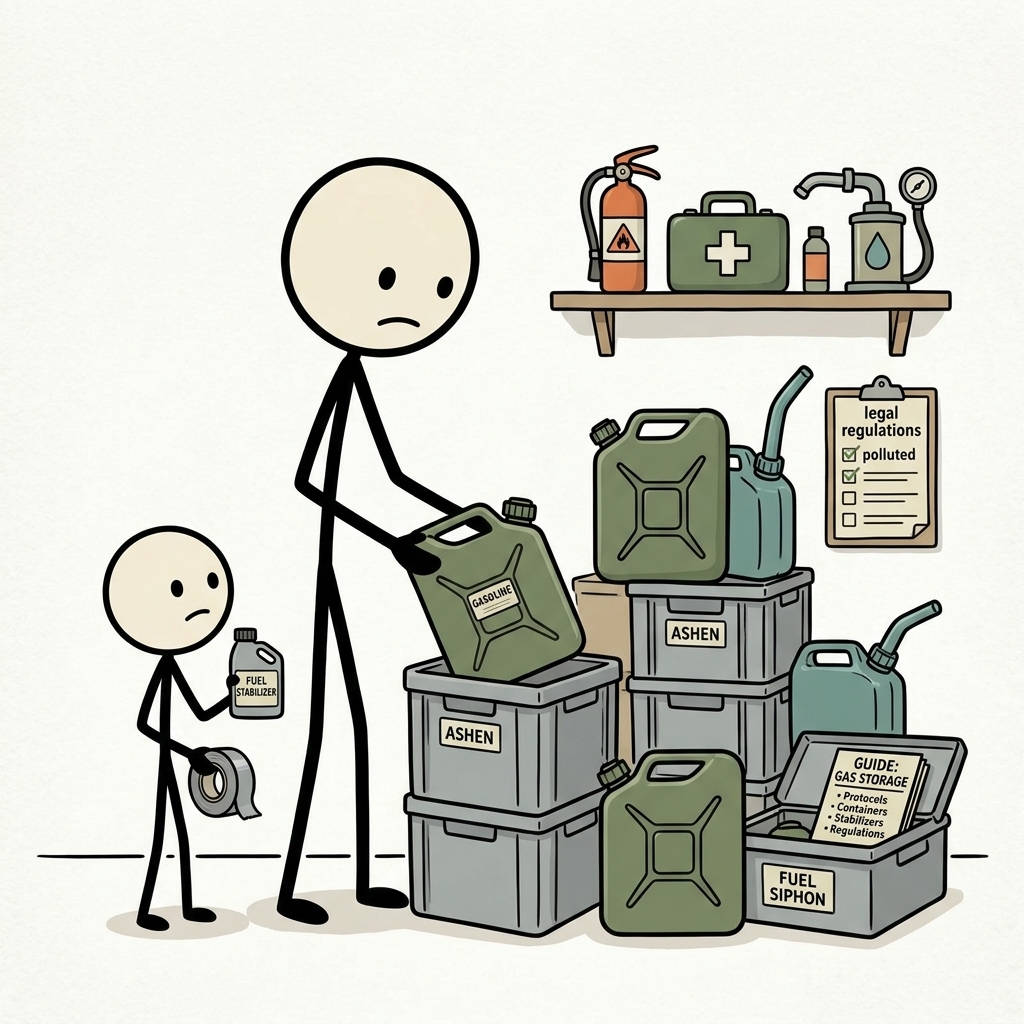
Implementing a safe and effective home gasoline storage system begins with selecting the correct container. Never, under any circumstances, store gasoline in improvised vessels such as milk jugs, glass bottles, or unapproved plastic drums. These materials can dissolve, crack, static-discharge, or leak vapor, creating an immediate fire hazard.
Plastic (HDPE) vs. Metal (Jerry Cans)
For residential emergency fuel storage, your primary choices are High-Density Polyethylene (HDPE) plastic containers or heavy-duty metal cans. Each material has distinct advantages and trade-offs that dictate how and where they should be deployed.
- High-Density Polyethylene (HDPE): Modern plastic fuel cans are manufactured from fluorinated HDPE, which resists chemical degradation and reduces vapor permeation through the plastic walls. They are lightweight, completely impervious to rust, and highly impact-resistant. However, budget-grade plastic cans are prone to swelling during temperature swings and can develop micro-cracks around the seams over several years of exposure to UV light.
- Metal (NATO-Style Jerry Cans): Original military-spec NATO jerry cans, constructed from 0.9mm cold-rolled steel, represent the gold standard for long-term fuel storage. High-quality steel cans feature a fuel-resistant interior lining that prevents internal rust, a robust cam-lock mechanism that ensures a 100% vapor-tight seal, and a locking pin to prevent accidental openings. While heavier and more expensive than plastic, metal cans are exceptionally durable, puncture-resistant, and far less likely to leak vapor during extreme temperature fluctuations.
Color-Coding Standards
To prevent dangerous fueling mistakes, the American Society for Testing and Materials (ASTM) establishes strict color-coding standards for portable fuel containers. Compliance with these standards is critical for emergency preparedness safety:
| Container Color | Designated Fuel Type | Safety & Application Notes |
|---|---|---|
| Red | Gasoline | Highly volatile; used for spark-ignition engines (generators, cars, lawnmowers). |
| Yellow | Diesel | Lower volatility, higher energy density; used for compression-ignition engines. |
| Blue | Kerosene | Highly refined; used primarily for space heaters, lanterns, and specific stoves. |
| Green | Oil / Specialty Fuels | Often used for pre-mixed 2-stroke fuels or specific bio-fuels. |
Essential Safety Features
When purchasing containers for home gasoline storage, ensure they carry safety certifications from Underwriters Laboratories (UL 30) or Factory Mutual (FM). Look for the following engineering features:
- Flame Arrestors: A flame arrestor is a fine, non-corrosive metal mesh screen inserted into the nozzle of the container. It allows liquid to pour out freely but absorbs and dissipates heat, preventing an external flame or spark from traveling back down into the vapor space of the container and causing an explosion.
- Self-Closing/Spill-Proof Spouts: Modern EPA-compliant cans feature spring-loaded valves that automatically close when pressure is released. This design prevents fuel spills during transfer and keeps the container hermetically sealed when not in use, drastically reducing vapor loss.
- Pressure Relief Valves: Heavy-duty safety cans feature a built-in spring-loaded cap that automatically vents internal pressure if temperatures rise to dangerous levels, preventing container rupture.
Fuel Stabilizers: Extending the Shelf Life
If you store standard, untreated pump gasoline, it will begin to degrade within two months. To maintain fuel viability for emergency preparedness, the application of a high-quality fuel stabilizer for gasoline is non-negotiable.
How Stabilizers Work
Fuel stabilizers are complex chemical formulations designed to interrupt the natural degradation processes of gasoline. They do not reverse fuel aging; rather, they preserve fresh fuel by acting on several chemical fronts:
- Antioxidants: These compounds act as free-radical scavengers, interrupting the oxidation chain reactions before hydrocarbons can polymerize into sticky gums and varnishes.
- Metal Deactivators: Soluble metals (such as copper from fuel lines and iron from tanks) act as catalysts that accelerate the oxidation process. Stabilizers chemically bond with these dissolved metals, neutralizing their catalytic properties.
- Corrosion Inhibitors: These additives form a molecular protective film over metal surfaces, shielding fuel injectors, carburetors, and fuel lines from the corrosive effects of moisture and ethanol phase separation.
- Water Emulsifiers vs. Demulsifiers: Depending on the formulation, stabilizers either chemically disperse small amounts of moisture evenly throughout the fuel to be burned off safely, or they force moisture out of suspension entirely so it can be filtered out before entering the engine.
Step-by-Step Fuel Treatment Protocol
To maximize the efficacy of your fuel stabilizer for gasoline, you must apply it systematically. Simply pouring stabilizer into an old, stale can of gasoline will not restore its chemical integrity.
- Purchase Fresh Fuel: Always fill your storage containers with fresh, high-quality gasoline from a high-volume gas station to ensure the fuel has not already spent weeks in a stagnant underground tank. If available, opt for premium ethanol-free gasoline (often sold as "recreational fuel" or "90 Octane Non-Ethanol"), which is far more stable than standard E10 blends.
- Dose the Container First: Add the precise dose of fuel stabilizer to your empty, clean storage container before filling it at the pump. The turbulent action of the fuel pumping into the container will ensure a thorough, homogenous mixture of the stabilizer throughout the gasoline.
- Follow Manufacturer Ratios: Standard dosing levels are designed for short-term preservation (e.g., 3 to 6 months). For emergency fuel storage intended to last 12 to 24 months, many manufacturers recommend doubling the dosage. Always consult the product label for specific long-term storage instructions.
- Run the Engine to Distribute: If you are treating fuel directly inside a generator or vehicle tank, run the engine for 10 to 15 minutes after adding the stabilized fuel. This ensures the treated mixture fills the fuel lines, fuel filters, and carburetor bowl, protecting the entire fuel delivery system from gumming up.
Stabilizer Brands and Longevity Expectations
Several commercial stabilizers are engineered specifically for long-term survival applications. Standard formulations like STA-BIL Storage can extend the shelf life of fresh gasoline up to 12 months. Marine-grade formulations, such as STA-BIL Marine or Star Tron Enzyme Fuel Treatment, are engineered with enhanced moisture-dispersing agents to combat the high-humidity environments that trigger phase separation. For ultra-long-term storage of up to two years, professional-grade stabilizers like PRI-G utilize advanced industrial-strength chemistry to preserve both regular and ethanol-blended fuels in peak condition.
Safety Protocols & Storage Location: Mitigating the Risks
Gasoline is an incredibly energy-dense material. A single gallon of vaporized gasoline, when mixed with the correct ratio of air, possesses the explosive potential of several sticks of dynamite. Implementing rigid gas storage safety protocols is paramount to protecting your home and family from catastrophic fire hazards.
The Golden Rules of Gas Storage Safety
When handling and storing flammable liquids, adhere strictly to these fundamental safety principles:
- Leave Expansion Headspace: Never fill a fuel container completely to the brim. Gasoline expands significantly as temperatures rise. Always leave at least 2 inches of air space (approximately 5% to 10% of the container's total volume) at the top of the container to allow for safe thermal expansion without venting or rupturing.
- Do Not Store Near Ignition Sources: Keep all fuel containers far away from potential ignition sources, including water heaters, furnaces, space heaters, electric motors, pilot lights, and areas where power tools are operated.
- Never Store in Living Spaces: Never store gasoline inside your home, basement, crawlspace, or any area directly connected to the living quarters. Vapor leaks can migrate through ventilation systems, creating an invisible, highly explosive atmosphere.
- Keep Out of Direct Sunlight: Solar radiation can quickly raise the temperature inside a fuel container to over 120°F, forcing the fuel to vaporize rapidly, swell the container, and bleed highly flammable fumes into the surrounding air.
Selecting the Ideal Storage Location
Where you choose to set up your home gasoline storage system directly impacts your household's safety profile. The following locations are ranked from safest to most hazardous:
1. Detached Storage Shed (The Gold Standard): A dedicated, lockable, well-ventilated outdoor shed located at least 10 to 15 feet away from your main residential structure is the safest place to store fuel. If a container leaks or experiences a catastrophic thermal failure, the fire risk is isolated away from your home.
2. Detached Garage: If a separate shed is not available, a detached garage is an excellent alternative, provided it is kept locked, ventilated, and free of active ignition sources like open-flame heaters.
3. Attached Garage (Use Extreme Caution): Storing fuel in an attached garage is acceptable only if you strictly limit the quantity stored, use high-quality metal safety cans, and store the fuel as far away from the interior house door as possible. Ensure the garage features low-level ventilation, as gasoline vapors are heavier than air and will pool along the floor.
Temperature and Ventilation Control
To slow down the chemical oxidation of your stored fuel and prevent the buildup of explosive vapors, your storage area must be kept cool and dry. Ensure your storage shed or garage features both low-level and high-level vents to facilitate continuous, passive cross-ventilation. This prevents heavy gasoline vapors from pooling on the floor, where they could otherwise be ignited by a stray spark from a lawnmower or electrical outlet.
Legal Regulations & Compliance: Staying Within the Law
Before stocking up on fuel for an emergency, you must understand the legal framework governing flammable liquid storage in your jurisdiction. Violating these regulations can result in heavy civil fines, mandatory code enforcement actions, and—most critically—the voiding of your homeowner's insurance policy in the event of a fire.
NFPA 30 Limits and National Standards
The National Fire Protection Association (NFPA) publishes NFPA 30: Flammable and Combustible Liquids Code, which serves as the baseline for most local fire codes across the United States. Under NFPA 30, gasoline is classified as a Class IA flammable liquid, which carries the highest level of hazard due to its low flashpoint (around -45°F).
According to NFPA 30, residential storage of Class I flammable liquids is strictly regulated:
- No more than 25 gallons of flammable liquids may be stored inside a single-family dwelling, and this storage must be confined to a utility room, garage, or basement that does not open directly into a sleeping area.
- Within an attached garage or storage shed, fuel must be stored in approved, individual containers not exceeding 5 gallons in capacity.
- If you wish to store larger quantities (up to 60 gallons), you must utilize a certified, heavy-gauge steel Flammable Liquid Storage Cabinet that meets OSHA and NFPA standards.
Local Fire Codes and HOA Restrictions
While NFPA 30 provides national guidelines, local municipalities and county governments frequently enact much stricter fire codes. In dense suburban or urban areas, local fire marshals may restrict residential gasoline storage to a maximum of 5 or 10 gallons. Additionally, Homeowners Associations (HOAs) often have private covenants that completely prohibit the storage of bulk fuels on the property. Always check with your local fire department and review your community bylaws before establishing your storage setup.
Insurance Policy Implications
In the unfortunate event of a house fire, insurance adjusters will meticulously investigate the origin and fuel load of the blaze. If they discover that you were storing gasoline in unapproved containers, or in quantities that exceeded local fire codes, your insurance provider may deny your claim entirely under standard "increased hazard" exclusion clauses. To protect your financial security, ensure your emergency fuel storage setup is fully compliant with every local ordinance.
Rotation and Usage Strategy: The FIFO Method
Even when you use the best containers and premium fuel stabilizers, gasoline cannot be stored indefinitely. To maintain a highly reliable emergency fuel supply, you must implement a structured rotation system based on the First-In, First-Out (FIFO) inventory management method.
Establishing a Rotation Schedule
A successful rotation system ensures that you are constantly cycling your oldest fuel out of storage and replacing it with fresh, newly treated gasoline. For most preppers, a 6-month or 12-month rotation cycle is highly effective:
- For Untreated Gasoline: Rotate every 3 months.
- For Stabilized E10 Gas: Rotate every 6 to 12 months.
- For Stabilized Ethanol-Free Gas: Rotate every 12 to 18 months.
Visual Labeling and Tracking
Never rely on memory to determine the age of your stored fuel. Use a highly visible, waterproof labeling system on every container. Write the exact date of purchase and the type of stabilizer used directly on the container using a broad-tip permanent marker, or attach heavy-duty plastic hang-tags with zip ties.
To easily manage your inventory, arrange your containers in a physical queue. When you need fuel, always pull the container at the front of the line (the oldest fuel), and add newly purchased fuel to the back of the line.
Safe Disposal and Fuel Cycling
When it is time to rotate your fuel, do not let the old gasoline go to waste. The safest and most economical way to dispose of stabilized, aged gasoline is to pour it directly into the fuel tank of your daily-drive vehicle. A modern, fuel-injected car engine can easily burn 12-month-old stabilized gasoline when it is mixed with a larger volume of fresh fuel.
To do this safely, wait until your vehicle's fuel tank is at least half empty, pour in one 5-gallon container of your oldest stored fuel, and then immediately drive to a gas station to fill the rest of the tank with fresh premium fuel. This dilutes the aged fuel, protecting your car's engine while completely refreshing your emergency stockpile.
If you encounter fuel that has completely spoiled—distinguished by a dark, amber color and a sour, varnish-like odor—never pour it down household drains, storm sewers, or onto the ground. This is highly illegal and environmentally destructive. Instead, transport the spoiled fuel in approved containers to your local municipal hazardous waste recycling center for safe disposal.
Empowered Preparedness
Establishing a comprehensive home gasoline storage system is not about living in fear of the next disaster; it is about taking active, disciplined control of your family's safety and self-reliance. By choosing high-quality, certified containers, treating your fuel with advanced stabilizers, and adhering to strict safety and legal protocols, you transform a highly volatile hazard into a safe, reliable asset. With a structured rotation plan in place, you can rest easy knowing that when the grid goes dark, your generators will run, your vehicles will start, and your household will remain secure, warm, and powered through any crisis.
Frequently Asked Questions
How long can you store gasoline before it goes bad?
Untreated gasoline typically lasts 3 to 6 months. Adding a quality fuel stabilizer can extend its shelf life to 1 to 2 years if stored in a tightly sealed, approved container.
What is the safest container for storing gasoline at home?
Use only UL-listed or FM-approved plastic or metal safety cans specifically designed for gasoline. Never use glass or unapproved plastic jugs like milk cartons.
Where is the best place to store gasoline on residential property?
Store gasoline in a detached garage or outdoor shed, at least 50 feet away from your living space and any ignition sources like water heaters, pilot lights, or power tools.
How much gasoline can I legally and safely store at home?
Most local fire codes limit residential gasoline storage to a maximum of 25 gallons, with individual containers not exceeding 5 gallons. Check your local municipal regulations for specific limits.
Can I use old or degraded gasoline in my vehicle or generator?
Stale gasoline can cause engine deposits and clogs. If it is only slightly old, you can dilute it by mixing it with fresh fuel at a 1:4 ratio. If it smells sour or looks dark, dispose of it at a hazardous waste facility.