⚡ Key Facts
- Most injuries are preventable: According to the CDC and FEMA, over 70% of earthquake-related injuries are caused by falling objects and unsecured furniture, not collapsing buildings.
- Doorways are a myth: The United States Geological Survey (USGS) explicitly warns against standing in doorways, as modern doorways are no stronger than the rest of the house and offer zero protection from flying debris.
- Secondary hazards are deadly: Historically, post-quake fires caused by ruptured gas lines destroy more property than the seismic shaking itself.
- The golden rule of survival: "Drop, Cover, and Hold On" remains the only globally recognized, data-backed protocol for protecting yourself during active seismic shaking.
- Self-reliance is mandatory: Emergency services will be overwhelmed. The Red Cross advises that every household should be prepared to survive independently for a minimum of 72 hours, though 14 days is the new standard for major fault zones.
First 72 Hours: Fast Action Path
The query behind this page is simple: 72 hours is 3 days. In preparedness terms, those three days are the bridge between a normal household and delayed outside help. Start with the 72-hour rule guide, then build skills through the free Catastrophe Survival 101 course.
For the practical kit, use the 72-hour kit guide, calculate supplies with the supply calculator, and set water targets with the water calculator.
There is no siren for an earthquake. Unlike hurricanes that we can track for weeks or tornadoes that trigger atmospheric warnings, a massive seismic event announces itself with sudden, violent force. One moment you are pouring a cup of coffee, and the next, the ground beneath your feet is rolling like an ocean wave. The sheer unpredictability of tectonic shifts makes earthquakes one of the most psychologically terrifying natural disasters we face. But fear is just a byproduct of feeling out of control. When you understand the physics of an earthquake and implement a concrete strategy, you replace panic with muscle memory. See Spanish courses for additional options. See French courses for additional options.
True earthquake preparedness isn't about paranoia; it is about acknowledging the reality of your geography and taking pragmatic steps to mitigate risk. Whether you live atop the San Andreas Fault, near the Cascadia Subduction Zone, or in an area with unexpected seismic activity, your survival depends entirely on what you do before the ground starts moving. By mastering a comprehensive earthquake preparedness checklist, you can transform your home from a hazard zone into a sanctuary of survival.
If you are not sure which threats deserve the most attention where you live, start with the Risk by ZIP tool and use the results to prioritize earthquake, flood, wildfire, and storm preparations.
Before the Quake: Building Your Foundation of Survival
The actions you take in the weeks and months leading up to a seismic event will dictate your reality in the aftermath. Preparing for an earthquake is a multi-tiered process that involves securing your physical environment, stockpiling the right supplies, and training your household to react instantly.
Secure Your Space: The 70% Rule
When the ground violently shifts, your home becomes a physics experiment. Every unsecured object is a potential projectile. Since the vast majority of earthquake injuries come from non-structural hazards-like flying glass, falling bookcases, and airborne electronics-securing your space is your first line of defense.
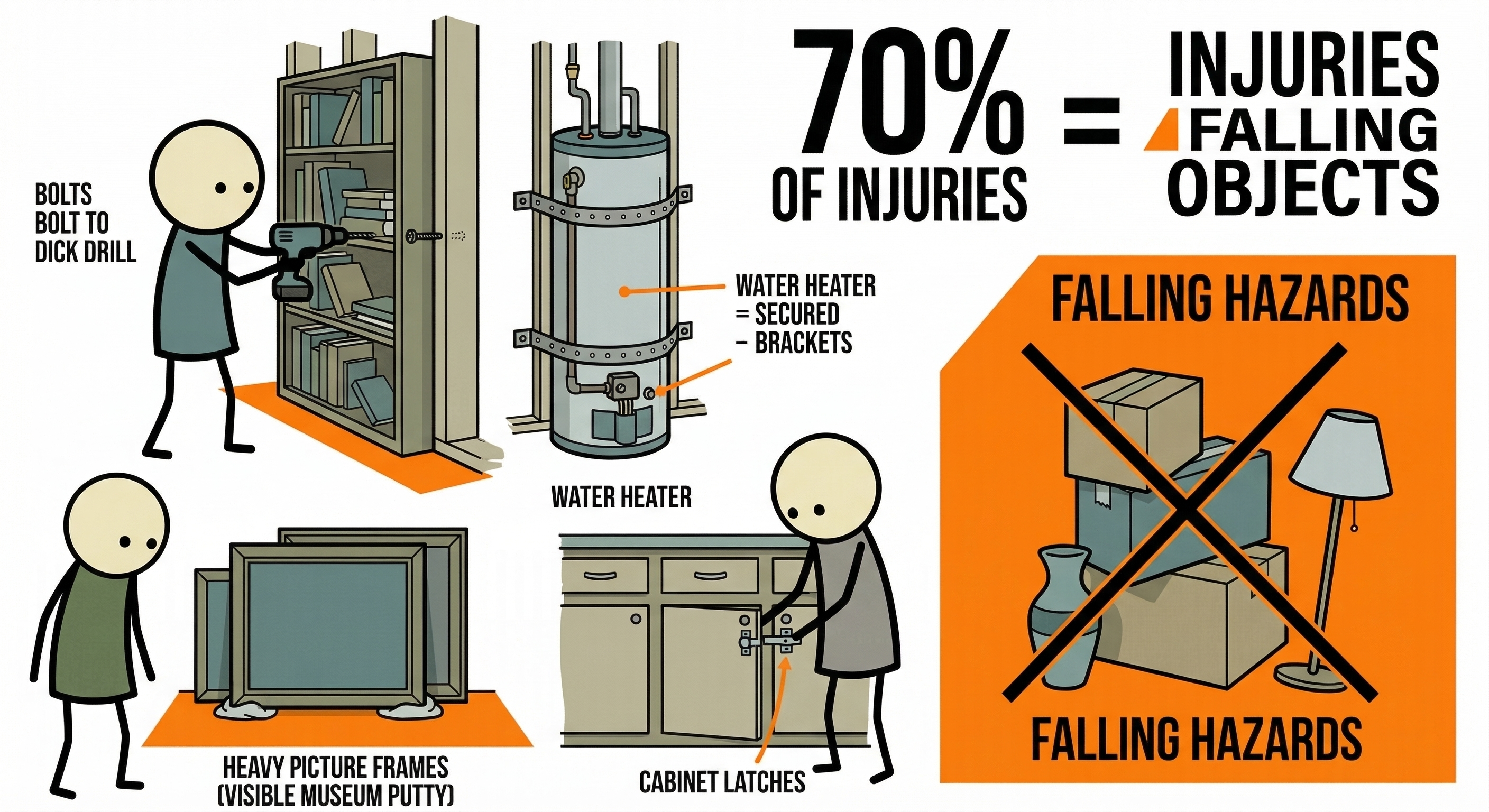
Start by conducting a room-by-room hazard hunt. Walk through your home and imagine the room being violently shaken from side to side. Identify anything tall, heavy, or expensive that could topple. Bookcases, dressers, and entertainment centers must be anchored directly to wall studs using flexible nylon straps. Rigid L-brackets can snap under the intense sheer force of an earthquake, whereas flexible straps allow the furniture to sway independently of the wall without falling.
Move to your kitchen, which is arguably the most dangerous room during a quake. Install heavy-duty safety latches on all cabinets to prevent plates, canned goods, and heavy glassware from spilling out and shattering across the floor. Ensure your refrigerator and gas oven are also tethered to the wall. A shifting gas oven can easily snap a rigid gas line, leading to an immediate and catastrophic fire hazard.
Finally, look at where you sleep. Do not hang heavy mirrors, framed art with glass, or shelving directly over beds or couches. Move heavy objects to lower shelves throughout the house. Strap your water heater securely to the wall studs using heavy-gauge metal strapping; not only does this prevent a massive flood and fire hazard, but a secured water heater also acts as a vital reserve of 40 to 50 gallons of fresh drinking water if municipal lines break.
Building the Ultimate Earthquake Emergency Kit
When a high-magnitude earthquake strikes, municipal infrastructure often collapses. Water mains snap, power grids fail, and supply chains grind to an absolute halt. You cannot rely on grocery stores or running water. Assembling a robust earthquake emergency kit is non-negotiable.
Your kit should be stored in a highly accessible location, ideally near an exit, and packed in durable, water-resistant bags or bins. Here is what a comprehensive earthquake emergency kit must contain:
- Water: The FEMA standard is one gallon of water per person, per day, for a minimum of 72 hours. However, for major quakes, aim for a two-week supply. Include a portable water filtration system (like a LifeStraw or Sawyer filter) and water purification tablets in case you need to source water from rain barrels or local streams.
- Food: Stockpile non-perishable, high-calorie foods that require zero cooking or refrigeration. Think protein bars, canned meats, dehydrated camping meals, and high-energy trail mixes. Do not forget a manual can opener.
- Trauma First Aid Kit: A standard drugstore first aid kit is insufficient for earthquake injuries. You need a trauma kit equipped with tourniquets, Israeli bandages, sterile gauze, splints, butterfly closures, and antiseptic washes. Earthquakes cause crush injuries, severe lacerations, and broken bones.
- Light and Communication: Power will be out. Pack multiple high-lumen LED flashlights, headlamps (for hands-free operation), and extra batteries. A hand-crank NOAA weather radio that doubles as a USB phone charger is a critical piece of gear for receiving emergency broadcasts. Never pack candles or matches, as gas leaks are highly probable.
- Tools and Shelter: Include a specialized gas shutoff wrench, a heavy-duty pry bar (doors often jam as doorframes warp), duct tape, heavy leather work gloves, and N95 masks to protect your lungs from pulverized concrete and drywall dust. Add emergency Mylar blankets, a tarp, and sleeping bags in case your home becomes structurally unsafe and you must sleep outside.
- Sanitation: Broken sewer lines mean you cannot flush toilets. Pack heavy-duty black trash bags, a 5-gallon bucket with a toilet seat lid, toilet paper, and liquid bleach to manage human waste safely and prevent the spread of diseases like cholera.
Create a Household Emergency Plan
Gear is useless without a plan. Your family must know exactly how to communicate and where to meet when the earth stops shaking. Local cellular networks will likely fail due to infrastructural damage or immediate system overload as millions of people try to call loved ones simultaneously.
Designate an out-of-state emergency contact. Long-distance phone lines often remain operational or recover much faster than local cellular towers. Every member of your household should memorize this out-of-state number. After the quake, everyone texts or calls this single point of contact to check in and report their status. Text messages require significantly less bandwidth than voice calls and will often ping through a congested network when a call will not.
Establish designated meeting spots. Choose one spot immediately outside your home (like a specific tree or mailbox) for sudden evacuations, and a secondary location outside your neighborhood (like a local school or park) in case your entire street is compromised or inaccessible.
Financial and Administrative Preparedness
Surviving the physical earthquake is only the first battle; surviving the financial aftermath is the second. Standard homeowners or renters insurance policies strictly exclude earthquake damage. If you live in a seismically active region, you must purchase a separate earthquake insurance policy. Review your coverage details to understand your deductibles and structural limits.
Digitize all your critical documents. Scan your passports, driver's licenses, social security cards, property deeds, insurance policies, and medical records. Store these files on an encrypted, password-protected USB drive inside your earthquake emergency kit, and keep a backup in a secure cloud storage service. Having immediate access to these documents will dramatically expedite your ability to claim FEMA assistance and insurance payouts.
What to Do During an Earthquake: Survive the Shaking
When the P-waves (the initial, fast-moving seismic waves) hit, you will likely hear a low rumble before the violent S-waves arrive. You have mere seconds to react. Your brain will want to panic, run, or freeze. You must override these instincts with the proven tactics of earthquake survival tips.
Drop, Cover, and Hold On
The single most important rule for what to do during earthquake shaking is to Drop, Cover, and Hold On. This methodology is universally endorsed by the CDC, FEMA, the Red Cross, and earthquake researchers worldwide because it works.
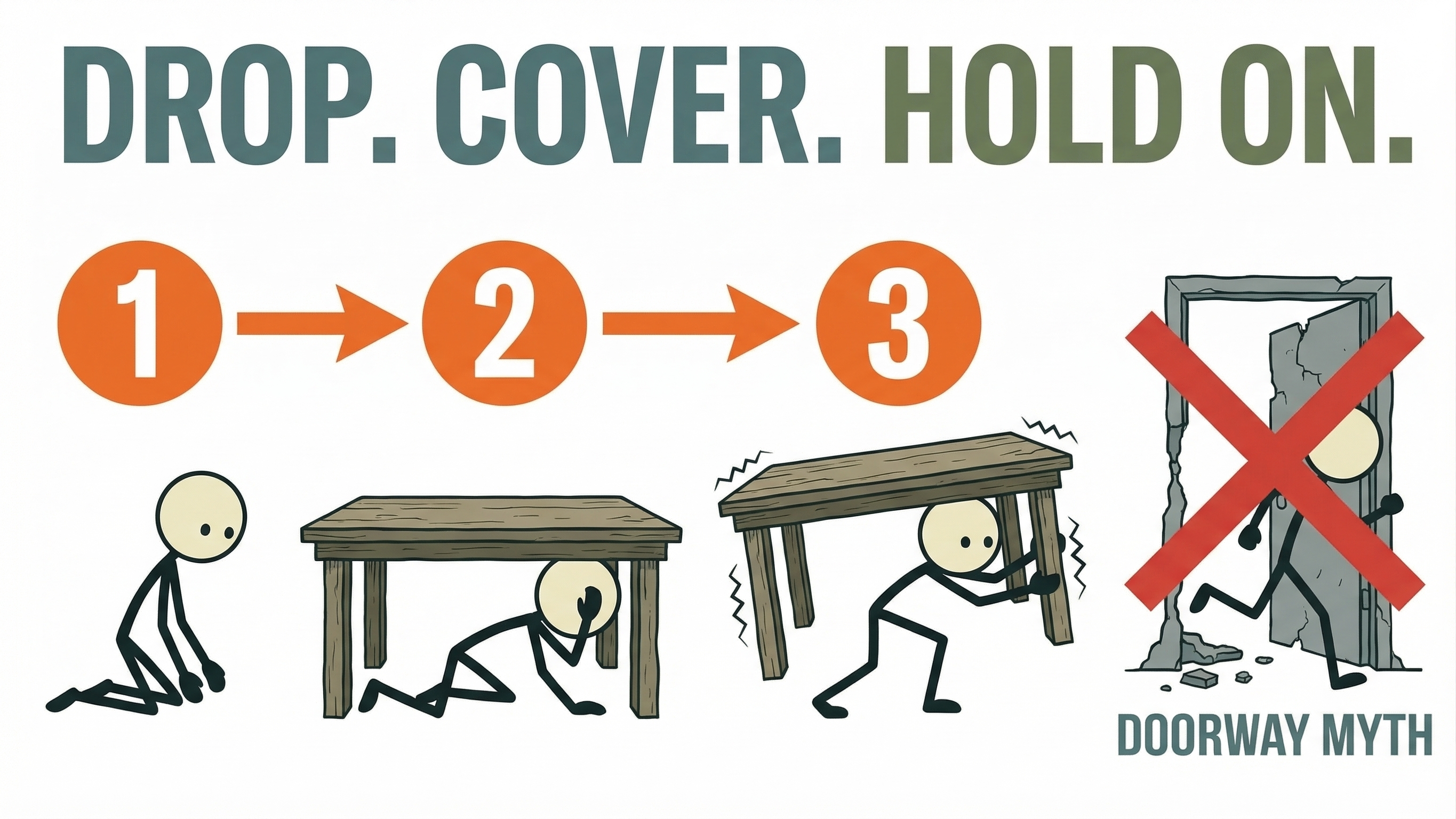
DROP: Immediately drop to your hands and knees. Earthquakes are violent enough to throw you across a room. Dropping lowers your center of gravity, preventing you from being knocked down and breaking a hip or limb. It also allows you to crawl to safety if necessary.
COVER: Take cover under a sturdy desk or table. This protects your head, neck, and vital organs from falling ceiling tiles, shattering light fixtures, and toppling furniture. If there is no table nearby, crawl next to an interior wall (away from windows) and cover your head and neck with your arms.
HOLD ON: Hold on to your shelter. During a severe quake, a table will literally bounce and slide across the floor. Grip the legs of the table firmly so that the shelter moves with you, keeping you protected until the shaking stops.
Do not attempt to run outside. Trying to walk or run during a major earthquake is nearly impossible and exposes you to falling exterior facades, shattering glass, and collapsing chimneys. Furthermore, the "Triangle of Life" theory-which suggests lying next to furniture rather than under it-has been thoroughly debunked by structural engineers. In modern construction, buildings rarely pancake-collapse; the primary threat is falling debris, making a sturdy cover your best defense.
Situational Tactics: Where Are You?
Earthquakes do not wait for you to be safely at home. Your response must adapt instantly to your environment.
- If you are in bed: Stay there. Do not try to roll out or run to another room. Many people suffer severe lacerations stepping on shattered glass in the dark. Lie face down to protect your vital organs, and firmly press a pillow over your head and neck to shield yourself from falling ceiling plaster or glass.
- If you are driving: Safely pull over to the side of the road as quickly as possible, avoiding overpasses, bridges, power lines, and large signposts. Put the car in park, set the emergency brake, and stay inside the vehicle until the shaking stops. The car's suspension and metal frame provide an excellent layer of protection.
- If you are outdoors: Do not run inside. Move immediately to a clear, open area away from buildings, streetlights, trees, and utility wires. Drop to the ground and cover your head. The greatest danger outdoors is directly outside buildings, where architectural details and glass rain down.
- If you are in a high-rise building: Drop, Cover, and Hold On. Do not rush for the stairwells, and absolutely never use the elevators. Expect the fire alarms and sprinkler systems to activate due to the shaking. Wait for the primary shaking to stop before systematically using the stairs to evacuate.
- If you are in a store or theater: Drop, Cover, and Hold On beneath a seat or a sturdy display, keeping away from heavy shelving. Do not join a panicked stampede toward the exits; crowd crush is a deadly secondary hazard during public emergencies.
After the Earthquake: Navigating the Aftermath
The moment the violent shaking ceases, a new phase of survival begins. The environment around you is now compromised, fragile, and highly volatile. Your actions in the first ten minutes can mean the difference between life and death.
The First 10 Minutes: Triage and Assessment
Take a deep breath to center yourself. Adrenaline will be surging, but you must remain analytical. Before you take a single step, ensure you have sturdy, thick-soled shoes on. The floor will likely be covered in shattered glass, splintered wood, and exposed nails. A deep foot laceration in a post-disaster scenario is a severe, potentially life-threatening liability.
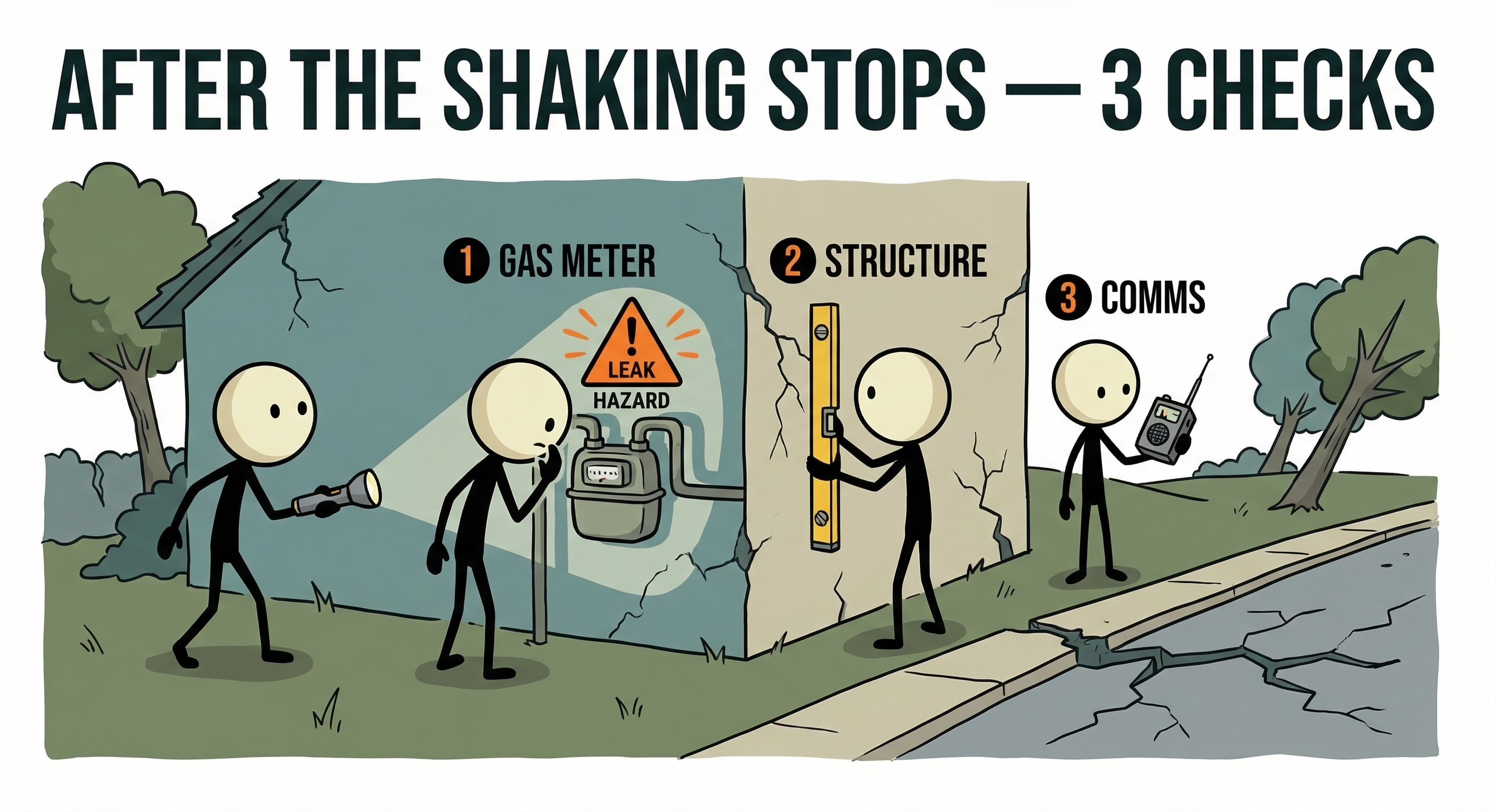
Grab your flashlight. Do not flick light switches, light matches, or use lighters. Sparks can ignite unseen gas leaks, causing devastating explosions. Once you are properly shod and have a safe light source, check yourself and your family for injuries. Apply direct pressure to any bleeding wounds and use your trauma kit to stabilize serious injuries. Emergency Medical Services (EMS) will not be coming, so you must act as your own first responder.
Next, perform an immediate utility assessment. Walk to your gas meter. If you smell the distinct odor of rotten eggs, hear a hissing sound, or see the dials spinning rapidly, use your shutoff wrench to turn the valve a quarter-turn until it is perpendicular to the pipe. Note: Only shut off the gas if you suspect a leak. Once turned off, only a licensed professional can safely turn it back on.
Inspect your water lines and electrical panel. If you see frayed wires, sparking, or smell burning insulation, turn off the electricity at the main breaker. If water pipes are ruptured, shut off the main water valve to prevent your home from flooding and to protect the clean water reserve trapped inside your home's plumbing and water heater.
Dealing with Aftershocks
Earthquakes are rarely isolated events. The mainshock will inevitably be followed by aftershocks. These secondary tremors can occur minutes, days, or even months after the initial event. While generally less powerful than the mainshock, aftershocks are incredibly dangerous because they act upon structures that have already been weakened.
A building that barely survived the primary quake could easily collapse during a mild aftershock. If your home shows signs of severe structural damage-such as massive diagonal cracks in the drywall, a shifted foundation, or a sagging roofline-evacuate immediately. Grab your earthquake emergency kit and move to an open area. Treat every single aftershock with the same Drop, Cover, and Hold On protocol as the main event.
Information, Communication, and Community
Once you are physically safe and your utilities are secured, you need information. Turn on your battery-powered or hand-crank NOAA radio to listen for emergency broadcasts, evacuation orders, and updates on local hazards like tsunami warnings (if you are in a coastal area) or chemical spills.
Execute your communication plan. Send a brief text message to your out-of-state contact detailing your status and location. Keep your phone usage to an absolute minimum to preserve battery life and keep the cellular networks clear for first responders.
Look out for your neighbors. In major disasters, the most effective search and rescue operations are conducted by everyday citizens pulling their neighbors from the wreckage before official teams arrive. Check on the elderly, those with disabilities, and families with young children in your immediate vicinity. A community that works together exponentially increases its collective chance of survival.
Long-term Recovery and Sanitation
As the hours turn into days, your focus will shift from immediate trauma response to sustained survival. Managing sanitation becomes paramount. Without running water, diseases multiply rapidly. Implement your twin-bucket system for human waste, separating liquids from solids, and use bleach to maintain hygiene. Wash your hands meticulously with soap and filtered water or use heavy-duty hand sanitizer before touching any of your food or water supplies.
Ration your supplies intelligently. Do not ration water to the point of dehydration-drink what your body needs to stay clear-headed and physically capable. Instead, ration your physical exertion to lower your water requirements. Keep your family together, maintain a calm and structured routine, and continually assess your environment for new hazards as the recovery effort slowly begins.
Surviving an earthquake is a profound test of human resilience. The tectonic plates beneath us will inevitably shift, and the ground will break. But disaster only dictates the environment; it does not dictate your outcome. By internalizing these protocols, securing your home, and building a comprehensive emergency kit, you strip the earthquake of its greatest weapon: surprise. You are no longer a victim waiting for the ground to stop shaking. You are a prepared, capable individual ready to protect your family, navigate the chaos, and rebuild when the dust finally settles.
To further strengthen your natural disaster survival skills, consider reviewing our emergency preparedness guide. You can also build your go-bag using our interactive tool. For additional training, browse our preparedness courses to master earthquake response techniques. Also review family evacuation drills to practice your earthquake plan.
Frequently Asked Questions
What should I do during an earthquake?
Drop, Cover, and Hold On. Drop to your hands and knees, take cover under a sturdy table or desk (or against an interior wall if no table is available), and hold on until the shaking stops. Stay away from windows, exterior walls, and anything that could fall. Do not run outside during shaking - most injuries occur from falling objects, not building collapse.
How do I secure my home against earthquake damage?
The most impactful steps are: bolt tall furniture (bookshelves, water heaters, refrigerators) to wall studs, use museum putty or earthquake straps to secure items on shelves, install cabinet latches to prevent doors from flying open, and strap your water heater with earthquake safety straps. FEMA estimates that up to 70% of earthquake injuries come from falling objects - most of which can be prevented.
What should I do immediately after an earthquake stops?
Check for injuries first, then check for gas leaks (smell for rotten eggs - if detected, open windows and leave immediately). Inspect your home for structural damage before re-entering. Turn on a battery-powered radio for official instructions. Stay off the roads and phone lines unless it's a genuine emergency. Expect and prepare for aftershocks, which can occur for hours or days. For a broader perspective on how communities handle these situations, see our real-world emergency scenarios guide.
Do I need a special earthquake kit different from a regular emergency kit?
Your core 72-hour emergency kit works for earthquakes, but add a few earthquake-specific items: a pair of sturdy shoes under every bed (broken glass is the first hazard after shaking stops), heavy gloves for moving debris, a wrench or shut-off tool for your gas valve, a whistle to signal for help if trapped, and dust masks for aftershock debris.
How far in advance should I prepare for an earthquake?
Today. Unlike hurricanes or floods, earthquakes give zero warning. The time to secure furniture, store water, and build your kit is months before any threat. The USGS estimates there is a 60% chance of a major earthquake (magnitude 6.7+) in the San Francisco Bay Area within the next 30 years - but every region with fault lines carries real risk. Preparation done today could save your life tomorrow.
Sources & Further Reading
Related resource: Catastrophe Survival 101 Course.