⚡ Key Facts
- Grid Vulnerability: According to the U.S. Department of Energy (DOE), weather-related power outages have increased by roughly 80% over the past two decades, exposing millions of households to extended periods without municipal power. For the practical checklist side, use the community emergency preparedness guide.
- Carbon Monoxide Dangers: The Centers for Disease Control and Prevention (CDC) reports that more than 400 Americans die annually from unintentional carbon monoxide (CO) poisoning, with a significant spike occurring during post-storm power outages due to improperly operated portable generators.
- Opportunistic Property Crime: Federal Emergency Management Agency (FEMA) disaster recovery assessments show that the vast majority of blackout-related security breaches are opportunistic property crimes—such as thefts of unsecured generators, tools, and fuel—rather than organized violent intrusions.
- Hardware Failure Points: Standard builder-grade residential entry doors can often be kicked open in under five seconds because they use short three-quarter-inch screws that only anchor into the softwood door jamb rather than the structural wall framing.
- Protocol Survival membership community: Research from the American Red Cross indicates that neighborhood preparedness networks with established emergency communication plan networks and mutual-assistance agreements recover substantially faster from multi-day infrastructure failures than isolated households.
When the hum of the electrical grid suddenly dies, human psychology shifts in an instant. For the first few hours, a widespread blackout often feels like a minor novelty—a quiet evening by candlelight or an excuse to disconnect from digital screens. However, as day transitions into night and hour twelve stretches into day three, the physical landscape transforms. Streetlights go dark, traffic signals flash out, automated municipal surveillance goes blind, and standard alarm systems begin chirping as their internal backup batteries run dry. Maintaining absolute calm during these critical transitions requires deliberate preparation, not panicked improvisation. Comprehensive power outage security emergency preparedness is not about constructing an armed bunker; it is about building sensible physical barriers, controlling environmental signatures, maintaining open communication with your neighbors, and preserving mental clarity under pressure.
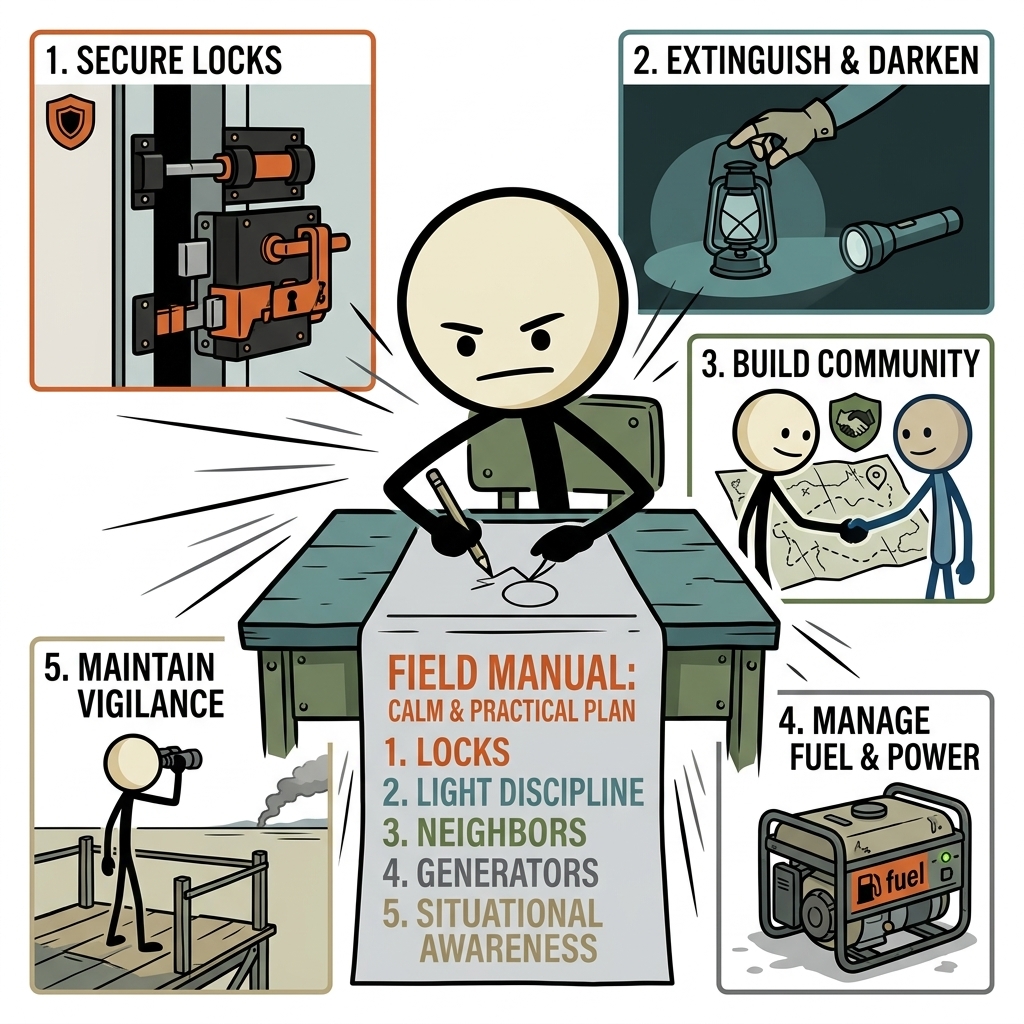
Hardening the Physical Perimeter: Entry Points and Mechanical Locks
Modern residential security relies heavily on active technology: video doorbells, smart locks, motion-activated cloud cameras, and monitored alarm systems. The moment a sustained blackout occurs, your home's security posture must seamlessly fall back onto passive, mechanical fundamentals. Power outage security begins at the structural boundary of your home, ensuring that every portal of entry remains robust regardless of whether the local electrical grid or Wi-Fi network is functional. Use the emergency preparedness guide to turn those basics into a household plan.
Upgrading Exterior Doors and Strike Plates
Most exterior doors in modern residential developments are equipped with standard Grade 3 locks held in place by flimsy, three-quarter-inch screws. When an intruder applies physical force, the screws do not snap; instead, they tear out of the soft pine trim of the door jamb. True mechanical security requires upgrading your hardware long before the power grid experiences a failure.
- Reinforce Strike Plates: Replace standard factory strike plates with heavy-duty, four-hole commercial box strike plates. Secure them using three-inch, hardened steel wood screws driven directly into the rough framing 2x4 studs behind the finished jamb.
- Verify Deadbolt Quality: Ensure all exterior entry doors utilize an ANSI Grade 1 deadbolt featuring a full one-inch throw bolt with a hardened steel anti-saw roller pin. Grade 1 hardware withstands aggressive blunt-force impacts and repeated hammer strikes that would shatter cheaper zinc-alloy mechanisms.
- Address Door Jamb Weaknesses: Consider installing full-length steel door frame reinforcement channels. These plates sandwich the wood framing between layers of heavy-gauge steel, distributing the kinetic energy of a kick across the entire height of the door rather than concentrating it on the single point around the lock latch.
- Electronic Lock Contingencies: If your home uses keypad or motorized electronic locks, verify their mechanical bypass capabilities. Keep a physical key stored in a secure, fireproof location, and inspect backup internal batteries biannually to prevent becoming locked out of your own residence during a municipal system failure.
Securing Windows, Sliders, and Basement Portals
Ground-floor windows and sliding glass patio doors represent the most vulnerable architectural components of any residential structure. When standard security sensors lose their network connection, these entry points require mechanical redundancy to deter unauthorized entry.
Sliding glass doors are particularly notorious for weak, spring-loaded latches that can be bypassed in seconds using a common flathead screwdriver. Secure these doors by placing an extruded aluminum or solid hardwood security bar (a "charley bar") into the bottom track, sized precisely to prevent horizontal movement. Additionally, install top-track anti-lift screws or brackets that prevent bad actors from lifting the entire moving panel out of its frame from the exterior. For ground-level double-hung windows, drill angled holes through the overlapping sashes and insert steel pins or sliding sash locks that limit opening width to no more than four inches for ventilation.
The Garage Door Vulnerability
An attached garage is frequently the soft underbelly of residential security. When the power goes out, electric overhead openers become completely inoperative unless connected to an uninterrupted battery backup system. However, the manual release rope—the red cord dangling from the overhead carriage—can be manipulated from the outside by inserting a stiff wire coat hanger through the top rubber weatherstripping of the garage door.
To eliminate this threat during an extended grid outage, zip-tie the emergency release lever in its locked position. This still allows you to snip the tie from the inside in a genuine life-safety emergency while preventing exterior latch-hooking. Furthermore, slide the manual mechanical side throw-bolts into the door track from the interior. Lock these bolts with heavy-duty padlocks to physically anchor the garage door panels directly to the steel vertical tracks, rendering external lifting virtually impossible.
Mastering Light Discipline: Managing Your Environmental Footprint
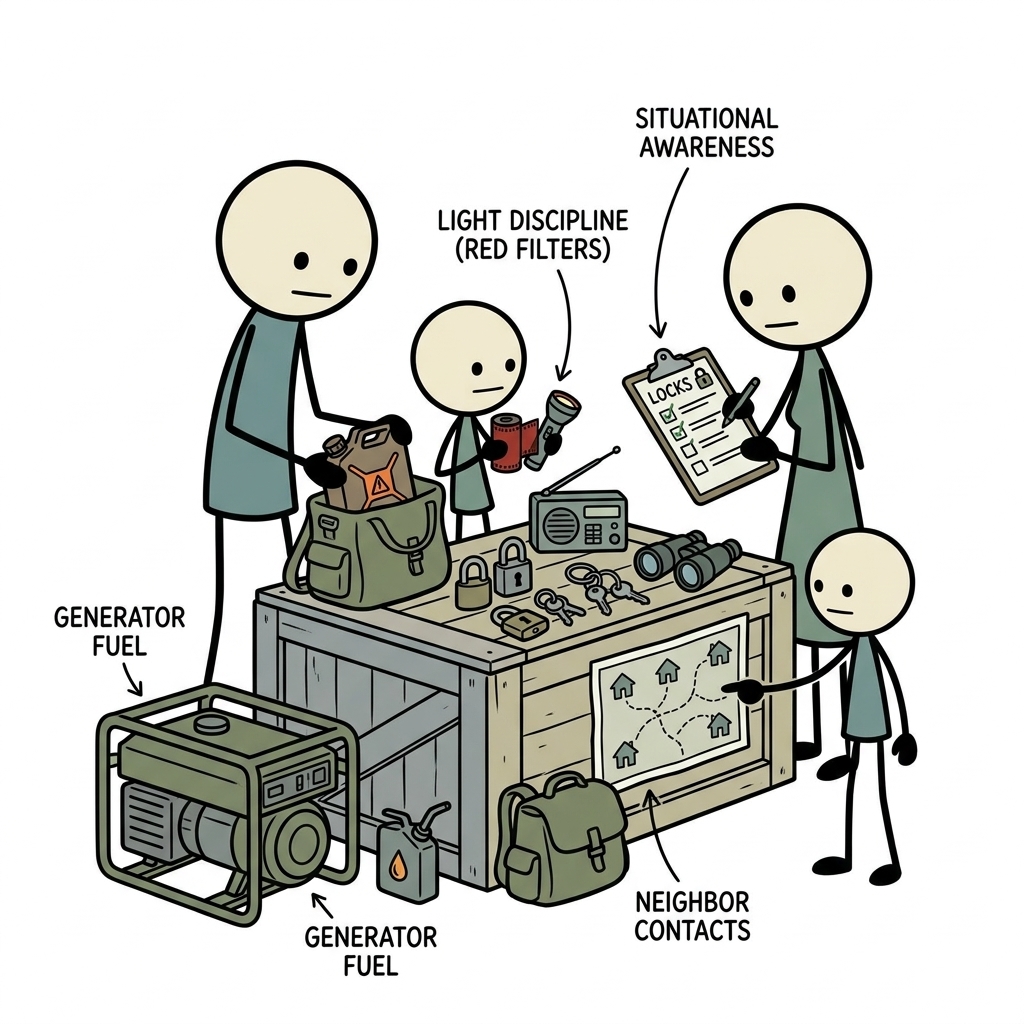
In a catastrophic grid failure, lighting functions as a visual beacon. A single fully illuminated window shining across a completely blackened neighborhood sends an unmistakable message from half a mile away: this home has active power, operational resources, and potential supplies. Practicing strict light discipline does not mean living in pitch darkness; it means deliberately controlling where, when, and how your illumination is cast to avoid drawing unnecessary attention.
The Psychology of the Blackout Signature
During an unexpected regional emergency, opportunistic individuals and desperate actors naturally gravitate toward signs of normalcy and abundance. If forty consecutive homes are completely dark and one residence has unshaded windows glowing with bright fluorescent light, that single residence becomes the visual center of the entire quadrant. Effective power outage security emergency preparedness dictates that your external physical signature should match the baseline of your environment as closely as possible.
Selecting and Deploying Blackout Curtains
Standard decorative window treatments, such as sheer drapes or lightweight horizontal blinds, do almost nothing to contain interior light at night. Investing in purpose-built thermal blackout curtains provides two critical survival benefits: complete light containment and significant thermal insulation against extreme outdoor temperatures.
- Edge-Sealing Techniques: Even heavy blackout fabric leaks light along the top, bottom, and sides if installed incorrectly. Use adhesive hook-and-loop (Velcro) strips applied to the window frame and the reverse side of the curtain hem to create a light-tight seal against the drywall.
- Reflective Insulation Panels: In cold-weather winter outages or extreme summer heat waves, cut rigid foam insulation panels or dual-layer radiant barrier foil to friction-fit securely inside the interior window frame. This completely blocks 100% of light emissions while drastically slowing radiant heat transfer.
- Establish an Interior "Core" Room: Identify a central living space that has no exterior-facing windows—such as a hallway, interior bathroom, or basement family room. Concentrate your primary evening activities, cooking, and reading in this core zone to eliminate the risk of accidental perimeter light leaks.
Lumen Management and Spectrum Control
The human eye adapts to absolute darkness over approximately thirty to forty-five minutes, gaining sensitivity through the production of rhodopsin in the retinas. Firing up a 1,000-lumen tactical flashlight inside a darkened room not only destroys your natural night vision for up to an hour but also creates massive illumination bounce that can be spotted through the smallest gap in a curtain.
Shift your lighting doctrine to low-lumen, task-specific illumination. Utilize headlamps and lanterns that feature red or warm amber LED modes. Red light operates at a wavelength that does not disrupt your eye’s rod cells, allowing you to read maps, prepare food, or administer medical care without blinding yourself or projecting a high-contrast beacon visible from the street. Keep task lighting below 15 to 30 lumens whenever moving through rooms that feature perimeter windows. A prepared go-bag checklist also keeps lights, batteries, and spare power in one place.
Generator Security, Sound Baffling, and Life Safety
A portable generator is among the most valuable assets you can operate during an extended blackout, but it is also one of the most hazardous. It presents three major operational challenges: it creates a potent acoustic signature that broadcasts your location, it represents a high-value target for opportunistic theft, and it generates deadly carbon monoxide gas that can incapacitate a household within minutes.
Carbon Monoxide Protocols: Non-Negotiable Safety
No discussion of power outage security is complete without addressing invisible atmospheric hazards. The CDC, the National Oceanic and Atmospheric Administration (NOAA), and the Consumer Product Safety Commission (CPSC) consistently warn that the primary killer during major storms is not falling debris or freezing temperatures—it is carbon monoxide poisoning from consumer generators operated too close to residential dwellings.
Never, under any circumstances, operate an internal combustion generator inside a home, garage, basement, crawlspace, or covered porch, even if the doors and windows are left wide open. The generator must remain a minimum of 20 feet away from any structure, with the engine exhaust pointed directly downwind and away from all building openings, eaves, fresh air intakes, and soffit vents. Install battery-powered, digital-readout carbon monoxide detectors on every level of your home, testing them monthly and replacing their backup batteries semi-annually. Pair that safety step with an emergency generator maintenance routine before storm season.
Physical Hardening Against Generator Theft
A running generator left unattended in a driveway or front yard is an invitation for opportunistic theft. During a regional power outage, black-market demand for functional generators skyrockets, and thieves frequently target equipment operating under the cover of darkness. Implementing physical theft countermeasures must be part of your pre-crisis installation plan.
- Ground Anchors: Drive a heavy-duty, commercial-grade earth screw or install an expanding masonry eye-bolt into an exterior concrete patio. Use this point to secure the machine to an immovable physical foundation.
- Case-Hardened Security Chains: Standard hardware-store steel chains and standard braided cables can be sheared through quietly in under twenty seconds using manual 24-inch bolt cutters. Use a through-hardened 12mm to 16mm manganese-steel security chain paired with a fully shrouded, high-security padlock that resists drilling, picking, and cutting attacks.
- Concealment from Sightlines: Position the generator in an enclosed backyard or behind an opaque privacy fence. A thief cannot target what they cannot see; keeping the machine out of direct line-of-sight from the main roadway eliminates drive-by scouting.
Acoustic Mitigation: Dampening the Operating Signature
Open-frame conventional generators produce between 72 and 80 decibels of harsh, mechanical clatter at 23 feet—roughly the equivalent of running a commercial lawnmower continuously on your patio. This acoustic signature carries for multiple suburban blocks, instantly alerting anyone within a quarter-mile radius to your power status.
Whenever financially feasible, invest in an enclosed inverter generator. Inverter units run at variable engine speeds based on real-time load, operating at a remarkably quiet 50 to 58 decibels under normal conditions. If you must run a standard open-frame contractor generator, build a modular, fire-resistant acoustic baffle tent. Using exterior-grade plywood lined with non-flammable Roxul mineral wool insulation, construct a four-sided lean-to screen around the unit. Ensure the structure maintains at least two feet of clearance on all sides, allows unrestricted convective airflow for engine cooling, and leaves the exhaust path completely unobstructed. This simple setup can attenuate directional acoustic emissions by up to 10 to 12 decibels, effectively cutting the perceived sound volume in half.
Neighborhood Cohesion: The Collective Defense Paradigm
A solitary home surrounded by struggling neighbors is inherently fragile, no matter how heavily reinforced its entryways may be. True resilience and long-term security emerge from collective stability. Cultivating a cooperative relationship with the people living directly across the street and on either side of your property line is the single most effective way to protect your home during an extended crisis.
Establishing Informal Mutual-Aid Protocols
Organizing a resilient neighborhood network does not require formal bureaucratic committees or survivalist terminology. It starts with simple, friendly conversations during benign times. Identifying the skill sets, specialized equipment, and medical vulnerabilities of your immediate neighbors transforms an isolated collection of households into an organized, supportive community.
Hold a block gathering or casual front-yard conversation to discuss basic emergency preparedness. Determine who possesses mechanical skills, medical certifications, chain saws, emergency generators, or alternative water collection systems. Simultaneously, catalog neighbors who may need special assistance during a winter or summer outage: elderly residents living alone, families with newborn infants, or individuals who rely on electrically powered oxygen concentrators and refrigerated medications.
Creating Neighborhood Communication Channels
When cellular infrastructure crashes—whether due to fiber line cuts, physical tower damage, or battery exhaustion at the base transceiver stations—conventional smartphones become little more than expensive flashlights. You need localized, resilient communication mechanisms that operate independently of commercial networks.
- Family Radio Service (FRS) and GMRS: Distribute inexpensive, pre-programmed FRS/GMRS handheld two-way radios among trusted block captains. Establish a standardized schedule for communications—such as checking in for five minutes on the top of every odd-numbered hour (e.g., 0900, 1100, 1300)—to conserve precious radio battery life while maintaining reliable contact.
- Visual Signaling Arrays: Agree on low-tech, passive visual indicators for vulnerable neighbors. For example, placing a green card in a front-facing window indicates the household is safe and requires no assistance; a red card or a piece of reflective cloth hanging from the porch indicates an urgent need for medical help, water, or mechanical support.
- Neighborhood Walking Patrols: Organize informal, two-person neighbor walking teams to traverse the block during morning and evening twilight hours. These walking pairs serve primarily as visible, friendly presences to deter opportunistic property crime, check for downed tree limbs or gas leaks, and provide reassurance to residents feeling anxious about the extended blackout.
Situational Awareness and Preserving Domestic Calm
A crisis environment can rapidly degrade cognitive performance. Sleep deprivation, broken routines, sensory disorientation from unexpected darkness, and constant background anxiety cause individuals to misinterpret their surroundings, often reacting with either paralyzed complacency or dangerous overreaction. Maintaining strict situational awareness allows you to make calm, measured decisions based on verifiable facts rather than groundless rumors.
Applying the OODA Loop to Grid-Down Security
The OODA Loop—Observe, Orient, Decide, Act—is an information-processing framework developed by military strategist John Boyd that applies perfectly to civilian emergency management. During an extended outage, your environment is dynamic; the conditions on Day 1 will not match the realities of Day 4.
Observe: Continuously monitor local conditions without falling into catastrophic hypervigilance. What is the weather doing? Are passing vehicles traveling at normal speeds, or is traffic erratic? Are local emergency sirens sounding more or less frequently? Has the baseline noise level of your neighborhood shifted?
Orient: Process your observations through an objective, calm lens. If you hear loud shouting down the block, do not automatically assume violent civil disorder is breaking out. It is far more likely a neighbor attempting to coordinate a tree-removal effort or frustrated individuals dealing with a dead car battery. Contextualize what you see and hear before taking action.
Decide: Formulate a specific, proportionate response. If a storm is worsening and street drainage is backing up, your decision may simply be to shift critical supplies out of the basement to the second floor and confirm your perimeter locks are engaged.
Act: Execute your decision methodically and quietly. Once the action is complete, loop back immediately to observation to assess the results of your decision.
Alternative Information Gathering
In a blackout, information is security. Rumors and misinformation spread rapidly when people are disconnected from their normal communication channels. You must maintain the ability to receive official emergency broadcasts from government and civil defense authorities without relying on municipal power or domestic broadband internet.
Keep a dedicated, multi-powered emergency radio on hand that can receive standard AM/FM frequencies as well as the seven dedicated NOAA All-Hazards frequencies. Look for models powered by high-capacity rechargeable lithium cells, disposable alkaline batteries, a built-in solar trickle panel, and an emergency hand crank. Tune in to your local Emergency Alert System (EAS) station at designated intervals throughout the day to receive validated updates regarding municipal restoration timelines, boil-water advisories, shelter locations, and severe weather tracks. Keep the home emergency radio guide nearby when choosing and testing that backup source.
Preserving Routines and Domestic Normalcy
Security is not merely a matter of locks and chains; it is deeply rooted in your household's internal psychology. When daily habits completely collapse, panic, irritability, and despair quickly fill the void. Maintaining a strict, predictable domestic routine creates a powerful sense of normalcy and control, particularly for young children or elderly family members.
Set a consistent schedule for waking, meal preparation, equipment maintenance, and bedtime. Ensure family members change out of sleepwear into functional, durable clothing every morning. Sit down together for hot, well-prepared meals cooked on a camping stove or outdoor grill. Dedicate daylight hours to productive tasks—such as water purification, security checks, and reading—while reserving the evening for low-light board games, conversation, and early rest. This intentional structure reduces stress hormones, keeps judgment sharp, and prevents the emotional friction that undermines situational awareness.
The Power Outage Security Checklist
To successfully execute these security protocols under duress, you must organize your actions chronologically. Use this comprehensive power outage security checklist to guide your household's operational transition from normal grid operations to sustained off-grid resilience.
Phase 1: Immediate Actions (The First 60 Minutes)
- [ ] Verify the Scope: Look down the street to confirm whether the outage is localized to your home's breaker panel or affecting the entire neighborhood. Check municipal utility outage maps via mobile phone if cellular service is still active.
- [ ] Disconnect Sensitive Electronics: Unplug computers, televisions, and expensive kitchen appliances to protect them from high-voltage surges when the municipal electrical grid is eventually re-energized.
- [ ] Secure Mechanical Entry Points: Walk your perimeter immediately. Verify that all exterior doors, sliding glass doors, and ground-floor windows are locked. Zip-tie the emergency release lever on all overhead garage doors.
- [ ] Deploy Low-Impact Task Lighting: Distribute headlamps and compact LED flashlights set to low-lumen or red-spectrum modes. Avoid lighting open-flame wax candles due to the severe, well-documented fire hazard highlighted by the American Red Cross and FEMA.
- [ ] Establish the Primary Cold Chain: Keep refrigerator and freezer doors closed. According to the CDC, an unopened refrigerator will keep food safely cold for approximately 4 hours, while a full, unopened chest freezer can maintain safe temperatures for up to 48 hours.
Phase 2: Operational Stabilization (Hours 2 through 12)
- [ ] Deploy Window Light Baffles: Close all blackout curtains, heavy drapes, or exterior storm shutters before sunset. If using an interior room with unshaded windows, hang thick wool blankets or fit foam insulation panels to prevent interior light leakage.
- [ ] Position and Anchor the Generator: Wheel your generator out to a well-ventilated exterior location at least 20 feet away from any door, window, or vent. Secure the frame to an immovable anchor with a heavy, case-hardened steel chain and security lock.
- [ ] Verify Carbon Monoxide Detectors: Push the test button on every battery-operated CO detector throughout your home. Ensure digital readouts register zero parts per million (PPM) before turning in for the night.
- [ ] Initialize Information Monitoring: Turn on your battery-operated NOAA weather radio and verify reception of the nearest local emergency broadcast station. Note scheduled broadcast update times on a notepad.
- [ ] Conduct Neighbor Check-Ins: Walk your street before darkness falls completely. Check on adjacent households, establish radio contact channels or window visual signals, and verify that elderly neighbors have adequate warmth, water, and essential medicines.
Phase 3: Sustained Outage Operations (Day 2 and Beyond)
- [ ] Maintain Perimeter Hygiene: Conduct daily morning and evening walk-arounds of your entire property. Inspect exterior fences, check ground anchors on outbuildings and fuel stores, and clear away any fallen storm debris that compromises sightlines.
- [ ] Rotate Generator Runs: Do not run your generator 24 hours a day. Adopt a cycling schedule—running the unit for two to three hours in the morning and two hours in the evening to chill refrigeration units, pump well water, and charge battery banks. This drastically reduces fuel consumption, dampens your acoustic signature, and prolongs engine oil life.
- [ ] Monitor Battery Logistics: Establish a centralized indoor charging station powered exclusively during scheduled generator cycling windows. Consolidate and recharge all household power banks, two-way radios, tactical lights, and medical gear simultaneously.
- [ ] Coordinate Community Watch: Coordinate with trusted neighbors to ensure alternating presence on front porches or shared walking routes, particularly during peak darkness hours. A visible, alert community is universally avoided by opportunistic actors.
- [ ] Sustain Mental and Physical Health: Prioritize personal hydration, balanced nutrition, and restful sleep, and use the water calculator to estimate the household supply that supports those routines. Maintain regular household wake and sleep schedules, keep lines of communication open and supportive among family members, and manage anxiety through structured daily tasks.
True Security Lies in Calm Execution
Maintaining home security during an extended, infrastructure-crippling power outage does not require paranoid defensiveness or complicated, theatrical tactics. True security is the natural outcome of quiet, deliberate, and practical preparation executed with a calm mind. By mechanically reinforcing your physical entryways, strictly controlling your light and sound signatures, placing your secondary power generation equipment safely out of reach of both thieves and living spaces, and forging unified, supportive ties with the neighbors who share your street, you transform vulnerability into enduring resilience. When the electrical grid eventually falters, follow your community emergency preparedness plan so your home is not a target of opportunity or an island of fear, but a secure, well-managed sanctuary capable of weathering the storm with quiet confidence.
Frequently Asked Questions
What should a power outage security plan include?
Start with the immediate safety steps, the supplies and records your household needs, a communication plan, and a regular review schedule. Follow local official guidance during an active emergency.
How often should I review power outage security preparations?
Review them at least twice a year and whenever your household, medication, location, or local risks change. Replace expired supplies and practice key steps.
Where can I find reliable emergency guidance?
Use local emergency management alerts and established public-health or emergency-management agencies. A blog guide should support, not replace, official real-time instructions.