⚡ Key Facts
- Rapid Degradation: Untreated gasoline can begin to break down, lose octane, and form gummy deposits in as little as 30 to 60 days. For the practical checklist side, use the community emergency preparedness guide.
- Strict Fire Codes: The National Fire Protection Association (NFPA) Code 30 limits residential indoor storage of Class I flammable liquids (like gasoline) to a maximum of 25 gallons. For the practical checklist side, use the neighborhood preparedness network.
- Heavy Vapors: Gasoline vapors are 3 to 4 times heavier than air, meaning they sink to the floor and can travel along the ground to find ignition sources up to 30 feet away. For the practical checklist side, use the emergency communication plan.
- Phase Separation: Modern E10 gasoline (10% ethanol) can absorb moisture from the air, leading to phase separation—where water and ethanol bind and sink to the bottom—within 90 days. For the practical checklist side, use the family emergency planning guide.
- Flashpoint Hazard: Gasoline has an extremely low flashpoint of -45°F (-43°C), meaning it can ignite at virtually any ambient temperature.
Imagine a severe winter storm or a sudden grid failure knocks out your local power infrastructure for days. Your household family emergency plan relies on a dual-fuel generator to keep your heating, refrigeration, and medical equipment running. You pull the starter cord, but the engine sputters, coughs, and dies. The culprit isn’t a mechanical failure; it is the stale, moisture-contaminated fuel sitting in your garage. According to the Federal Emergency Management Agency (FEMA), fuel security is a cornerstone of household resilience, yet improper fuel management remains one of the most common points of failure in disaster planning. Mastering the science of safe, legal, and long-term gasoline storage is not just about hoarding fuel—it is about understanding chemistry, physics, and fire safety to protect your home and family when the grid goes dark.
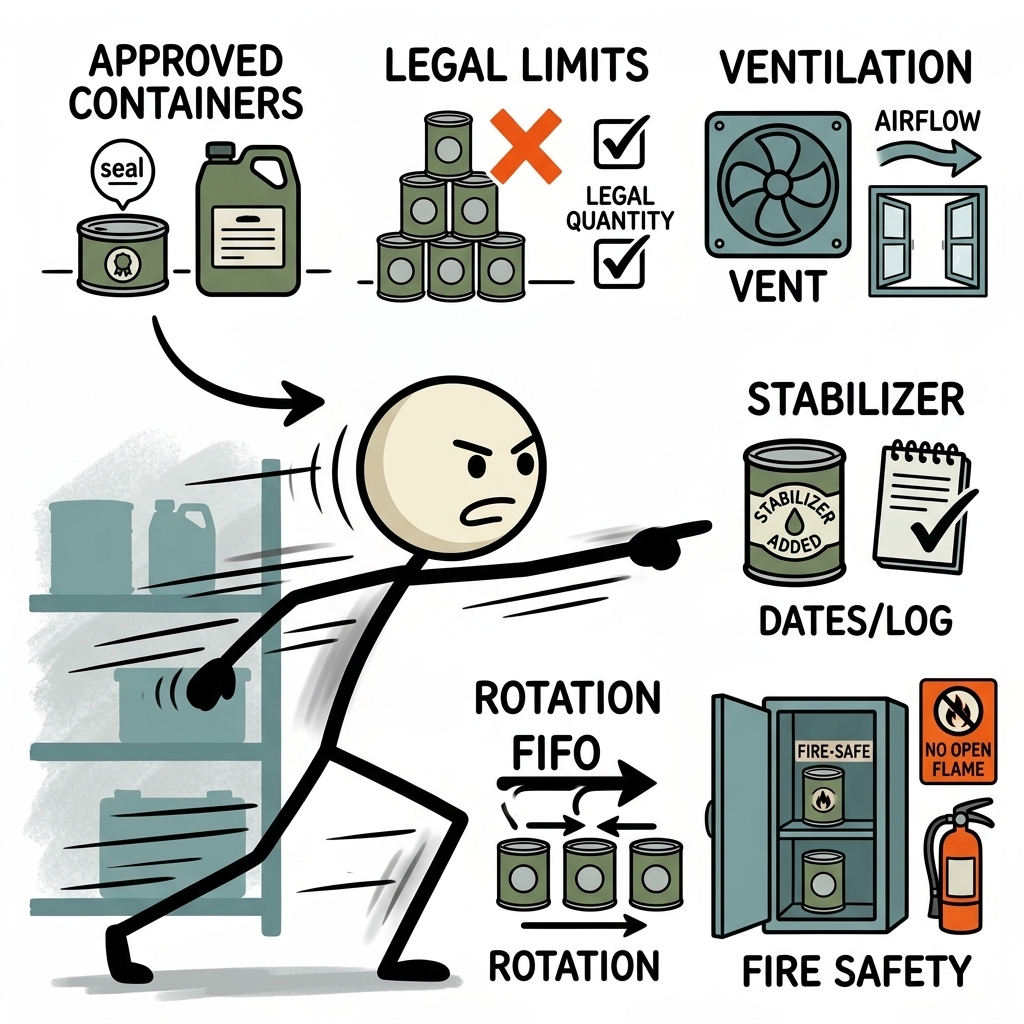
The Chemistry of Fuel Degradation: Why Gasoline Spoils
To understand the mechanics of safe gasoline storage, you must first understand what gasoline is. Gasoline is not a single chemical compound; it is a complex volatile mixture of over 150 different hydrocarbons, additives, and blending agents. The moment fuel leaves the refinery pump, it begins to undergo a continuous process of chemical degradation. Exposure to oxygen, temperature fluctuations, and moisture initiates a countdown timer on the fuel's viability.
The Threat of Oxidation and Evaporation
When gasoline is exposed to oxygen, the hydrocarbons within the fuel react to form peroxides. This chemical chain reaction gradually transforms the liquid fuel into a sticky, amber-colored gum and varnish. These sticky residues clog the microscopic jets of carburetors, coat intake valves, and ruin fuel injectors. Simultaneously, the highly volatile, low-boiling-point hydrocarbons—the compounds responsible for easy engine starts—evaporate into the headspace of the container. This loss of volatile organic compounds (VOCs) lowers the fuel's octane rating, making it highly resistant to clean combustion and causing engine knocking or complete ignition failure.
Ethanol and the Nightmare of Phase Separation
Most gasoline sold in the United States contains up to 10% or 15% ethanol (E10 or E15) to meet Environmental Protection Agency (EPA) renewable fuel standards. Ethanol is highly hydrophilic, meaning it readily absorbs water directly from the humidity in the surrounding air. A sealed container with temperature-driven pressure changes will "breathe" if not perfectly airtight, drawing in moist air.
Once the water content in the gasoline reaches a critical threshold (roughly 0.5% by volume at 60°F), the ethanol and water bind together. Because this ethanol-water mixture is heavier than the surrounding hydrocarbons, it drops out of suspension and sinks to the bottom of the storage container. This chemical failure is known as phase separation. The top layer of fuel is left stripped of its octane-boosting ethanol, while the bottom layer is a highly corrosive, water-rich sludge. If this mixture is poured into an engine, it will cause catastrophic, immediate engine damage.
Approved Containers: The First Line of Defense
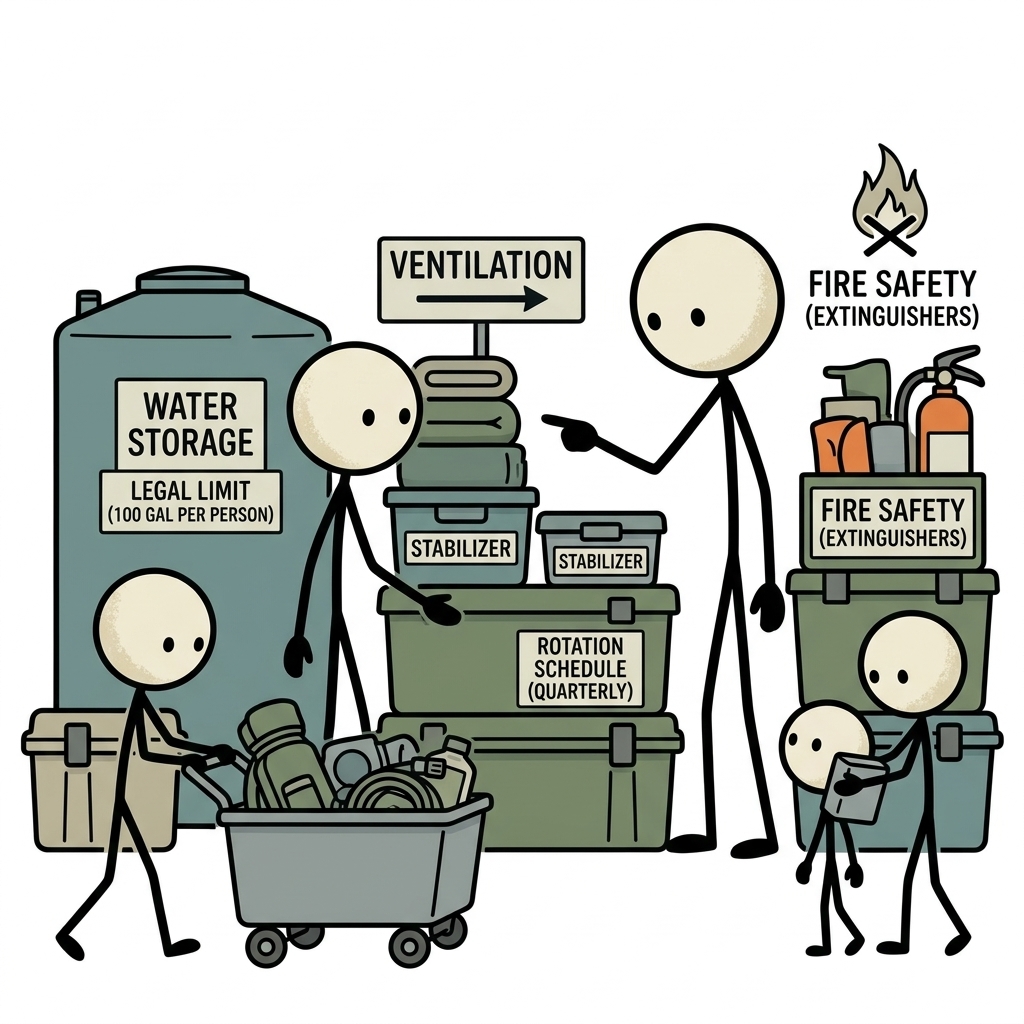
When executing a plan for gasoline storage emergency preparedness, your choice of containment is your primary defense against leaks, fires, and fuel spoilage. You must never store gasoline in glass, light plastic milk jugs, or unapproved metal drums. These makeshift containers will degrade, dissolve, or rupture, leading to catastrophic environmental contamination and fire hazards.
Color-Coding Standards for Emergency Fuels
Under American National Standards Institute (ANSI) and ASTM International guidelines, portable fuel containers must be color-coded to prevent dangerous fuel-mixing accidents. Emergency responders rely on these colors to quickly identify hazards during an incident:
- Red: Reserved exclusively for gasoline and highly flammable Class I liquids.
- Blue: Designated for kerosene, a Class II combustible liquid.
- Yellow: Designated for diesel fuel, a Class II combustible liquid with a higher flashpoint.
- Green: Used for oils, lubricants, and specialty blended two-stroke fuels.
HDPE Plastic vs. Safety Metal Cans
For residential gasoline storage, you will generally choose between high-density polyethylene (HDPE) plastic containers and heavy-duty metal safety cans. Both have distinct engineering advantages and regulatory approvals.
Modern plastic gas cans must be constructed of fluorinated HDPE to prevent vapor permeation—a process where fuel vapors slowly migrate through the plastic walls over time. Look for containers that carry certifications from Underwriters Laboratories (UL 1313) or ASTM F852. High-quality plastic cans are lightweight, rust-proof, and highly resistant to impact. However, cheap consumer-grade plastic cans often feature frustrating, spill-prone "spill-proof" spouts that can crack under UV exposure and thermal stress.
Type I and Type II metal safety cans represent the gold standard for long-term gasoline storage. These containers are constructed from heavy-gauge galvanized steel or stainless steel and are designed to withstand extreme physical abuse. They feature a spring-loaded, self-closing cap that automatically vents internal pressure when it reaches between 3 and 5 PSI, preventing the can from rupturing in a fire. Additionally, high-quality metal safety cans are equipped with dual-mesh brass flame arrestors inside the spout. These metal screens dissipate heat, preventing an external spark or flame from traveling down the spout and detonating the fuel vapors inside the can.
| Container Feature | Standard Utility Plastic (HDPE) | Type I / Type II Metal Safety Cans |
|---|---|---|
| Material Durability | Moderate; prone to UV degradation over years | Excellent; highly resistant to punctures and impact |
| Pressure Relief | Manual venting required (or swells under heat) | Automatic spring-loaded pressure relief valve |
| Flame Arrestor | Rarely included in standard retail models | Standard integrated dual-mesh brass screens |
| Vapor Permeation | Low (if fluorinated), but higher than metal | Zero vapor permeation through container walls |
| Expected Lifespan | 3 to 5 years under active use | 10 to 20+ years with proper gasket maintenance |
Legal Limits and Fire Codes: Staying Compliant
You cannot simply stockpile hundreds of gallons of fuel in your suburban backyard without facing severe legal, civil, and physical risks. Fire codes exist because gasoline is one of the most energy-dense, volatile liquids in common human use. Violating these codes can result in criminal negligence charges if a fire occurs, and will almost certainly cause your homeowner's insurance company to void your policy and deny coverage for property damage.
Understanding NFPA 30 and the International Fire Code
The National Fire Protection Association (NFPA) sets the benchmark for fuel safety through NFPA 30 (Flammable and Combustible Liquids Code). Local municipalities and states adopt these standards into their own legally binding International Fire Code (IFC) regulations.
Under NFPA 30, gasoline is classified as a Class IA Flammable Liquid, meaning it has a flashpoint below 73°F (22.8°C) and a boiling point below 100°F (37.8°C). For standard single-family residential dwellings, the regulations are highly restrictive:
- Indoor Storage Limits: You are permitted to store a maximum of 25 gallons of Class I flammable liquids inside a residential dwelling. This total includes any attached garage or basement.
- Individual Container Limits: No single portable container stored in a residential occupancy may exceed 5 gallons in capacity.
- Detached Storage Exceptions: In detached, unoccupied outbuildings (such as a backyard tool shed), the storage limit may be increased up to 60 gallons, provided the structure is located a safe distance from property lines and dwelling units.
- Approved Cabinets: If you must store larger volumes, you must utilize an OSHA-compliant, double-walled steel flammable liquid storage cabinet. These cabinets are engineered to protect the contents from an external fire for at least 10 minutes, giving occupants time to evacuate.
Before establishing your gasoline storage emergency preparedness system, consult your local fire marshal or municipal building department. Local ordinances are often significantly more stringent than national codes, particularly in high-density urban areas or wildfire-prone regions.
Ventilation, Temperature, and Environmental Controls
Gasoline is a dynamic liquid that reacts continuously to its physical environment. Storing fuel requires meticulous control over air movement, ambient temperature, and moisture exposure to prevent dangerous accumulations of explosive vapors.
The Danger of Vapor Density
The primary hazard of gasoline is not the liquid itself, but the invisible vapors it continually sheds. Gasoline vapors have a vapor density of approximately 3.0 to 4.0. Because air has a baseline vapor density of 1.0, gasoline vapors do not rise and dissipate into the upper atmosphere; instead, they flow downward like water, pooling along floors, in sumps, and down stairwells.
If you store gasoline in an unventilated basement, crawlspace, or attached garage, these heavy vapors will slowly accumulate. All it takes is a single spark from a washing machine motor, a water heater pilot light, or a chest freezer compressor to trigger a catastrophic fuel-air explosion. Therefore, the number one rule of gasoline storage is continuous, natural ventilation. Fuel must only be stored in structures that feature high and low vents to allow continuous cross-ventilation, sweeping any escaping vapors safely out into the open atmosphere.
Managing Thermal Expansion and Contraction
Gasoline has a high coefficient of thermal expansion. For every 15°F (8.3°C) increase in ambient temperature, gasoline expands by approximately 1% in volume. If you fill a 5-gallon container to the absolute brim on a cool morning and leave it in a hot metal shed, the expanding liquid will overwhelm the container's structural limits, causing it to rupture or spray fuel through the vent cap.
To prevent this, always leave a minimum of 10% headspace (ullage) at the top of your storage containers. This empty space acts as a cushion, allowing the fuel to expand and contract safely without compromising the container's seals. Additionally, try to maintain a stable, cool storage environment. Avoid direct sunlight, which degrades plastic containers via UV radiation and drives up internal temperatures, accelerating the fuel's chemical breakdown.
Fuel Stabilizers and the Science of Preservation
If you purchase standard pump gasoline and store it without treatment, it will likely degrade beyond usability within two to three months. To extend this shelf life to 12, 18, or even 24 months, you must intervene chemically using a high-quality fuel stabilizer.
How Fuel Stabilizers Work
Fuel stabilizers are highly engineered chemical packages designed to interrupt the natural degradation pathways of hydrocarbons. They typically contain three primary active components:
- Antioxidants: These compounds act as sacrificial agents, reacting with free radicals and dissolved oxygen before they can attack the hydrocarbon chains. This prevents the polymerization process that forms gums and varnishes.
- Metal Deactivators: Trace metals (such as copper and iron) from storage tanks and fuel lines act as powerful catalysts that accelerate oxidation. Metal deactivators chemically bind to these metal ions, neutralizing their catalytic properties.
- Corrosion Inhibitors: These additives form a microscopic, protective barrier on the internal metal surfaces of your fuel system and storage cans, preventing water from making direct contact with the metal and causing rust.
Step-by-Step Stabilizer Treatment Protocol
To achieve maximum efficacy, you must apply fuel stabilizer correctly. Simply dumping stabilizer into an old, stale can of gasoline will not reverse the chemical degradation that has already occurred; stabilizers are preventative, not restorative.
Follow this precise protocol for treating your emergency fuel supplies:
- Purchase Fresh Fuel: Go to a high-volume gas station to ensure you are starting with the freshest possible fuel. If available, choose ethanol-free gasoline (often sold as "clear gas" or "90 Octane Recreational Fuel") for your emergency storage. Ethanol-free fuel has a significantly longer natural shelf life and is far less prone to moisture absorption.
- Add Stabilizer First: Measure the correct dosage of stabilizer (such as STA-BIL, Pri-G, or Seafoam) according to the manufacturer’s instructions. Pour the stabilizer directly into your empty, clean fuel container before filling it at the pump. The turbulent flow of the incoming gasoline will ensure complete, homogeneous mixing.
- Seal and Label Immediately: Secure the container's cap tightly. Use a waterproof marker or a heavy-duty tag to label the container with the purchase date, the octane level, the presence of ethanol, and the date the stabilizer was added.
- Run Your Equipment: If you are adding the stabilized fuel directly to a generator or small engine tank, run the engine for 5 to 10 minutes. This ensures that the treated fuel circulates through the entire fuel system, replacing any untreated fuel sitting inside the fuel lines, fuel filters, and carburetor bowl.
The Rotation Routine: Implementing a FIFO System
No matter how advanced your containers are or how much premium stabilizer you use, gasoline cannot be stored indefinitely. A robust gasoline storage emergency preparedness strategy must include a structured, disciplined rotation routine. The industry standard for managing perishable inventory is the First-In, First-Out (FIFO) method.
Designing Your Rotation Schedule
To maintain a fresh, reliable supply of fuel, you should establish a rotation cycle of 6 to 12 months. If you are storing standard E10 gasoline with a stabilizer, target a strict 6-month rotation. If you are storing premium, stabilized ethanol-free gasoline, you can safely extend this rotation to 12 months.
Set up a physical or digital tracking log to manage your inventory. Organize your storage area so that the oldest fuel containers are always positioned at the front of the shelf, ready for immediate use, while the newly filled containers are placed at the back. To make this process seamless, integrate your fuel rotation with your daily life. Every 6 months, empty your oldest 5-gallon gas cans directly into the fuel tank of your primary commuter vehicle. Your car's modern fuel injection system and large fuel tank will easily consume and dilute the older, stabilized fuel without issue. Once the storage cans are empty, immediately take them to the station, refill them with fresh fuel and stabilizer, and place them at the back of your rotation line.
Identifying and Disposing of Stale Fuel
Before pouring any stored fuel into an expensive emergency generator, perform a quick sensory inspection. Fresh gasoline is clear, highly translucent, and has a sharp, sweet chemical smell. Degraded, stale gasoline undergoes noticeable physical changes:
- Appearance: It takes on a dark amber, brownish, or muddy yellow hue. You may see visible particulate matter, rust flakes, or a distinct separation layer of water at the bottom of the container.
- Odor: It loses its sweet smell and develops a pungent, sour, or varnish-like odor reminiscent of old paint or turpentine.
If you discover stale or contaminated gasoline, do not pour it down the drain, onto the ground, or into a storm sewer. Doing so is highly illegal, presents an immediate fire hazard, and causes severe environmental damage. Instead, store the bad fuel in a sealed container and contact your local municipal solid waste authority to find a designated hazardous household waste collection day or recycling facility.
Fire Safety, Static Electricity, and Emergency Protocols
When you store and handle gasoline, you are managing a highly volatile, explosive substance. One gallon of vaporized gasoline, when mixed with the correct ratio of air, has the explosive potential of approximately 20 sticks of dynamite. Mitigating physical hazards requires strict adherence to safety protocols during dispensing and transfer.
The Invisible Threat of Static Electricity
As gasoline flows through a plastic nozzle or hose, it generates friction. This friction strips electrons, building up a powerful electrostatic charge on the surface of the container and the nozzle. If this charge discharges as a spark near the open neck of a fuel container, it can instantly ignite the escaping fuel vapors.
To eliminate static electricity hazards, always follow these critical safety steps:
- Never Fill Containers in a Vehicle: Never fill a portable fuel container while it is sitting inside a car trunk, a SUV cargo area, or on the plastic bedliner of a pickup truck. The vehicle's rubber tires insulate it from the earth, preventing static charges from dissipating. Always place the container flat on the bare ground before removing the cap and inserting the pump nozzle. This grounds the container, safely discharging any static buildup into the earth.
- Maintain Physical Contact: Keep the metal pump nozzle in direct, continuous contact with the rim of the container's opening throughout the entire filling process. This prevents a voltage differential from building up between the nozzle and the container.
- Avoid Electronic Devices: Turn off your vehicle's engine and leave your cell phone inside the car while refueling. Cell phones can act as a distraction and, in highly rare instances, present a minor spark hazard in high-vapor environments.
Bonding and Grounding During Fuel Transfers
When transferring fuel from a large storage drum or safety can to your generator, you must establish electrical bonding. Use a simple bonding wire equipped with alligator clips on both ends to connect the metal frame of the generator to the metal body of the fuel container. This ensures that both items share the same electrical potential, completely eliminating the risk of a static spark jumping between the spout and the fuel tank opening.
Responding to Gasoline Fires and Spills
If a fire occurs while you are handling gasoline, you must respond instantly and correctly. Never throw water on a gasoline fire. Gasoline is lighter than water and hydrophobic; pouring water on a fuel fire will only splash the burning liquid, spreading the fire rapidly across a wider area.
Instead, keep a Class B fire extinguisher (specifically rated for flammable liquids) mounted within 10 to 15 feet of your fuel storage area. Class B extinguishers utilize dry chemicals, carbon dioxide (CO2), or clean agents to smother the fire, cutting off its oxygen supply. If a fire starts at the pump nozzle while you are refueling, do not pull the nozzle out of the container. This will spill burning fuel onto yourself and the ground. Instead, immediately step back and activate the emergency fuel shut-off switch located at the gas station island.
For minor spills on the ground, immediately apply an inert absorbent material such as bentonite clay cat litter, sand, or a commercial spill kit powder. Once the liquid is absorbed, sweep up the contaminated material using non-sparking plastic tools, place it in a sealed metal container, and contact your local environmental protection agency for proper disposal instructions.
The Ultimate Gasoline Storage Checklist
Use this comprehensive gasoline storage checklist to audit your current system and ensure your household is fully prepared for any emergency power generation needs.
📋 Emergency Fuel Preparedness Audit
- Container Compliance: All gasoline is stored in approved, fluorinated HDPE plastic or Type I/II metal safety cans certified by UL or FM.
- Color Coding: All gasoline containers are bright red, clearly labeled, and physically separated from other fuels like diesel or kerosene.
- Legal Limits: Total stored fuel volume complies with local fire codes (typically under 25 gallons indoors/attached garages).
- Ventilation Check: Storage location is detached from living spaces and features continuous passive or active cross-ventilation.
- Environmental Controls: Containers are kept out of direct sunlight and away from hot water heaters, furnaces, or electrical ignition sources.
- Thermal Headspace: All containers are filled to no more than 90% capacity, leaving a 10% air cushion for thermal expansion.
- Stabilizer Treatment: Fresh fuel is treated with a high-quality stabilizer at the time of purchase, prior to storage.
- FIFO Rotation: A formal rotation log is maintained, and fuel is cycled into vehicles and replaced every 6 to 12 months.
- Static Mitigation: Containers are always placed on the ground during filling, and contact is maintained between the nozzle and container.
- Fire Suppression: A fully charged Class B dry chemical fire extinguisher is mounted and easily accessible near the storage area.
Empowered Self-Reliance Through Safety
Developing a robust gasoline storage emergency preparedness protocol is not about living in fear of the next disaster; it is about taking structured, logical steps to ensure your household remains resilient, safe, and functional during challenging times. By understanding the chemical nature of fuel degradation, selecting certified containers, respecting local fire codes, and practicing disciplined inventory rotation, you transform a potentially volatile hazard into a highly reliable, safe asset. True emergency preparedness is defined by precision, knowledge, and proactive planning. Secure your fuel, respect the science of safety, and rest easy knowing that your family is fully prepared to weather whatever storm comes next.
Frequently Asked Questions
What should a gasoline storage plan include?
Start with the immediate safety steps, the supplies and records your household needs, a communication plan, and a regular review schedule. Follow local official guidance during an active emergency.
How often should I review gasoline storage preparations?
Review them at least twice a year and whenever your household, medication, location, or local risks change. Replace expired supplies and practice key steps.
Where can I find reliable emergency guidance?
Use local emergency management alerts and established public-health or emergency-management agencies. A blog guide should support, not replace, official real-time instructions.