Key Facts
- The winter outlook describes regional seasonal probabilities, not a forecast for your street.
- Check local warnings before making decisions about travel, shelter or evacuation.
- Test battery lighting and alerts before an outage. Equipment supports a plan; it does not replace one.
- Never run a generator indoors or drive into floodwater.
A winter outlook can help you decide what to check this week, but it cannot tell you whether the power will fail on Tuesday. Start with your household: who needs help, which services you depend on, and where you could safely go if staying home becomes unsafe. This guide turns the current outlook into a practical checklist without treating a regional probability as a local warning.
NOAA Seasonal Climate Outlook Breakdown
This article was prepared on November 2, 2026 using NOAA’s October 15 outlook for December 2026 through February 2027. The next scheduled outlook update is November 19. Recheck the official forecast as conditions change.
NOAA’s broad outlook: Warmer-than-average seasonal temperatures are favored across much of the northern United States, with wetter-than-average conditions favored across the southern tier and East Coast. Drier conditions are favored in parts of the northern Rockies and Great Lakes. These probabilities do not predict your local snow total or rule out severe cold spells. Check the linked NOAA release for regional detail.
Use the outlook to prioritize maintenance, not to cancel normal winter precautions. Check how water drains around your home, whether your lights work and how your household would manage a heating interruption. The winter storm preparedness guide covers the broader supply checklist; this article focuses on choosing actions and triggers.
Translating Probabilities to Household Action: Regional Priorities
The examples below are planning prompts, not predictions of particular storms or guaranteed local impacts. Adapt them to your dwelling, local flood history and official advice.
| Household situation | Useful check now | Decision trigger |
|---|---|---|
| Low-lying property or past drainage problems | Keep accessible drains clear, test an installed sump pump and identify higher-ground routes. | Follow local flood warnings and evacuation orders; leave before routes become unsafe. |
| Home dependent on electric heat or pumps | Identify a warm destination, stored water and safe battery lighting. | Relocate early if medical needs or safe indoor conditions cannot be maintained. |
| Exposed plumbing or previous frozen pipes | Locate the household shutoff and ask a plumber about insulation and freeze protection. | Follow local freeze guidance and act promptly if a leak occurs. |
| Medical equipment or accessibility needs | Agree a device-specific backup and transport plan with the care team. | Use the agreed backup or relocation threshold, not a generic internet runtime estimate. |
Local Alert Thresholds: Monitoring Official Data Without Panic
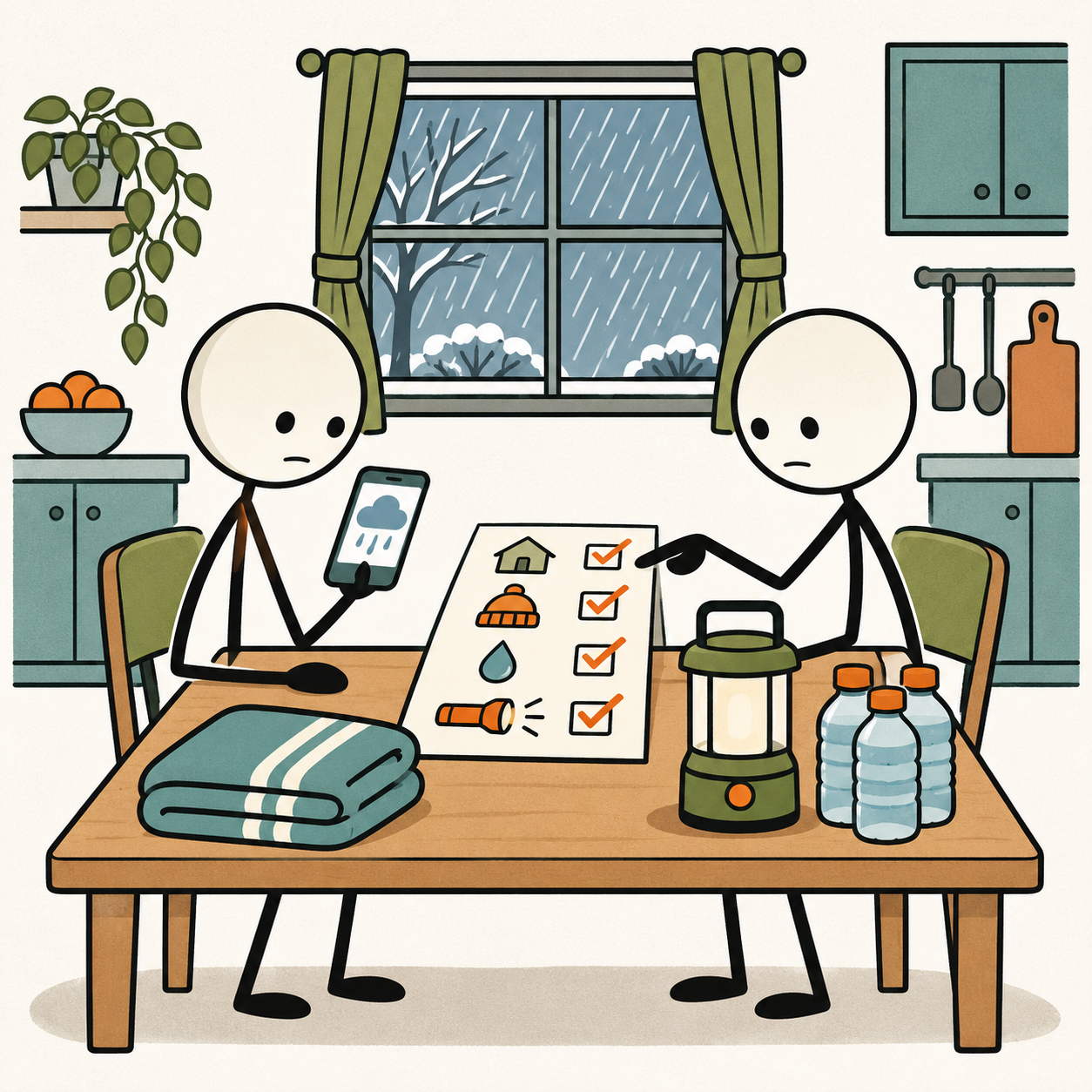
Use your local National Weather Service forecast and local emergency-management alerts as the decision source. A phone app can be convenient, but make sure you know who issued an alert and which area it covers. Keep a second way to receive warnings if your usual connection fails.
Decoding NWS Alert Terminology
The National Weather Service uses a standardized advisory system. Understanding the administrative definitions keeps your household from reacting too early or too late:
- Outlook: A longer-range indication of possible hazards. Use it to plan and read the specific product, rather than treating it as a warning for your address.
- Watch: Conditions may support a particular hazard. Check the timing and instructions, charge essential devices and review your plan. Lead times vary by hazard.
- Advisory: Hazardous conditions may cause significant disruption. Read the local instructions; an advisory does not mean travel is safe for every person or vehicle.
- Warning: Take the protective action specified for the hazard. That may mean sheltering, avoiding travel or moving to higher ground; no single response applies to every warning.
Hydrologic and River Alert Thresholds
If you live near a river, learn which official river forecast and local flood instructions apply to your address. Gauge stages and impacts differ by location; do not assume a generic stage label predicts conditions at your home. Small streams and urban flash floods can become dangerous without a useful upstream gauge. Use the home flood and evacuation plan to identify safe routes before heavy rain.
Home Infrastructure: Lighting, Potable Water, and Medical Supplies
List the services your home depends on and what you would do if each stopped working. A short list of lighting, drinking water, warmth, communication and medical needs is more useful than buying equipment without knowing its job.
Safe, High-Efficiency Emergency Illumination
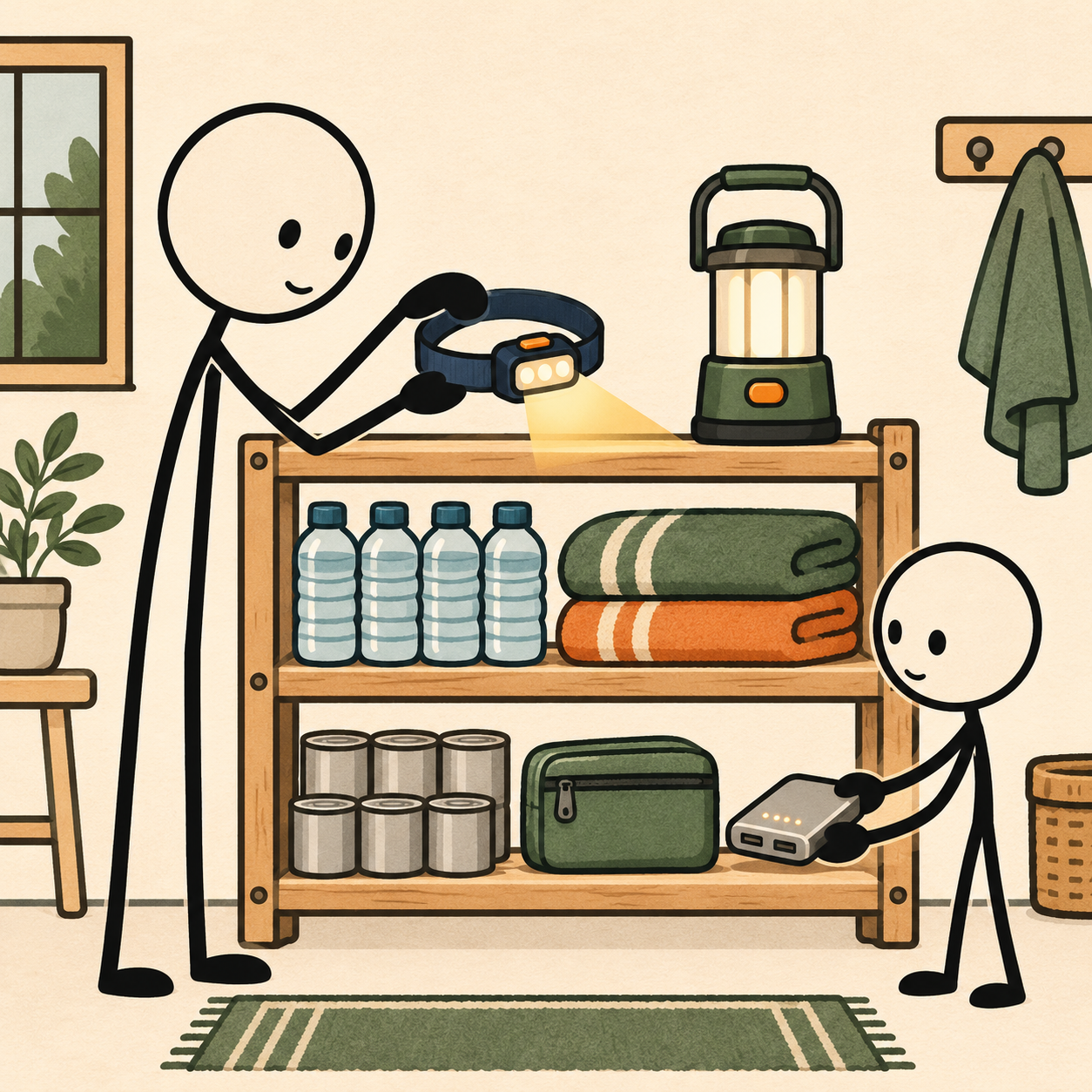
Prefer battery-powered lighting to open flames during an outage. Keep a light where each household member can reach it, test the controls and store compatible spare batteries. A headlamp leaves both hands free when checking supplies. Choose water resistance appropriate to the intended use; splash resistance does not mean a light can be submerged. Our emergency lighting guide explains the main options, and the headlamp guide covers hands-free choices.
Potable Water Security and Purity
An outage or local contamination incident can interrupt drinking-water service. Stored safe water gives you time to follow utility instructions without improvising a treatment method. Never assume boiling removes chemical contamination. Use the household water calculator to organize your reserve, allowing for individual needs and local guidance.
- Reserves: Plan drinking and basic hygiene water for each person, with additional needs for pets and individual health circumstances. The water calculator can help organize quantities; local public-health guidance should determine safe use.
- Containers: Use clean containers explicitly suitable for drinking-water storage. A recycling number alone does not prove a container is suitable. Never use a container that previously held chemicals.
- Private wells: Check whether your pump depends on electricity and keep a safe drinking-water reserve. Follow public-health testing advice if floodwater may have contaminated the well.
Prescription buffers and Medical Continuity
Cold weather disruptions routinely close retail pharmacies and delay regional package logistics. Medical readiness must be addressed through established legal channels, without relying on experimental medical advice or untested workarounds:
- Prescriptions: Ask your clinician and pharmacist about an appropriate, legally obtainable reserve and keep a current medication list. Do not change doses or ration prescribed treatment to extend supplies.
- Medical equipment: Ask the care team and equipment supplier for a compatible backup-power and relocation plan. Test approved equipment as instructed. A consumer power bank may be unsuitable, and any utility priority registration does not guarantee uninterrupted service.
- Temperature-sensitive medicines: Follow each medicine’s storage limits and your pharmacist’s advice. Some products must not freeze. Do not place medication directly against ice or frozen packs unless the product instructions explicitly allow it.
Thermal Management and Critical Indoor Life Safety
During winter power failures, preserving body heat becomes a pressing priority. However, the methods people use to heat their homes during emergencies are frequently far more dangerous than the cold itself. Carbon monoxide (CO) is a colorless, odorless, tasteless gas produced by the incomplete combustion of carbon-based fuels. It kills quietly and swiftly.
Strict Life-Safety Rules for Heating and Electricity
Never bring outdoor fuel-burning appliances inside or use a cooking appliance to heat a room. Installed heating systems should be maintained and used only as intended. If safe warmth is unavailable, use a planned warm destination rather than improvising combustion heating.
- Outdoor equipment stays outdoors: Never run portable generators, charcoal grills or camping stoves in a home, garage or other enclosed area, even with doors or windows open.
- Never Use Kitchen Ranges for Heat: An open natural gas oven or range top produces both carbon monoxide and unburned hydrocarbons, consuming oxygen inside a sealed home and quickly creating a lethal atmosphere.
- Generator placement: CDC guidance is to operate portable generators outdoors at least 20 feet from doors, windows and vents, with exhaust directed away. Follow manufacturer instructions and local requirements. Do not connect a generator to household wiring without an approved installation.
- CO alarms: Install and maintain carbon monoxide alarms according to manufacturer instructions and local requirements. Test them as directed, including their backup power. Read the carbon monoxide prevention guide; if an alarm sounds, move everyone to fresh air and contact emergency services.
Passive Thermal Preservation
If central heating fails and safe auxiliary heat is unavailable, abandon efforts to warm the entire house. Instead, condense your living space to preserve ambient thermal energy safely:
- Choose a room: Gather in a suitable room with fewer drafts if it is safe to remain at home. Keep exits and required ventilation clear; do not isolate someone who needs assistance.
- Reduce drafts safely: Close suitable curtains and doors, keeping textiles away from heaters and electrical equipment. Never block required combustion-air or ventilation openings.
- Wear Layered Textiles: Rely on moisture-wicking synthetic or wool base layers against the skin, an insulating fleece or down mid-layer, and a protective outer shell. Never sleep in damp clothing.
- Insulate from the Floor: Cold ground pulls heat directly away from the body through conduction. Place sleeping mats, dense foam pads, or thick layers of wool blankets between mattresses and the floor.
Floodwater Dynamics: The "Turn Around Don't Drown" Standard
Wet conditions are a reason to check flood plans, not a reason to assume every road will flood. Learn which routes have flooded before and identify an alternative that avoids those locations.
Floodwater can hide washed-out pavement, debris and dangerous currents. Visibility is worse at night. Never use a vehicle’s size or another driver’s attempt as evidence that a flooded crossing is safe.
Do not drive or walk through floodwater. Turn around and use a safe alternative, or wait in a safe place. Follow evacuation instructions promptly and do not wait for water to reach your doorway.
The First-Evening Action Checklist: Decision Tasks Under Disruption
When bad weather rolls in and utilities suddenly cut out at twilight, a household faces an immediate flurry of small tasks. A written procedure helps prioritize immediate safety needs over minor chores. Adapt this example sequence to the hazard; do not wait for a time slot to take urgent protective action. Keep this chronological checklist accessible alongside your backup gear.
Operational Night-One Checklist
- Verify the Hazard and Secure Safe Lighting (Minutes 0–5):
- Distribute pre-positioned battery-powered LED lanterns or headlamps to each family member. Avoid candles completely.
- Check your phone or battery-operated weather radio for urgent NWS warnings or utility alerts.
- Protect Major Appliances and Stabilize Electrical Systems (Minutes 5–15):
- Unplug sensitive home electronics (computers, televisions, expensive audio gear) to protect them from grid voltage spikes during utility restoration.
- Follow appliance and utility instructions for disconnecting equipment. Do not switch off essential medical devices or enter wet electrical areas. Leave a safe lamp switched on if useful as an indicator of returning power.
- Review your long-term appliance safety protocols via our power outage survival guide.
- Seal the Thermal and Moisture Envelopes (Minutes 15–30):
- Confirm all exterior windows and storm doors are tightly latched.
- Check for water intrusion only from a safe, dry location. Do not enter standing water near electrical equipment.
- Follow a plumber’s or local utility’s freeze-protection guidance. Know where your shutoff is, and do not attempt open-flame pipe thawing.
- Secure Household Food Preservation (Minutes 30–45):
- Keep refrigerator and freezer doors closed and monitor temperatures. Use official food-safety guidance, not smell or taste, to decide what to discard after an outage.
- Execute Household Check-In and Establish Schedule (Minutes 45–60):
- Use a brief text to check in with your designated contact if service is available. Text may work when voice networks are congested, but it is not guaranteed. Use your emergency communication plan if networks fail.
- Agree when to check conditions again and what would trigger relocation. Make sure alerts can wake the household if needed.
The 20-Minute Household Tabletop Drill
Having equipment stashed in closets provides a false sense of security if the people in your home have never practiced using it. Reading through an emergency scenario in low-stress conditions builds muscle memory, identifies missing components, and reduces anxiety during real events. Gather your family or housemates around a table once every season and walk through this twenty-minute drill.
Step 1: Set the Scenario (3 Minutes)
Read the premise aloud: "It is 6:30 PM on a Tuesday in January. Outside, sleet has transitioned to a heavy downpour, and the wind is gusting at 45 mph. Suddenly, all grid power cuts out, our neighborhood streetlights are dead, and tap water pressure drops to a weak trickle. The home temperature is beginning to drop, and road conditions are impassable. What do we do?"
Step 2: Assign and Review Immediate Roles (5 Minutes)
Review who handles primary responsibilities within the first five minutes without using ceiling lights or grid power:
- Who retrieves the primary emergency illumination gear?
- Who checks for water intrusion from a safe, dry location without entering standing water?
- Who monitors the battery-powered radio for official local updates?
- Who manages pets or attends to children or elderly family members?
Step 3: Equipment and Supply Verification (7 Minutes)
Physically open your supply cabinets and handle your gear rather than just talking about it:
- Turn on your lanterns and headlamps to verify battery charges. Ensure you know where spare AA or AAA cells are stored.
- Locate the accessible household water shutoff and learn how your particular valve operates. Do not force it or operate utility-owned equipment; ask a plumber if unsure.
- Review the battery percentage on portable power banks and verify appropriate charging cables are attached to each unit.
Step 4: Review Communications and Contingencies (5 Minutes)
Confirm everyone understands backup procedures if the home needs to be evacuated due to localized flash flooding or prolonged structural failure:
- Recite the phone number of your primary out-of-area emergency contact from memory.
- Identify two alternative driving routes away from your neighborhood that do not pass through known low-lying flood points.
- Review the exact exterior assembly location in case of a residential fire or carbon monoxide alarm activation.
This tabletop review can reveal gaps before an actual disruption. Update the plan after the exercise.
Building Long-Term Resilience
The useful outcome is a short written plan: what to check, who is responsible and when to act. Start with working lights and alerts, safe drinking water, medical continuity and a realistic place to go. Revisit the outlook when NOAA updates it, but let local warnings and your household’s needs guide immediate decisions. These preparations reduce avoidable problems; they cannot guarantee safety or uninterrupted services.
Frequently Asked Questions
Does an El Nino winter mean my town will be warmer all winter?
No. Seasonal outlooks describe probabilities for averages across broad regions. Cold spells and disruptive storms can still occur. Check local National Weather Service forecasts and warnings for decisions about travel and shelter.
Does NOAA’s winter outlook predict how much snow my town will receive?
No. The seasonal outlook does not provide a local seasonal snowfall total. Use shorter-range local forecasts and warnings as storms approach.
What should I check before buying more winter equipment?
Test existing alerts, identify a safe light source for each household member, review water and food supplies, and write down a safe place to go if home conditions become unsafe. Check medical and accessibility needs with the appropriate professionals.
Can I use a generator in a garage with the door open?
No. Operate portable generators outdoors, at least 20 feet from doors, windows and vents, with exhaust directed away from buildings. Never use one inside a home or garage, even with doors open.
When should I update my winter household plan?
Review it when the official seasonal outlook is updated and before a local storm. NOAA listed November 19 as the next update in its October 15, 2026 release. Local alerts always take precedence over the seasonal overview.