⚡ Key Facts
- Thermal Acceleration: According to the National Oceanic and Atmospheric Administration (NOAA), interior vehicle temperatures can climb to 138°F in just 90 minutes when ambient temperatures are 90°F, severely degrading food quality and packaging. For the practical checklist side, use the community emergency preparedness guide.
- The Danger Zone: The Centers for Disease Control and Prevention (CDC) warns that foodborne pathogens multiply rapidly between 40°F and 140°F, a temperature range routinely breached inside parked vehicles. For the practical checklist side, use the neighborhood preparedness network.
- Winter Survival Statistics: FEMA reports that winter storms and extreme cold contribute to dozens of vehicular entrapments annually, where a lack of emergency car food and hydration exacerbates exposure risks.
- Rotation Reality: The American Red Cross recommends auditing and rotating vehicle emergency kits every six months to prevent nutritional degradation and packaging failures.
Choose Vehicle Food for the Job
Long-storage meals can be useful, but a bucket is not automatically the right format for a car kit. Our ReadyWise vs Mountain House comparison breaks down calories, water needs, packaging, and portability before you add freeze-dried food to a vehicle emergency plan.
In January 2022, a sudden winter storm transformed a 50-mile stretch of Interstate 95 in Virginia into a freezing, static parking lot. Hundreds of drivers were stranded in their vehicles for up to 27 hours in sub-freezing temperatures. Those without food or water faced a grueling physical and psychological ordeal. This event underscored a fundamental truth of modern life: your vehicle is not just a mode of transportation, but your primary mobile shelter. While many drivers throw a few granola bars into the glove compartment and assume they are prepared, this "set it and forget it" mentality is a dangerous mistake. True emergency car food emergency preparedness requires understanding the unique, hostile environment of a vehicle and selecting, storing, and rotating your emergency car food with scientific precision.
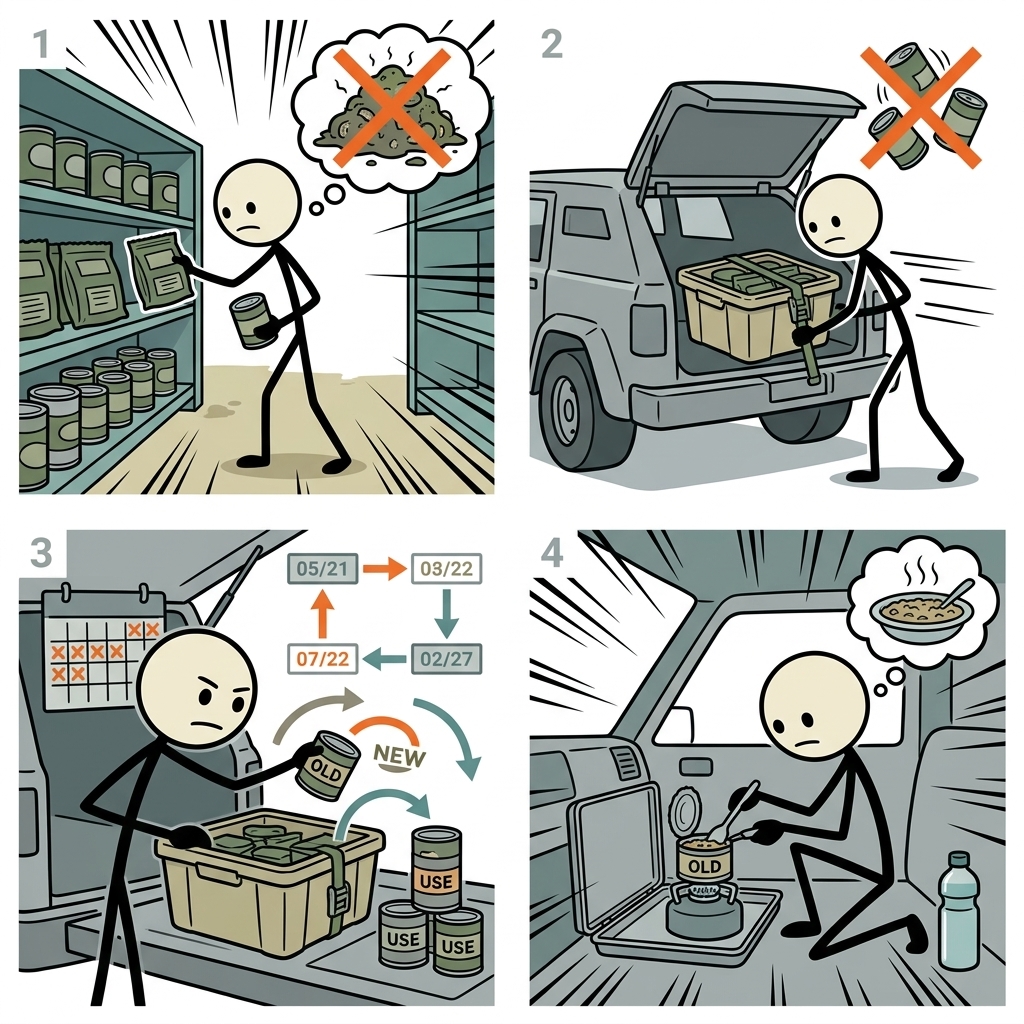
The Hostile Vehicle Environment: Why Ordinary Food Fails
A vehicle parked outdoors is essentially a solar oven or a deep freezer, depending on the season. Unlike a climate-controlled home pantry, which hovers around a stable 60°F to 70°F, a car trunk or cabin experiences massive, daily temperature swings. These environmental extremes wreak havoc on standard grocery store items, making them unsafe, unpalatable, or nutritionally dead within a fraction of their normal shelf life.
The Greenhouse Effect and Thermal Degradation
On a mild 70°F day, solar radiation passing through vehicle glass can heat the interior to over 110°F in less than an hour. During peak summer, cabin and trunk temperatures can easily exceed 140°F. This heat acts as a catalyst for chemical reactions within food. It accelerates lipid oxidation, causing fats and oils to turn rancid. Rancid fats not only taste terrible, but they can also cause severe gastrointestinal distress—the last thing you want to experience during an active emergency.
Furthermore, extreme heat destroys heat-sensitive vitamins, particularly Vitamin C, Vitamin B complex, and thiamine. Food stored in a hot car may look fine, but its nutritional value drops precipitously, leaving you with empty calories when your body needs dense micronutrients to combat stress and exposure.
The Freeze-Thaw Cycle
Conversely, winter presents the opposite challenge. In northern climates, temperatures inside a vehicle can plunge far below freezing overnight, only to rise above freezing during the day when the sun hits the car or the heater is run. This constant freeze-thaw cycle destroys the cellular structure of food, turning canned fruits and vegetables into mush. More critically, freezing causes water-based foods to expand, which can rupture metal cans, break glass jars, and split plastic seals, exposing the contents to airborne bacteria and mold.
Vibration and Mechanical Stress
Every mile you drive transmits micro-vibrations through the chassis of your vehicle. Over months and years, these constant vibrations act as an abrasive force. They can cause thin plastic packaging to rub against other items and wear through, leading to pinhole leaks. Vibration also accelerates the settling of ingredients and can cause fragile food items, like standard crackers or freeze-dried meals, to pulverize into dust long before you ever need to eat them.
The Core Principles of Vehicle Food Selection
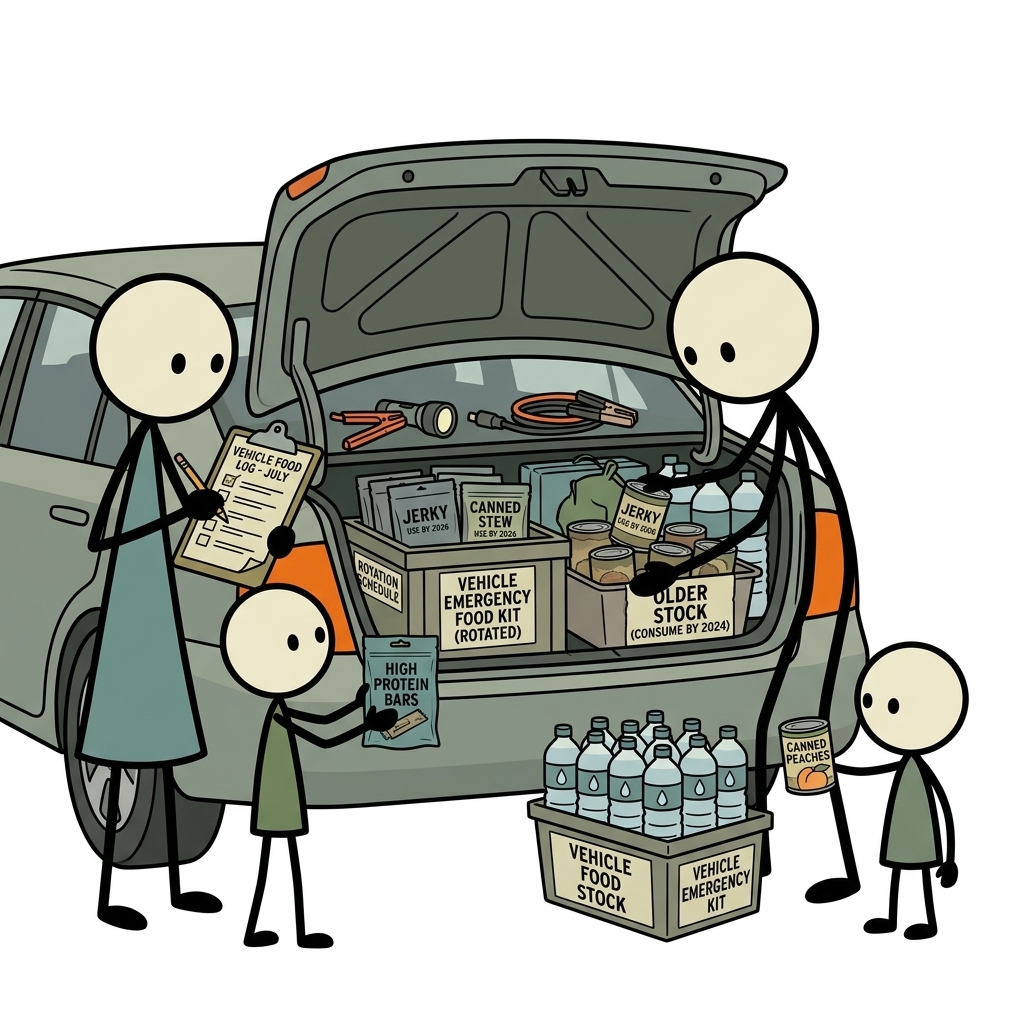
To build a resilient mobile pantry, you must abandon the rules of home food storage. When selecting your emergency car food, every item must pass a strict set of survival-focused criteria. If a food item fails even one of these principles, it does not belong in your vehicle.
1. Non-Thirst-Inducing (Low Sodium and Low Protein)
Water is your most precious resource in a Survival Scenarios. Digesting protein and processing high amounts of sodium require significant amounts of water. Consuming high-sodium foods like canned soups, cured meats, or heavily salted nuts will trigger intense thirst and accelerate dehydration. Your emergency car food should lean heavily toward complex carbohydrates and stable fats, which require minimal water for metabolic processing.
2. Zero Preparation Required (Ready-to-Eat)
If you are stranded in a blizzard, a flash flood, or a grid-down evacuation, you may not have the luxury of fire, clean cooking water, or utensils. Your food must be fully edible straight out of the packaging. Avoid raw grains, dried beans, or freeze-dried meals that require boiling water to reconstitute, unless you also carry a dedicated stove and water filtration system. Focus on items that can be consumed while driving or sitting in a dark, cold cabin.
3. High Caloric Density
Space in a vehicle is finite. To maximize your survival footprint, choose foods that pack the highest number of calories into the smallest, lightest package possible. A standard can of green beans takes up significant space and weight but offers a meager 70 calories. In contrast, a single emergency ration bar can provide 400 calories in a fraction of the space. Aim for foods that offer at least 120 to 150 calories per ounce.
4. Durable, Climate-Resilient Packaging
Cardboard boxes and thin plastic wraps are major points of failure. They are easily breached by moisture, vibrations, and pests. Your emergency car food must be housed in robust, puncture-resistant packaging. Mylar pouches, heavy-duty foil laminates, and double-sealed cans are the gold standards for vehicle storage. If you purchase food in commercial packaging, always secondary-package it inside hard-sided, airtight containers.
The Danger of "Set It and Forget It" (The Myth of Unsafe Long-Term Storage)
One of the most common mistakes in emergency car food emergency preparedness is buying a 25-year survival food bucket, throwing it in the trunk, and assuming you are safe for the next two decades. This is a highly dangerous practice that ignores the reality of thermal degradation.
Manufacturers calculate the 25-year shelf life of freeze-dried foods based on a constant, optimal storage temperature of 60°F or lower. When exposed to the fluctuating, high-heat environment of a vehicle trunk, that 25-year shelf life can shrink to less than two years. The plastic buckets themselves can degrade, releasing volatile organic compounds (VOCs) and chemical plasticizers like BPA into the food.
Furthermore, relying on ultra-long-term storage foods often leads to complacency. If you never check your kit, you will not notice when a rodent has chewed through a container, or when moisture condensation has rusted a metal lid, allowing deadly botulinum toxins or mold to colonize your emergency food storage guide. True safety lies not in indefinite preservation, but in a disciplined system of active rotation.
The Ultimate Emergency Car Food Checklist
When assembling your vehicle kit, aim for a three-day (72-hour) supply of food per regular passenger. This is the standard timeline recommended by FEMA and the Red Cross for emergency services to re-establish supply lines. Below is a curated, battle-tested emergency car food checklist designed specifically to withstand the rigors of vehicle storage.
| Food Category | Ideal Selection | Caloric Value | Estimated Vehicle Shelf Life |
|---|---|---|---|
| Emergency Ration Bars | USCG-approved calorie blocks (e.g., Mainstay, Millennium) | 400 kcal per bar / 2400-3600 kcal per pack | 5 Years (highly stable in extreme heat/cold) |
| Retort Pouches | Pre-cooked tuna, salmon, or chicken in foil pouches | 100 - 150 kcal per pouch | 1 to 2 Years (must be rotated before summer) |
| Nut Butters | Individual squeeze packs of almond, peanut, or sunflower butter | 180 - 200 kcal per pack | 1 Year (oils may separate, knead before opening) |
| Potted Meats & Seafood | Canned sardines, mackerel, or chicken breast (pull-tab lids) | 150 - 250 kcal per can | 2 to 3 Years (keep from freezing to protect seals) |
| Dry Fruit & Nut Mixes | Unsalted raisins, cranberries, banana chips, raw almonds | 120 - 160 kcal per ounce | 6 to 12 Months (high fat content requires fast rotation) |
| Pilot Bread / Hardtack | Vacuum-sealed, low-moisture survival crackers | 100 kcal per cracker | 3 to 5 Years (practically indestructible) |
Deep Dive: Why USCG-Approved Ration Bars are the Gold Standard
If you can only store one type of food in your vehicle, make it United States Coast Guard (USCG) approved emergency ration bars. Engineered specifically for lifeboats exposed to baking sun and freezing salt spray, these bars are formulated to withstand temperatures ranging from -22°F to 149°F.
They are baked to an ultra-low moisture content, preventing bacterial growth and freezing damage. Crucially, they are formulated to be non-thirst-inducing, using a precise balance of carbohydrates and fats with minimal sodium and protein. Brands like Millennium, Mainstay, and S.O.S. Food Labs pack up to 3,600 calories into a vacuum-sealed, heavy-duty foil block that is impervious to rodents, water, and rough handling.
The Role of Retort Pouches vs. Standard Cans
While canned foods are a staple of home pantries, they have distinct disadvantages in a vehicle. Traditional steel cans are heavy, noisy when driving, and require a can opener (unless they have pull-tabs, which are prone to bursting under pressure or impact).
Retort pouches—flexible foil-and-plastic laminates used for military MREs (Meals, Ready-to-Eat) and commercial tuna—are far superior for mobile use. They are puncture-resistant, lightweight, take up minimal space, and can flex slightly if the contents freeze, preventing the catastrophic seal failures common with rigid metal cans.
How to Store Your Vehicle Food Safely
How you store your emergency car food is just as important as what you select. Proper storage techniques can buffer temperature extremes, protect against pests, and ensure your food remains edible when you need it most.
Thermal Buffering: Fighting the Heat
You cannot stop a parked car from getting hot, but you can slow down the rate of temperature transfer. Never store your food loose in the cabin, glove box, or door pockets, where solar radiation is most intense. Instead, utilize the trunk or the spare tire well, which naturally stay cooler than the passenger compartment.
To create a thermal buffer, store your emergency car food inside a high-quality, insulated cooler bag or a hard-sided cooler. You do not need to add ice; the insulation works both ways, keeping the hot summer air out and maintaining a more stable internal temperature for your food. For maximum protection, wrap your food containers in a reflective thermal space blanket before placing them inside the cooler.
Moisture and Pest Mitigation
Vehicles are surprisingly susceptible to moisture condensation and pest invasions. Mice can easily enter engine bays and cabin air intake vents, eventually chewing through plastic panels to reach food inside your vehicle.
To prevent this, all emergency food should be stored in heavy-duty, airtight polymer containers, such as marine dry boxes or gasket-sealed storage bins. These containers lock out moisture, prevent rust on metal cans, and block food odors that attract rodents and insects.
The Rotation and Maintenance Protocol
A vehicle emergency food kit is not a static installation; it is a living system. Without a disciplined maintenance protocol, your emergency car food emergency preparedness plan will eventually fail. You must establish a routine to audit, rotate, and refresh your supplies.
The "Standard Time Shift" Rotation Schedule
The easiest way to remember to rotate your vehicle food is to tie it to a biannual event. A highly effective strategy is the "Standard Time Shift" method: audit your kit every spring and autumn when you change your clocks for Daylight Saving Time.
- The Spring Audit (Preparing for Heat): Remove any temperature-sensitive foods, such as chocolate-coated bars, nut butters, or soft canned goods that will degrade rapidly in summer heat. Replace them with highly stable USCG ration bars, hardtack, and fresh water.
- The Autumn Audit (Preparing for Cold): Remove items that are prone to freezing damage, such as thin-walled plastic water bottles or high-moisture canned goods. Replace them with freeze-tolerant foods, high-calorie fats, and ensure your Water Calculator containers have adequate headspace for expansion.
Implementing a First-In, First-Out (FIFO) System
Never let rotated food go to waste. When you pull items from your vehicle kit during your biannual audit, integrate them into your home pantry, take them on your next camping trip, or pack them in your daily work lunch. This First-In, First-Out (FIFO) system ensures that you are constantly consuming and replacing your stock, keeping your financial waste to absolute zero.
Keep a small, laminated index card inside your emergency food box. Write down the purchase date, the expiration date, and the target rotation date for every item. A quick glance during your monthly vehicle cleaning will tell you exactly when your supplies need to be refreshed.
Hydration: The Critical Companion to Vehicle Food
You can survive for weeks without food, but only days without water. Any discussion of emergency car food is incomplete without a robust plan for vehicle hydration. However, storing water in a car presents unique challenges that can turn your life-saving liquid into a toxic hazard.
The Danger of Commercial Plastic Water Bottles
Single-use plastic water bottles (made from polyethylene terephthalate, or PET) are not designed for long-term storage, especially in high-heat environments. When exposed to hot car interiors, the plastic can begin to degrade, leaching antimony, phthalates, and microplastics into the water. Over time, this chemical cocktail can cause endocrine disruption and gastrointestinal issues. Furthermore, these thin bottles easily crack when frozen, leading to ruinous leaks inside your trunk.
Safe Vehicle Water Storage Solutions
To store water safely in your vehicle, you must use containers engineered to withstand extreme thermal expansion and chemical leaching.
- Emergency Water Pouches: Much like ration bars, USCG-approved emergency water pouches are packaged in heavy-duty, pre-measured foil laminates. They are designed to withstand extreme temperatures, can freeze solid without bursting, and have a verified 5-year shelf life.
- High-Density Polyethylene (HDPE) Jugs: If storing larger quantities of water, use rugged, BPA-free HDPE containers (often colored blue for water). Only fill them to 85% capacity to allow safe headspace for ice expansion during winter.
- Stainless Steel Canteens: Single-walled stainless steel canteens (non-insulated) are incredibly durable. If you need to melt snow or boil water in an emergency, a single-walled steel canteen can be placed directly over a fire or camp stove—a dual-purpose survival tool that insulated flasks cannot replicate.
Building Your Personal Kit: Step-by-Step
Ready to secure your vehicle? Follow this straightforward, step-by-step assembly guide to build a professional-grade mobile food kit today.
- Acquire the Container: Purchase a rugged, gasket-sealed plastic dry box (such as a marine dry box or a heavy-duty tool chest). Ensure it fits comfortably in your trunk or behind your seat.
- Lay the Foundation (Caloric Base): Place two 2400 or 3600-calorie emergency ration packs at the bottom of the container. This provides your baseline survival calories for 3 days, completely immune to temperature swings.
- Add Variety (Comfort Foods): Layer in high-durability comfort foods to boost morale. Good options include individual retort pouches of tuna, vacuum-sealed dried fruit, and pilot crackers.
- Secure Hydration: Add twelve 4.2-ounce emergency water pouches around the food items to prevent shifting. If using a steel canteen, wrap it in a spare pair of wool socks to prevent rattling and provide extra insulation.
- Include Basic Utilities: Toss in a multi-tool, a pack of heavy-duty plastic spoons, a small box of waterproof matches, and a pack of wet wipes for hygiene.
- Label and Seal: Place your laminated inventory card on top of the items. Close the lid, secure the latches, and store the container in your trunk, ideally secured with a cargo net or bungee cords to prevent shifting during travel.
Conclusion: Empowered and Prepared
True emergency preparedness is not about surviving a hypothetical apocalypse; it is about managing the highly predictable friction of daily life. Being stranded on a highway, trapped by an unexpected blizzard, or forced to evacuate due to a wildfire are real-world scenarios that happen to ordinary people every day. By rejecting the dangerous complacency of "set it and forget it" storage and embracing a disciplined, scientifically backed system of vehicle food selection and rotation, you transform your car from a potential hazard into a resilient mobile sanctuary. Take action today: audit your trunk, build your kit, and drive with the peace of mind that comes only from true readiness.
A practical family emergency plan helps turn this advice into responsibilities everyone can rehearse before a disruption.
Use the household supply calculator to size food, water, and consumables to the people who will actually depend on them.
For a time-critical departure, the go-bag builder keeps the essential loadout separate from heavier backup gear.
Working through relevant emergency scenarios reveals where a plan needs a backup power, transport, or communication decision.
The structured preparedness courses provide a useful way to practice the same decisions instead of leaving them as a one-time checklist.
Frequently Asked Questions
What should a emergency car food plan include?
Start with the immediate safety steps, the supplies and records your household needs, a communication plan, and a regular review schedule. Follow local official guidance during an active emergency.
How often should I review emergency car food preparations?
Review them at least twice a year and whenever your household, medication, location, or local risks change. Replace expired supplies and practice key steps.
Where can I find reliable emergency guidance?
Use local emergency management alerts and established public-health or emergency-management agencies. A blog guide should support, not replace, official real-time instructions.